Some Old Movies
I've been a little surprised over the past ten years or so to hear young people apply the term "old movie" to movies made as recently as the 1980s or mid-1990s. It makes perfect sense, of course, from their point of view. Or for that matter from a fairly neutral point of view: in movie industry terms, twenty years is a pretty long time. But for me an "old movie" is one that was old when I was young, which is to say, something made before roughly 1960. Here are notes on a few such that I've seen over the past month or so.
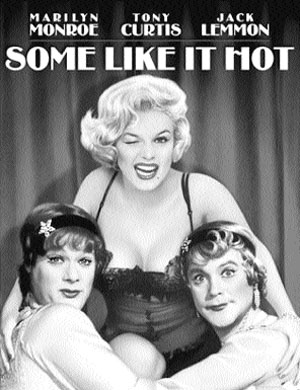
Some Like It Hot
Although I grew up in the time when "Marilyn Monroe" was as much a synonym for "sex symbol" as "Cadillac" was for "luxury car," I don't think I'd ever actually seen one of her movies in its entirety. I was only thirteen or fourteen when she died, so she was no longer an active screen presence when I was a young man, and of course in those days, when a movie had run the course of its release, it wasn't seen again unless it happened to turn up on late-night old-movie shows. Perhaps I saw bits and pieces, but I really can't recall an entire movie.
Some Like It Hot is apparently regarded as one of her best performances, and seems to be considered a classic even apart from that. I've run across extremely enthusiastic references to it over the years, and therefore had high expectations when I sat down to watch it a few weeks ago.
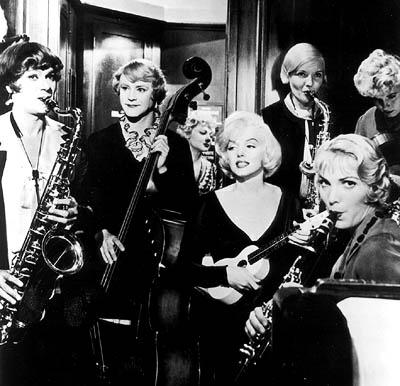
So it's certainly not prejudice that causes me to report a decided lack of enthusiasm for it. At best I would put it in the "somewhat amusing" class. I had no idea at all what it was about, but if I had known, my expectations would have been much lower. Some people seem to find men dressing up as women one of the funniest things in the world, but I am not one of them. I find it a little creepy; at best it gets an occasional mild chuckle from me. The plot of Some Like It Hot involves Jack Lemmon and Tony Curtis as small-time musicians who witness a gangland murder and flee for their lives by dressing as women and joining an all-"girl" band, which features a seductive (to say the least) singer named Sugar Kane, played by Monroe (obviously). Naturally the boys fall for Sugar, and are fallen for by men, and all sorts of complications ensue.
I won't say it's badly done, and I didn't hate it, but…well, as I said, "somewhat amusing" is about the best I can do.
But Marilyn: she was a bit of a revelation. Now I understand what all the fuss was about. She plays a stock, stereotypical dumb-but-sexy-blonde, but there's something about her that transcends the role. Yes, she's a bombshell (and platinum blondes are not my type), and the character is a drunk who has lived with a series of no-good men, but in spite of that there seems something sweet and innocent about her, as if the sleazy life she's lived has not really touched her soul. You want to take her away from all that and protect her. Whether this has much relation to the real Marilyn I don't know, but if it does then I can see why a decent man like Joe DiMaggio kept trying to save her, even after their marriage had collapsed, and why he continued to behave like a gentleman toward her long after her death, until his own, after which we can hope they have had a happy meeting.
Strangers On A Train
This is a fairly early Alfred Hitchcock, which, like Some Like It Hot, most people who have any great interest in movies have probably seen. This was my first viewing, and although I doubt I'll ever watch it again, the experience was the reverse of the above: I had low expectations, which were exceeded. I have generally thought Hitchcock's reputation somewhat greater than is justified. Not that I've disliked his work, but I didn't quite see why he is held in such high regard. I think I liked Rear Window best of the ones I've seen. And maybe I Confess, which was made around the same time as Strangers.
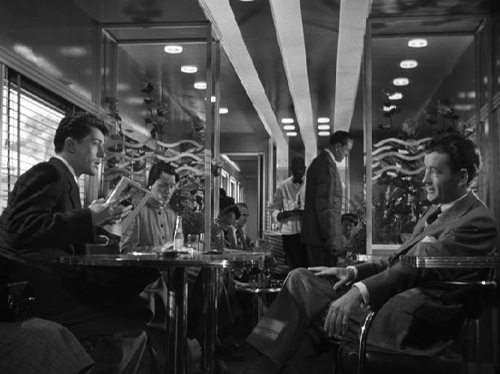
Two men meet on a train. Both have domestic difficulties and would like to be free of the person causing the difficuly: one is a tennis player who wants a divorce from his cheating wife, the second a rich young man who wants to get his domineering father out of the way and take possession of the family fortune. The rich young man suggests that they agree to murder each other's Inconvenient Person. The tennis star, a good man, is horrified and quickly detaches himself from the other. But the rich young man proves to be a psychopath who is not so easily discouraged.
I think maybe one of the reasons I've thought Hitchcock's reputation somewhat exaggerated is that some critics seem to find a depth there that I don't see. But with that expectation put aside, and taking the movies simply as good stories, I greatly enjoyed this one, except that, as with several other Hitchcock works, I found the closing resolution a bit of a letdown after the skillfully-built tension of everything up to that point.
I'm left with one question: why did Farley Granger, who plays the tennis player, not become a major star? He's handsome and strikes me as a better actor than a lot of leading men of the period. But then he doesn't have a single memorable persona like a lot of the others: Jimmy Stewart, John Wayne, Cary Grant, et.al.
Mark of the Vampire
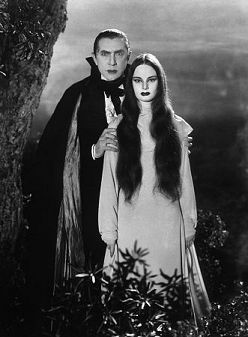
This is a fairly low-grade installment in the Dracula series, but it's very atmospheric and enjoyable if you like this sort of thing. There's Bela Lugosi, who actually plays a fairly minor role. But the star of the show, vampire-wise, is the Lugosi character's daughter, who looks like her cover job could be singing in a goth-metal band. She doesn't say anything until the very end, but she's a notable presence. And there's Lionel Barrymore as the Van Helsing-type professor who knows all about vampires and guides the struggle against them. And Lionel Atwill as the policeman who doesn't believe all this nonsense. And there's a plot twist that sets it apart from similar films. Like I said, if you like this sort of thing…
Swing Time
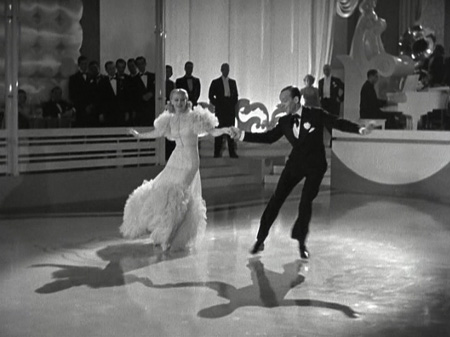
I really shouldn't mention this one yet, as I've only seen half of it (my wife and I have taken to watching movies in one-hour segments on weekday evenings, when we'd like to relax for a bit but can't spare time for an entire movie). But this is the second time I've seen it, and I already know what I think about it. It's a Fred Astair and Ginger Rogers dancing romance, and many say it's the best of that lot. I don't know about that, but, to speak again of "this sort of thing," I find it hard to imagine that it gets much better than this.
And I'm mildly astonished, if that makes sense, that I like this sort of thing. At twenty or thirty I probably would have scoffed at it. At forty I might only have been bored. At fifty I had begun to see the appeal, and now I find it entirely delightful.
Come to think of it, I remember scoffing at it, sometime in my early twenties: to someone who loved musicals, I said I couldn't quite accept the idea of people suddenly bursting into song and dance in the middle of ordinary life. But that, she replied, was exactly what she liked so much about them. And now I'm much more of her mind. Swing Time doesn't appear to have much to do with the world we live in, but it does: it's the world as it might be, not in heaven, but on some plane considerably nearer to heaven than is the one we inhabit. As on earth, Fred and Ginger must negotiate a series of difficulties, but you know all along that nothing will prove insurmountable, and along the way there will be a great deal of rejoicing, with much more at the end. The Astaire-Rogers dance numbers are an expression of pure joy, not only because of their skill but because the personalities they radiate are so engaging.
I discovered some years ago that reading P.G. Wodehouse is a wonderful medicine for depression; it's effervescent, like mental champagne. Swing Time has much the same effect. And what Waugh said of Wodehouse is true of this movie:
Mr. Wodehouse's idyllic world can never stale. He will continue to release future generations from captivity that may be more irksome than our own. He has made a world for us to live in and delight in.
To the Wodehouse comparison I would add one to Mozart. Surely, as long as people are capable of enjoying the lighter works of Mozart, they will be capable of enjoying Fred Astaire and Ginger Rogers.
 Light On Dark Water
Leave a comment