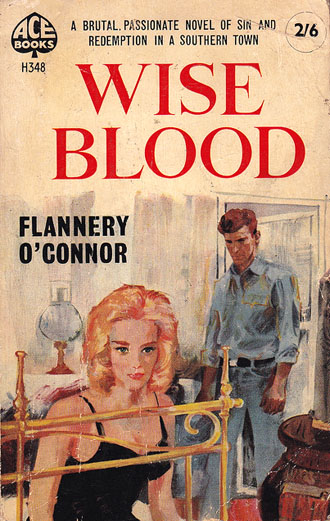
I mean paperback in the sense that it was used fifty or more years ago, when it referred mainly to the small editions badly printed on cheap paper of generally disposable if not trashy fiction–before there was such a thing as "quality" or "trade" paperbacks. For a book to have its original printing in this kind of paperback was about like a movie going directly to video without ever showing in theaters at all. And when publishers decided to put out a paperback edition of a good book, it was generally packaged as if it weren't.
Here's how they treated Flannery O'Connor. This Wise Blood at least has the merit of being not totally inaccurate. It is brutal, and it is passionate, and it is about sin and redemption. But not exactly in the way the cover suggests.
The main graphic for A Good Man surely refers to the story "Good Country People," and I'm pretty sure Flannery O'Connor didn't have a woman who looked like that in mind for Hulga. The smaller picture must be for "The River," and really is not too bad. I give this artist credit for apparently having some acquaintance with the book. And the last image of that quote from Time is pretty good, really.

This edition of The Violent Bear It Away appears to be later, from the late '60s or early '70s. Again, "novel of depravity" is not totally inaccurate, but it's misleading.

All in all, you have to suppose that some of the purchasers of these books were pretty disappointed.
I acknowledge having lifted these images from Crisis, where they accompanied three pieces on O'Connor, and in recompense I'll give you links to them. They're all worth reading.
This "Caution on the Writings of Flannery O'Connor" is almost touchingly wrong-headed.
But if you will pardon me for saying so in a rather blunt manner, it is a very odd sort of an artist who conjures the gruesome and gratuitous massacre of a grandmother as a backdrop to debating points of systematic theology.
If you read that story, or for that matter any of O'Connor's work, as a set of debating points of systematic theology, you've mistaken the nature of what you're reading.
Much better is this piece by Karen Beebe, "A Good Woman Is Hard to Figure", and this one by Regis Martin, "Flannery O'Connor Fifty Years After". O'Connor died fifty years ago this month, and so there is more than usual talk about her in the Catholic press.
Finally, there is this "Defense of the Grotesque" by R. Jared Staudt, which answers some of the objections in the first piece.
 Light On Dark Water

Leave a comment