The Anglican Muddle

The Panther and the Hind, by Aidan Nichols, O.P.

This book has been on my "do a blog post about this" list for several months now, so many that its details have begun to fade. One aspect of it that will not fade, though, unless I am overtaken by senility, is the clarity with which Fr. Nichols makes the case that Anglicanism was a theological muddle from the very beginning, and that the possibility of something more definite forming itself from the muddle is remote. This is not to deny tendencies such as that of the American Episcopal Church to become pretty well unified along liberal (to use the polite term) theological lines. But that sort of evolution is not an expression of the unity of Anglicanism, but rather of its splintering, as those who hold other views depart, either individually to other communions, or corporately into a schism which holds itself to be the continuation of real Anglicanism.

Over the past thirty or forty years it has become increasingly difficult to hold that there is any one thing that can be called Anglicanism apart from saying (tautologically) that it is whatever is formally encompassed within the Anglican Communion. And even that requires excluding from the picture those bodies which persist in calling themselves Anglican but are not part of the Communion. 

Fr. Nichols does not use the word "muddle" (as far as I recall). But that is what he describes. The crucial analysis is found early in the first chapter, under the subheading "The Theological Structure of the English Reformation." 

In dealing with the theological, as distinct from the narrative, structure of the English Reformation, we can single out four factors. These I would term the Wycliffite, Erastian, Lutheran, and Reformed elements. 

I'll summarize his summary, following his structure:

A. The Wycliffite element: the current of thought which is perhaps most recognizable to Americans in the form of Evangelical Protestantism. There is no visible Church, and the Bible is its one authority. 

B. The Erastian element: the Church is subordinate to the state; "the [element] likely to be overlooked by the modern student–whereas the historian Maurice Powicke wrote in his The Reformation in England, 'the one definite thing which can be said about the Reformation in England is that it was an act of State'".

C. The Lutheran element: scripture alone, grace alone, faith alone;  "the chief practical effect of Lutheran ideas lay in the dismantlement of those forms of mediaeval piety which were meaningless or indefensible in terms of justification by faith alone";  the visible Church remains, but mainly as the vehicle for transmitting those three central doctrines; sacramental practices remain, but are largely redefined.

D. The Reformed element: Nichols is referring here to Calvin and the others who systematized Lutheranism, and worked out some rather chilly doctrines about predestination and the like as logical deductions from Luther's ideas; I think this is in Nichols' view almost a matter of theological approach and culture, in its recourse to abstract ideas, an approach to which the English were not necessarily sympathetic.

Many of those elements may be reconcilable at the level of systematic theology, although probably at the cost of agreeing to disagree about some fairly important things. But some conflicts–for instance those between A and B, and D and everybody else–can only be accomodated within one institution by sacrificing truth (as conceived by one party) for unity. It is not surprising that the more radical elements of the Reformation soon became bitter enemies of the Church of England. 

At any rate, there is no place among those four elements, either within any one of them alone or the group as a whole, for a Catholic party. Those who continued to believe along Catholic lines regarding questions apart from the nature of the Church could find ways of existing within the Church of England, but could not plausibly regard themselves as having any sort of official place. I use "plausibly" from my perspective; of course many of them did believe that they had a real place, and a Catholic party did exist. Although Newman's journey was the story of his coming to the conclusion that Anglo-Catholicism as he wished to understand it was not in fact tenable, Anglo-Catholics who disagreed with him remained in the Church of England.

But as I understand (and remember!) Nichols, it is part of his thesis that the Catholic party could never be anything more than a party or a faction, and that this was so not by historical accident but intrinsically, because it was in the very foundation of the Church of England that it must accomodate factions animated by mutually exclusive ideas, and decide in favor of none. You can argue that this is not a muddle, but rather a healthy tolerance. But you can't reconcile it, institutionally or theologically, with Catholicism. It simply won't fit. Anglicans and Catholics can't hope to attain unity by following Augustine's counsel about agreeing on the essentials and letting the rest go because we don't agree about what the essentials are.

Nichols goes on to trace Anglican theology up to the time of his writing, 1993, and I will leave it to those interested to follow him by reading the book itself, which is not very long and an excellent place to being for a Catholic who wants to know something of the history of Anglicanism. Much that is either Catholic or entirely compatible with Catholicism found its way back into Anglicanism, taking on an English flavor (and including, of course, some very rich writing), but always as a minority view. Nichols ends, not surprisingly, with a pessimistic view of the possibility of institutional reunion, and a suggestion that will sound both plausible and familiar to many:

Supposing, as I believe to be the case, that Anglicanism is so very much three churches within one that no satisfactory ecumenical negotiations can ultimately be carried out with it (not, at any rate, to the point of organic reunion), what is to be done? An Anglican church united with Rome but not absorbed, an Anglican Uniate church, is perfectly feasible….

Such an Anglican Uniate community might be relatively small in numbers, yet, provided with its own canonical structure, liturgical books, parishes, and means of priestly formation, it would enrich Roman Catholicism with its own theological patrimony….

Well, that pretty well describes what Pope Benedict created in 2009 with Anglicanorum Coetibus: the Anglican Ordinariate. It was an answer to the prayers of many an ex-Anglican, including myself. And I'm lucky enough to have a local Ordinariate group and an Anglican Use Mass. But I fear the Pope's gracious move may have come too late–about thirty years too late. In 1980 John Paul II established a much more limited accomodation for Anglicans, the Pastoral Provision, which allowed married Anglican clergy to be ordained to the Catholic priesthood and provided for an Anglicanized liturgy in parishes which came over as a group, along with their priest. But there was no institutional structure, and only a few Episcopal parishes availed themselves of the offer.

Moreover, that period–the early 1980s–was probably the peak of dissatisfaction of Catholic-leaning Episcopalians with the Episcopal Church. In the interim, many of the dissatisfied have struck out into various continuing Anglican bodies–some of them no more sympathetic to Rome than the Episcopal Church of, say, 1900 way–or come over to Rome as individuals. Most of those who remain, even if they are unhappy with the leadership and general direction of their church, have resigned themselves to living with it. What we've seen in the Ordinariate is a few clergy converting, but no substantial movement of lay people. 

I'm a bit disheartened by this. And I've been less surprised by the lack of converts from Anglicanism than that the movement has not met with more interest from Catholics who might be drawn to the Anglican liturgy; my impression is that the usual reaction is "That's weird." (Naturally, Catholics who love the liturgical trends of the 1970s are appalled; I read somewhere a comment from one of them describing it, bizarrely, as "narcisisstic.") But the story is certainly not over, and there may be happy surprises yet to come. At any rate we will continue to try "to enrich Roman Catholicism" in whatever ways we can.

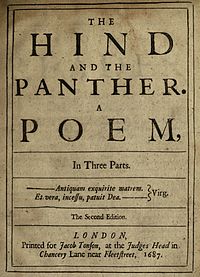
"The Panther and the Hind," by the way, is the title of a long poem by Dryden written on the occasion of his conversion to Catholicism in 1687, and arguing the Anglican-Catholic controversy. I've never read it, but I intend to, based on the excerpts from it included in this book, for instance this, on sola scriptura:

Suppose we on things traditive divide,
And both appeal to Scripture to decide;
By various texts we both uphold our claim
Nay, often ground our titles on the same:
After long labour lost, and times expence,
Both grant the words and quarrel for the sense.
Thus all disputes for ever must depend;
For no dumb rule can controversies end.
200px-The_Hind_and_the_Panther_1687

By the way, the only edition of the Nichols book that I was able to find available at reasonable cost is published by T&T Clark of Edinburgh, and is somewhat poorly printed. The binding and the paper are fine, but the type looks as if it was printed at inadequate resolution and then scanned.


, ,

35 responses to “The Anglican Muddle”

  1. If there was an ordinariate parish near South Bend I would certainly try it.
    I remember reading that book with great enjoymeny many years ago

  2. I forgot to mention what an engaging writer he is, though anyone who’s read one of his books already knows that.

  3. Alas, no ordinariate out here in Eastern Europe – but then there’s only one english-language mass in this city; our liturgical ambitions are more along the lines of “get an english-speaking priest to turn up every week, somehow”. I’d like to attend the Catholic-Anglican mass at some point though.
    I remember picking up the BCP in anticipation a year or two back, having heard its grand use of language praised; I put it down in disgust after the introductory bits and acts of Parliament outlined the official CofE position that the Pope and Councils are not infallible interpreters of the Bible, so we’re just going to let the English Parliament legislate what we do and pray instead. (The language wasn’t as impressive as I’d heard either.) You wouldn’t think things could go downhill after Henry VIII’s grand vision for Anglicanism (“it’ll be just like Catholicism… except with me in charge!”), but it did.
    One thing to be said for the “grand muddle” is that it served as a sort-of unifying culture for the various sects involved, providing a framework for some form of coexistence – unified practise, somewhat divergent beliefs – in a manner appropriate to a national church: just as the nation contains all sorts, so does the church; and Anglicanism is so much part of the culture that the lack of defined beliefs isn’t actually too important: unified practice is more important than unified beliefs, and culture is too fuzzy for careful definitions and anathemas. It’s only when you get a religion what wants to be catholic that you need those.
    …of course, all that is irrelevant when talking of overseas forms of Anglicanism, where “being part of the English culture” isn’t enough, and the Anglican Communion is an attempt at being catholic across cultures; and it’s in the overseas bits that the problems are arising these days.

  4. Very true about the CofE as national church. One thing you can say for it (or against it) is that it worked, in a secular political sense, at least for a time.
    As an American Anglican, i.e. Episcopalian, I was never really conscious of just what the idea of a national church meant in England until I read a Chesterton essay, possibly in The Well and the Shallows, where he rails against the specific thing you mention, the power of Parliament to define doctrine. Of course nothing like that was the case here, and I just had not thought about it. I had been told not to pay too much attention to the 39 Articles anyway, although I remember reading them (this was 35 years ago) and enjoying some of the turns of phrase, such as the bit about the sacraments not “to be gazed upon or carried about”.
    I think it was the plain contradiction of some things in the Articles with things taught in the more-or-less-sort-of what we believe way that began to make me uneasy that there was actually no core of doctrine in the church. I’m thinking in particular, as I glance at the Articles (http://anglicansonline.org/basics/thirty-nine_articles.html) which pretty clearly deny the Real Presence, which was more-or-less-sort-of affirmed.

  5. Have you read Newman’s Loss and Gain? That has quite a funny passage about the 39 Articles.

  6. No. I got the impression early on, I guess from literature classes, that one needn’t bother with it. Even if that’s true from the literary point of view, though, it wouldn’t be from the religious.

  7. “scripture alone, grace alone, faith alone”
    — that’s a lot of alones!

  8. This is clearly a reminder to me to go and attend Mass at Our Lady of Walsingham here in Houston at least once.

  9. And if/when you do, let us know your reaction.

  10. I read Loss and Gain. It had little literary merit but I found it v moving as a devotional book

  11. Browsing that version Louise linked to, I think it could be quite interesting as a picture of what that genteel, learned, Anglo-Catholic, Oxford Movement life was really like.

  12. I’m sure I must have talked about Loss and Gain in the Brideshead discussion. On or around the first page of Book I Charles says, “In her [Oxford’s] spacious and quiet streets men walked and spoke as they had done in Newman’s day.” And then Charles Reding/Charles Ryder, and there are other parallels, although more differences, of course. I found it worth reading for that alone.
    AMDG

  13. Goodness Louise, it took me about a month to get that book on inter-library loan and there it is. Awful hard to read it like that, though.
    Then I see you can get it on Kindle for $1.99, but I know you don’t like that.
    AMDG

  14. I would think there would be a Project Gutenberg edition.
    I knew “Charles Reding” sounded familiar.

  15. Re: the 39 articles (Mac, your link is complicated by the close-bracket on the end, which a click-through tries to parse as part of the address) – I’m pretty sure I’ve never met anyone who actually believed in them – they’re a kind of quaint relic, no different to the way the laws of the land or of ancient institutions contain rules which are technically in force but forgotten or universally ignored. (I heard of an Oxford or Cambridge student – forget which – who, taking an exam, resurrected the old and forgotten rule that a student was obliged to a drink of beer during the exam. The examiners obtained him his beer, then found some old and forgotten rules about exam dress codes and disqualified him for not wearing a black gown.)
    I once saw a priest getting instated as vicar of an Anglican parish, taking his vows of office – one of them was to uphold the 39 articles, which absolutely no-one present actually wanted him to do (and many would have objected strenuously to) – he pulled an “oo-er-missus” face and made the vow with obvious insincerity, and then got on with the actual business of vicaring. I didn’t at the time think it was reasonable to genuinely try to uphold the 39 articles, but it did seem gratuitously unreasonable to make vicars swear to do something they weren’t going to, and more or less couldn’t, actually do.

  16. “old and forgotten rules about exam dress codes”? When I sat my exams the necessity of turning up in a black gown was very much in force! (These days I only get to wear it at Halloween though …)

  17. I don’t believe I’ve ever seen the word “instated” used before. Only “reinstated.”
    Thanks for noting the broken (“complicated” was very diplomatic ๐Ÿ™‚ ). I’ll fix it.
    “…something they weren’t going to, and more or less couldn’t, actually do.” And moreover probably would have been punished for attempting to do. It is a pretty silly business.

  18. “When I sat my exams the necessity of turning up in a black gown was very much in force!”
    Part of me thinks that’s cool. Part of me doesn’t. Still another part of me is entirely indifferent. ๐Ÿ™‚
    Yes, Maclin, if I ever get to Our Lady of Walsingham parish, I’ll share my thoughts.

  19. Robert Gotcher

    Louise, the part that doesn’t think it is cool is probably the part that watched Dead Poet’s Society.

  20. You may be right. ๐Ÿ™‚ Although I actually don’t remember much about DPS.

  21. You still see the kids in Oxford in their black clothes st exam time

  22. I don’t think I ever saw a film with Robin Williams in it.

  23. You managed to miss Mrs. Doubtfire?

  24. Did you ever see Mork and Mindy?

  25. Me? No. I remember people going on about how funny it was, but I don’t know if I even had a tv at the time.

  26. Never saw Mrs Doubtfire. I don’t know if Mork and Mindy ever reached the UK – is it a TV show or a film? In the 1980s, between 1983 and 1990 really I was writing my PhD and then my first classes and that’s about all I did. I did have a TV for a little while in about 1985 and watched HIll Street Blues with great enjoyment but for most of the 1980s I did not have a TV and was much too absorbed in writing to think about it.

  27. Robert Gotcher

    Mork and Mindy was a TV show in the late 1970s. It was a spin-off of Happy Days. It is the very first thing Williams did. I recall it being hilarious. I just watched an episode. It was funny, but not as funny as I remember it. Maybe it was an “off” episode. Pam Dawber couldn’t act.

  28. Mork and Mindy was on British TV. The “Mork” character made a sort of beeping or clucking sound that was briefly ubiquitous on playgrounds. I saw it when I was 11 and remember thinking it was beneath contempt. That may say more about me at 11 than about the series, though.

  29. If it was between 1970 and 1977 I was at boarding school. We were allowed to watch TV once a week, and it was Upstairs Downstairs and (?) The Forsyth Saga. Anyhow, some dull 19th century costume drama which went on and on and on and on. We also watched Top of the Pops. I considered all these things beneath me then and if I went back to boarding school tomorrow I would probably do so again

  30. Robert Gotcher

    Grumpy,
    Maybe it was Poldark, the 18th century soap opera set in Cornwall.
    I always has plebian tastes, even though I went to boarding school. Still do, really.

  31. Do you mean beneath you because you had more educated taste, or because it was stupid dorky stuff that the grownups said would be good for you, like imitation potato chips (crisps) made of kale? Either way, I can imagine a teenaged girl wanting nothing to do with it. But Upstairs Downstairs is actually pretty good. Compared to American TV of the time, it was Dickens vs. Archie & Veronica.

  32. Robert Gotcher

    Wait. Are you dissing Archie and Veronica?

  33. Perish the thought–merely placing things in their proper order.
    Paul, I missed your comment earlier. I don’t know if it was the same noise you’re referring to, but the people I worked with at the time, chronologically adults in their mid-20s or so, frequently said “nano nano” whenever the show was mentioned. My reaction was similar to yours.

  34. Robert Gotcher

    Mork also said “shazbat” as a kind of cuss word.

Leave a comment