You have to make allowances for movies made in the 1950s and earlier, I know. Well, you have to make allowances for movies in general, but it was sometime in the 1960s that movies (American ones, at least) made a noticeable turn toward a greater realism, or at least believability (not necessarily the same things). Part of the change, I suppose, was technical. Perhaps part of it was just an increase in skill. In any case a movie like Bonnie and Clyde (1967) seems realistic in a way that few films of the 1950s and earlier do, in spite of its factually inaccurate portrayal of the title characters. It's not just the realism of the violence, which was shocking. It's in the details–the way the people look, the way things look, the dialog, the acting. Maybe in the latter case it's an increasing distance from the acting styles of the pre-cinema stage.
But anyway: I don't generally have much difficulty in making whatever allowances are required for movies of the '40s and '50s that are set contemporaneously. Considered with detachment, Humphrey Bogart as Phillip Marlowe or Sam Spade is not really believable as a person whom you might actually encounter. But I accept the character…well, perhaps there's a touch of irony in that acceptance, but it doesn't stop me from entering into the world of the film.
Westerns, though, are another story. I've seen a few of the old classics over the past decade or so, and have been a little disappointed. The Searchers has been on my list for a long time, and since it's widely considered the greatest Western of all time I expected to like it.

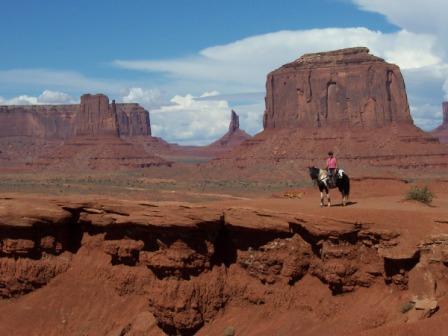
But I found myself unable to overlook the many unconvincing aspects of it. I got off to a bad start with the fact that the story is supposed to take place in Texas, and the door of the cabin opened onto what I was pretty sure was no Texas landscape (it's Monument Valley, Utah). The cabin is made of brick and heavy timber that seem unlikely building materials for an isolated house in a remote desert, and in any case too comfortable and substantial for the time and place. "Outdoor" scenes that were shot in the studio are too obviously fake–one reviewer at the time said that the campfire scenes could have been shot in the window of a sporting goods store. Most of the actors are unpersuasive, and I have to include John Wayne in that group. One minor character, Charlie something, has the most ludicrous fake southern-western accent I've ever heard, and that's saying a lot. The Indians, at least those with speaking roles, mostly seem like caricatures. (What I thought was the worst Indian portrayal, the chief Scar played by a blue-eyed actor named Harry Brandon, may not be that at all: there is a plausible argument that the character is meant to be a white man taken captive as a child.)
The story is powerful, and unsentimental to a degree that surprised me a little. The search alluded to in the title is for a girl taken captive by Comanche raiders who have killed the rest of her family. She is the niece of Ethan Edwards, John Wayne's character, who spends years searching for her. He has a grim hatred of the Indians and speaks of them in viciously racist ways that are a bit shocking today. And the Indians as portrayed are not entirely undeserving of his fury. But probably one of the things that has made the film's reputation is that it doesn't leave the picture–either Edwards' hatred or the savagery of the Indians–entirely as it first appears.
If you are an admirer of The Searchers, you can put the blame on me rather than on it for my lack of enthusiasm for it. I wanted to like it, and I really did try to overlook what was unconvincing, but it just got in my way too much, too much for me to feel entirely the impact of the narrative.
What I did like, very much, maybe enough to make me see it again, was the landscape, and the way it was filmed. Never mind that it's not Texas; it's stunning, and magnificently photographed.
 Light On Dark Water

Leave a comment