My sisters and I grew up surrounded by excellent books, all chosen by our mother and almost all of them British classics. (I have often wondered where my mother, a Chinese immigrant to California, acquired her knowledge of English children's literature.) As children, we didn't know that they were classics. They furnished the imaginative landscape we took for granted among ourselves. At the same time, the Britishness of that landscape set us apart from both our French Canadian schoolmates and our American cousins.
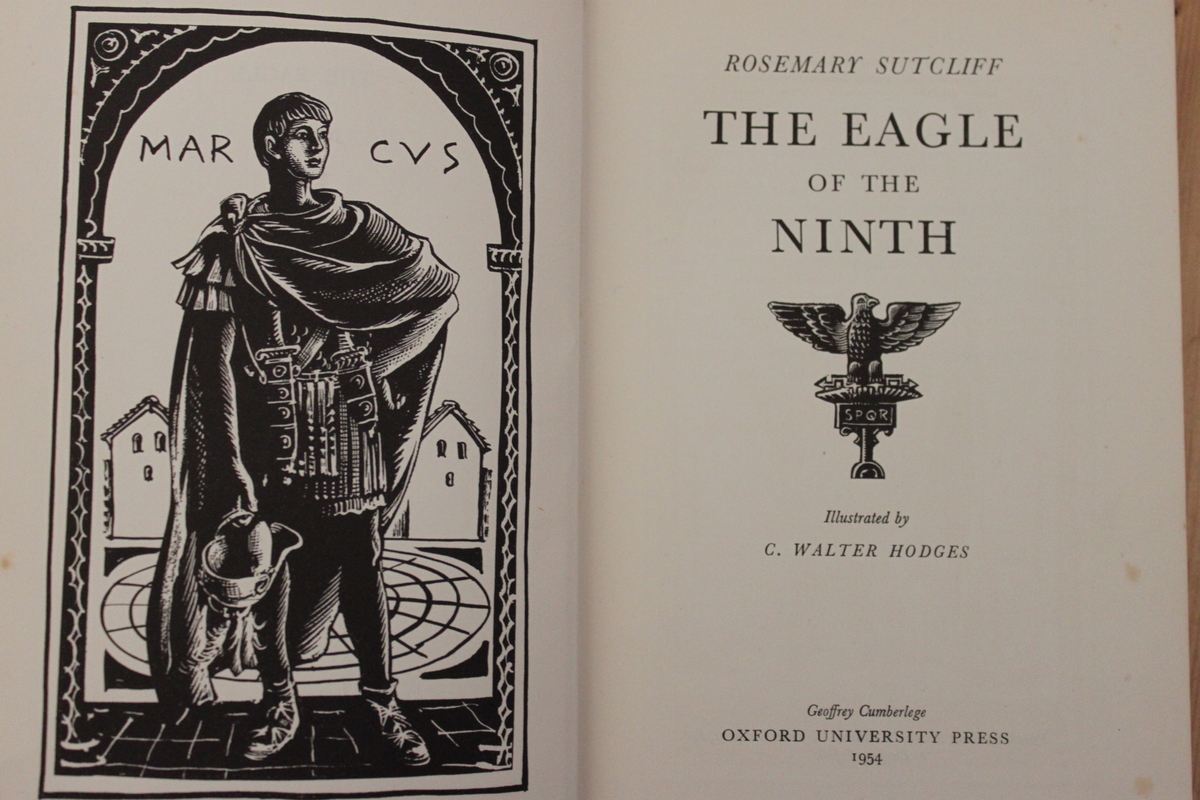
Rosemary Sutcliff was one of the authors on our shelves. She wrote retellings of many legends—Greek, Celtic, and Arthurian—but her best-known works are The Eagle of the Ninth books, a sequence of historical fiction novels for children whose protagonists are descendants of the hero of the first book. It would be misleading to call them a series, as each of them is an independent story, unconnected to the others except by the genealogical tie. It's even slightly misleading to call them historical fiction for children, because her books stand on their merits as fiction, unqualified by age range or educational content. She prided herself on not writing down to children; as an adult, I have enjoyed reading her for myself at least as much as my kids have enjoyed my reading her aloud to them.
One reason for this is that Sutcliff successfully avoids the didactic tone that plagues a lot of historical fiction. Her goal is clearly to tell a great story in a particular historical context, not to inculcate historical knowledge of that context. She never creates an ignorant character just so his ignorance can be remedied for the reader's benefit. Not for her the traveler asking about local customs, or the child puzzled by adults' doings, unless the narrative demands one. Not for her the lecture in reply, but rather a natural conversation. (Reading Bonnie Dundee, in fact, I gleaned so little explanation from the text itself that I kept having to consult Wikipedia to keep track of the shifting religious and military/political enmities.)
For example, at the beginning of The Eagle of the Ninth, the protagonist arrives to take over command of a Roman garrison in Britain. Being new to command and new to the country, of course Marcus has questions for the outgoing commander, and the answers are as helpful to the reader as to him. However, his inexperience and foreigner status are not mere devices set up to make space for the answers; instead, they are among the driving forces of the whole story. The conversation itself is written entirely naturally, with both men taking part and wandering from one topic to another. Their shared assumptions are left unstated; the reader has to infer, for instance, that to these legionaries “home” always means “Rome.”
Another reason why adults can enjoy Sutcliff is the attention she gives to place and landscape. The details of weather, topography, and human construction are concretely and specifically described. They play a vital part in the story, influencing and reflecting both the action and the characters' states of mind. Here is Marcus's first view of his new post:
The British town was spread below the southern scarp of the Mount; a sprawling huddle of reed-thatched roofs, every colour from the gold of honey to the black of dried peat, according to the age of the thatch; with the squared, clean lines of the Roman forum and basilica looking oddly rootless in their midst; and the faint haze of wood-smoke lying over all.
The contrast between the irregular, vivid British houses and the precise, geometric Roman buildings will be echoed throughout the story in the encounters between Britons and Romans, and especially in the relationship between Marcus and his British slave. By the end of the story Marcus's feelings about the landscape have changed.
Standing there with the last cold spattering of the shower blowing in his face, he thought, 'I can go home,' and saw behind his eyes, the long road leading South, the Legion's road, white in the Etruscan sunlight; the farmsteads among their terraced olive-trees, and the wine-darkness of the Apennines beyond. He seemed to catch the resiny, aromatic smell of the pine forests dropping to the shore, and the warm mingling of thyme and rosemary and wild cyclamen that was the summer scent of his own hills. He could go back to all that now, to the hills and the people among whom he had been bred, and for whom he had been so bitterly home-sick, here in the North. But if he did, would there not be another hunger on him all his life? For other scents and sights and sounds; pale and changeful northern skies and the green plover calling?
That excerpt illustrates a recurring theme in Sutcliff's writing, the individual undergoing a change both personal and collective. Her characters are uprooted or cut off in one way or another and lose their identity: they are orphaned, they are captured as slaves and renamed, they are cast out from their tribe, they are invalided out of the Legions. Eventually they forge a new identity, but the pain of the loss remains with them. Sometimes the specific loss is forced upon them, and sometimes circumstances dictate that loss there must be, but the character decides which one: to make his home under the pale and changeful northern skies, Marcus must leave his hunger for the pines forests unsatisfied. Either way, the loss is irrevocable. As another character says, “There is no way back through the Waters of Lethe.”
The changes in identity are mediated by the characters' allegiances to other individuals. Unavoidably, then, these shifts bring conflicting loyalties, in which the personal usually overcomes the tribal. In The Lantern-Bearers, Aquila's sister is carried off by one band of Saxon raiders and he is enslaved by another; years later, she helps him escape but will not go with him, because of her love for her Saxon husband and child. When Aquila offers his wife, a Welsh chieftain's daughter, the chance to return to her people, she too says, “I used to dream night after night of being free; free to go back to my people—my own people… But it is too late. I belong to you. […] I am betraying my own people—my own world—to stay with you.” However, through the personal attachment, there can come a later attachment to the tribe and a new collective identity. Thus a Roman centurion who deserted and married a local woman many years ago can now say, “I am of the Segoviae.”
The shifting identities in the Eagle sequence carry a startling revelation—startling, at least, to me—of how much British history there was before England ever existed. In the first book, the Romans are clearly outsiders, an occupying power opposed to the British (Celtic) tribes. In later books, their descendants have come to consider themselves British as well as Roman, indeed to consider British a species of Roman. In almost all the books, the Saxons are the invading barbarian enemy. For a long time, I hadn't clearly distinguished between British and Anglo-Saxon, so despite her non-didactic books, Sutcliff has been very educational for me.
—Anne-Marie
 Light On Dark Water
Leave a comment