I love mysteries. My affection for a good mystery began with Nancy Drew when I was in the third grade (Nancy Drew was better then.), and has continued for 57 years unabated. There are some authors currently writing mysteries that I enjoy, but my very favorite authors are the women who began writing in what is known as the Golden Age of Detective Fiction, the 1920s and 1930s. Four of these women: Dorothy Sayers (Peter Wimsey) , Ngaio Marsh (Roderick Alleyn), Margery Allingham (Campion), and Agatha Christie (Well, you know.), were known as The Queens of Crime. Christie and Sayers are still well known, and all four have had BBC Mystery series featuring their detectives, but there was another woman writing during that time that I enjoy just as well, and maybe more.
I wish I could remember when or where I first found a book by Josephine Tey, née Elizabeth Mackintosh, or which book it was. I know it was a long time ago. In her day, she was quite well-known, probably more so in England than the United States, but her popularity doesn’t seem to have been as durable as that of the “queens.” Her books are easily available online, but they all seem to have been last published in the 90s. Maybe it’s because she wrote so few books—only eight mysteries in all. I’m sure publishers love to see those rows of Christie mysteries on the shelves and know that once you’re hooked, you’re going to want to read them all.
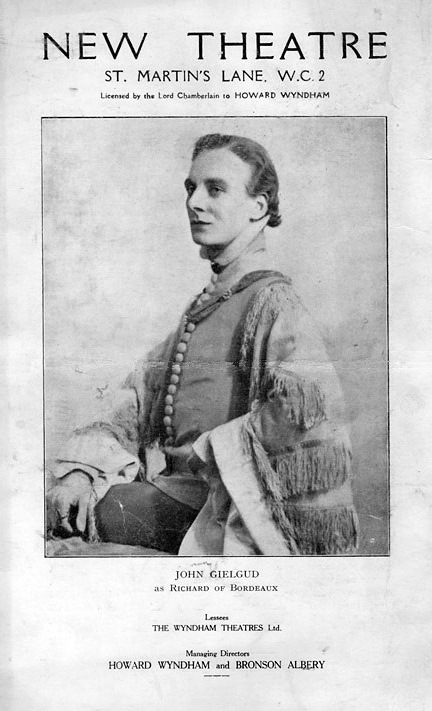 Early in her writing career Tey, under the name Gordon Daviot, wrote plays. Her first play, Richard of Bordeaux, ran for 14 months in the West End (the Broadway of London), which, Wikipedia tells me, was at that time considered a long run. The star and director of Richard was John Gielgud and, again from Wikipedia quoting a book by Martial Rose:
Prior to that production, Gielgud was regarded as a highly respected classical actor based on his performances at the Old Vic, but the overwhelming success of Richard of Bordeaux catapulted him into the status of superstar.
Tey must have been rather fond of the play herself. In Daughter of Time, her next-to-last mystery, she has her detective, Inspector Grant, say that he saw Richard of Bordeaux three times when he was young. From this and other comments that Grant makes, one gets the impression that Tey did extensive research for her plays, which later contributed to her most famous mystery.
Murder, she didn’t necessarily write.
Unlike the Queens of Crime, Tey did not always write mysteries which were centered around murder. In two of her mysteries, I won’t say which, there is no murder at all, and in some of the others, the murder is in the past and not the most important element of the book. What is central to many of her mysteries is the characters: their psychological makeup and their relationships. The books are more like novels than mysteries.
The first two mysteries: The Man in the Queue (1929) and A Shilling for Candles (1936), were written in the early period of Tey’s career when she was busy with her plays, and two novels. Both of these early mysteries (and indeed almost all of the latter) show the influence of the theatre. They are what you might think of as the average good mystery of the time. They begin with a murder, and Inspector Grant follows the clues and solves the mystery. If you were looking for a mystery featuring Miss Marple, Campion, or especially Roderick Alleyn, and couldn’t get your hands on any of these, you would be happy with either of these books.
Sir John Gielgud, who became a close friend of Tey’s, said that she, “… was distressed by her inability to write original plots.” If you stopped with those first two mysteries, you might think that this was an accurate assessment, but then in the late '40s, Tey wrote a series of mysteries that belied this opinion.
UnGranted
Tey’s first mystery sans Inspector Grant is Miss Pym Disposes. Miss Pym, a retired French teacher has found fame by writing a book about psychology.
She read her first book on psychology out of curiosity, because it seemed to her an interesting sort of thing; and she read all the rest to see if they were just as silly.
She thereafter develops her own theory of psychology which, by pure happenstance, comes to the attention of a publisher. On the publication of her book, she becomes the darling of the lecture circuit and thereby finds herself speaking at a college of physical culture at the behest of an old friend who is the head of the college.
During her stay there is an accident at the college, or perhaps a malicious act, and though the police arrive to investigate, the real detective is…well, nobody. Miss Pym observes what is going on, though, and it is gradually borne in on her what has happened.
There is in Miss Pym a vague similarity to Dorothy Sayer’s Gaudy Night, but it is vague. What we have here is not the arena of the intellect, but that of the body, and how extreme physical stress affects the psyches of the different characters. The solving of the mystery is not the main lynchpin of the story. The unfortunate incident is incidental. It is just a means of illuminating the character of the students.
Next, there is The Franchise Affair. The story of two women living in genteel poverty who are accused of a terrible crime by a seemingly undefeatable adversary—a young, innocent-seeming teenage girl. Their only defense is a lawyer who has spent his career working on the business affairs of a small village: writs, and wills, and real estate, and who has no knowledge at all of criminal law. Inspector Grant has a small role in this one, but he could just as well have been Inspector Smith or Inspector Jones. The main story here is the ability of a relentless, self-centered, and conscienceless will to manipulate the truth, and the terrorism of the mob incited by an amoral press.
Brat Farrar is the third of this group. A young man, an orphan, who has lost his means of supporting himself due to an accident is approached by man who asks him to impersonate the deceased heir of his neighbor’s estate. Brat has an uncanny resemblance to the boy who is a supposed suicide, although no body has ever been found. Brat’s eventual acceptance of this imposture springs more from his desire to have a place in the world, and in particular a place which revolves around horses, as any monetary design. Again, the death of the boy heir is not the center of the story, but the door into the life of the characters.
A word about the inspector
Inspector Allan Grant is a detective for Scotland Yard. We are told that:
If Grant had an asset beyond the usual one of devotion to duty and a good supply of brains and courage, it was that the last thing he looked like was a police officer. He was of medium height, and slight in build, and he was—now, if I say dapper, of course you will immediately think of something like a tailor’s dummy, something perfected out of all individuality, and Grant is most certainly not that; but if you can visualize a dapperness that is not of the tailor’s dummy type, then that is Grant.
Elsewhere, we are told that he looked more ex-military than police.
Knowledgeable about food and wine, theatre and opera, he nevertheless lives a very simple life. He seems to be an introvert. When he has a nagging problem that he can’t solve, he employs the eureka principle—not that he calls it that. He goes elsewhere and tries to get involved with something else, and things fall into place in the back of his brain.
Unlike the detectives of the fab four mentioned above, and many other famous detectives from Sherlock Holmes to, well, Benedict Cumberbatch as Sherlock Holmes, he doesn’t have a sidekick. He has Williams, who does whatever Grant doesn’t have time to do, and he has Simpson who does likewise, only not as often, but for the most part, he works alone.
As for women, there is the actress Marta Hallard, who is a better woman than thee or me. A tall, graceful actress who knows how to cook, what to drink, and when to keep her mouth shut, she is the woman that Grant would marry if either of them were interested in marriage. There is never the slightest intimation that their relationship is other than Platonic.
In a couple of the books it is mentioned that Grant has flair. Not the best word for it in my opinion, but it means that he has a certain intuitive sense that something is not right, or that there is another way to look at the problem than the one they are using. His superior, Superintendent Barker, recognizes this, but he thinks that you can overdo it.
“Is this an example of the famous flair?” said Barker. . .Put it out of your head, Grant, until you get even a tittle of evidence to substantiate it. Flair is all very well, and I don’t deny that you have been uncanny once or twice, but it has always been more or less in accordance with the evidence before….
Grant makes his appearance again in To Love and Be Wise and stays through the last mystery, The Singing Sands. These two meld the detective fiction of Tey’s first two mysteries with the more narrative style of the next three. I won’t say much about them except that in the last book, Grant’s interest and imagination are captured by a poem that he finds scrawled on the back of a newspaper that he accidentally removes from the train compartment of a man who has died from a fall in a drunken state.
The beasts that talk,
The streams that stand,
The stones that walk,
The singing sands,
. . . . . . . .
. . . . . . . .
That guard the way
To Paradise
The face of the dead man, and the words of the poem are so inconsistent with his death by inebriation that Grant sets off to find out who the man was and where he was going—and what that poem describes.
I said all that to say this.
In 1960 the Crime Writer’s Association voted Tey’s masterpiece, Daughter of Time, The Best Mystery Novel of All Time. Peter Hitchens described it as “one of the most important books ever written.” I don’t know about that, but it is an excellent book that shows just how much of what we think we know about history is just not true.
We find Inspector Grant having prickles of boredom as he lies in a hospital bed recovering from having fallen through a trap door while in hot pursuit of Benny Skoll. To allay his boredom, Marta brings him a stack of prints of faces—faces of people to whom some mystery is attached. After thumbing through the group, Grant finds that this picture has dropped to his side.
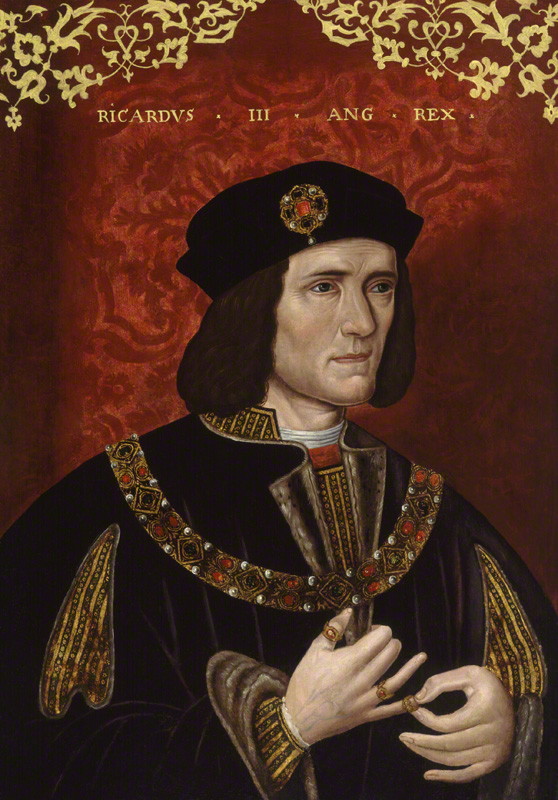 This is the painting of Richard III which hangs in the National Portrait Gallery in London. Grant, who believes himself to be an expert judge of faces, is surprised that Shakespeare’s villain, the man who murdered his beloved brother’s sons, has a face that he would have ascribed to a judge. “[A] judge,” in his opinion, “had a special quality; an integrity and a detachment. So, even without a wig, one did not confuse him with the man in the dock, who had neither integrity or detachment.” Well, you can’t always count on that anymore, but it’s sometimes true. In fact, I have a friend who is a judge, and she has just that look.
This dissonance between Richard’s face and his reputation leads Grant, with the help of young American researcher, to investigate the primary sources that reveal the more likely history of this much-maligned king.
Now, ever since Wolf Hall started to air, there has been much discussion about how Hilary Mantel has maligned Thomas More, and I have wanted to write something about this, but I decided I would save it for this post. The book that is responsible for most of the erroneous detraction of Richard III is attributed to Thomas More. Grant and his aide, Carradine, do find out, however, that the book that was published under More’s name was a manuscript copy of a book written by one John Morton. More lived in Morton’s home when he was young, and was almost certainly influenced by Morton’s adherence to the Tudor line.
I have wondered if Mantel might even have been influenced by Daughter of Time. While she is the perpetrator of just the kind of misinformation that Morton indulged in, she might perceive herself as being on the other side. So, I did a Google search for “hilary mantel daughter or time.” While I didn’t find any reference to Tey’s book by Mantel, there are others who have made that connection, notably Christopher Hitchens writing in Atlantic, who said:
Wolf Hall is a magnificent service to the language and literature whose early emancipation it depicts and also, in its demystifying of one of history’s wickedest men, a service to the justice that Josephine Tey first demanded in The Daughter of Time.
Except she didn’t. Most amusing though was this quote from Mantel herself describing the portrait of Cromwell that hangs in the National Gallery. She says, “"[Cromwell] doesn't care what you think of him. No man more immune to insult. Truth is the daughter of time. Time is what we haven't got." Maybe she is thinking about Tey. That quote, “Truth is the daughter of time,” is found at the beginning of The Daughter of Time.
And by the way
Recently, Josephine Tey has been resurrected by a series of mysteries written by Nicola Upson in which Tey is the detective. I have been listening to the first one, An Expert in Murder, and while it is well-written, I’m not completely happy with it. The murder scene is rather graphic (although far from the worst) and eerie, which is something you never see in Tey, and Upson has so far professed a political opinion or two which I suspect is foreign to Tey. Tey was a very private person, and not much at all is known about her life. I’m afraid that Upson might be inventing a false life for her similar to the false life of Richard III.
—Janet Cupo has been commenting on this blog for about as long as it's existed, and has her own excellent blog at The Three Prayers.
 Light On Dark Water
Leave a comment