Because it’s timely.
“I always wonder,” said Lise, “why, in Britain and America, we make Hallowe’en into a frightening thing with, for children, ghosts and skulls, witches, spiders and black cats, when it is the eve of one of the most radiant feasts of the year—All Saints, all those men and women who have shone out light and goodness, courage and faith into the world.”
“And All Souls is radiant too,” said Soeur Marguerite—it followed the next day. “For us there is loss, but for the dead, for him or her, it is the culmination, the crown . . . .”
Five for Sorrow, Ten for Joy, Rumer Godden
I first heard of Rumer Godden from my grandmother. She had been reading In This House of Brede and she couldn’t quit talking about it. My grandmother, although Catholic, wasn’t a person who talked a lot about the faith, but she was a serious reader and knew a good novel when she read one. I, being about 19, and not too interested in nuns, didn’t read the book at the time, but I respected my grandmother’s opinion and long ago I came to share it.
I have read many of Rumer Godden’s novels over the past 30 years or so and several of her children’s books. However, before I wrote about them, I wanted to read some of her autobiographies to get some idea of what formed the woman who could write such beautiful and mysterious, and sometimes terrifying fiction. Pretty soon I was completely caught up in Ms. Godden’s own story which is as fascinating as any novel, and so it will be largely about her three autobiographical works that I write.

I chose this picture because Rumer Godden loved Pekingese. She had something over 50 during her life.
In one of the autobiographies, A Time to Dance, No Time to Weep, Ms. Godden writes this:
Indians have a custom of taking ‘darshan’ which means, with a temple, a place, a holy cave or a renowned view such as the sight of the Himalayan snow peaks, Everest or Kanchenjunga, or a notable person–for instance Gandhi or the President–they will travel miles, make pilgrimages simply to take ‘darshan’ of that person or place, not trying to make contact or speak–certainly not taking photographs as we do–but, simply by looking, to let a little of the personality, sainthood, holiness or beauty, come into their souls. They go away, usually without speaking and so keep it for the rest of their lives. Innately, from the time we were children, we had done the same thing; it was perhaps our deepest delight.
As I read these three books, I got the feeling that after having taken darshan for many years, she was sharing all she had learned with me.
Two Under the Indian Sun, written by Rumer and her older sister Jon in 1966, tells the story of their childhood in India. It is not, they say, “an autobiography as much as an evocation of a time that is gone.” And that it is. They present us with a vision of India from the viewpoint of a child, and that vision evokes a yearning for beauty and mystery.
English children in India were usually sent home to school about the age of six; however, Rumer and Jon (ages 6 and 8) after a year with rather straight-laced aunts in London were sent back to Narayangunj (now in Bangladesh) in 1914 “because of Zeppelins.” Here they lived with their Fa and Mam, Aunt Mary, and younger sisters, Nancy and Ruth, and a number of Hindu and Moslem servants until 1920 when they went back to England to be educated.
The Godden children did not live entirely without structure, they had to do lessons with their mother and aunt, but they seem to have had a great deal of freedom for rich, imaginative play and to visit the colorful and fascinating bazaar filled with colorful paper garlands, rich silks, wonderful kites, every kind of food, and sacred cows. They lived near the river, and their father, who was an agent of a steamship navigation company, had a boat, The Sonachora. Some of the loveliest passages in the book take place on the river. For instance, on the nights of the Hindu festival Diwali, the Hindu Festival of Lights, Hindus light thousands of little “earthenware lamps shaped like leaves or tiny boats,” and set them everywhere, under trees or on the rooftops or anywhere else, to help Kali in her battle with the evil one. On these nights the whole family boarded the Sonachora to view the flickering lights from the river. Another time, they took a long trip—weeks—as the only passengers on a larger steamer, through the Sundarbans, the river jungle of the Ganges Delta. They tell of long, languid days watching the banks for tigers that they heard along the bank, but never saw. Nevertheless, there was plenty of wildlife to be seen and they tell of crocodiles, monkeys, porpoises, and myriad river birds: osprey, eagles, ibis, storks, and kingfishers. Their days on the river were full of lush beauty and peace.
There was, of course, a dark side to their time in India. There was dirt, squalor, and violence—including a murder in their own household. I’m sure that their mother’s view of India wasn’t nearly as sanguine as theirs, but this is memoir of children, and the wonder overshadows the tragedy.
A Time to Dance, No Time to Weep begins with Rumer’s return to England for a formal education. Neither she nor Jon was prepared for life in a girls' school either academically or temperamentally, and they failed at more than one. Finally, and thankfully, at the Moira House Girls’ School, Rumer found that one teacher, Mona Swann, who recognized her talent, and spent the next six terms drilling her relentlessly in the disciplines of writing. It is fairly certain that Ms. Swann was responsible for the excellence of Rumer Godden’s future work—and it was going to be not her present, but her future work.
After leaving Moira House, Rumer had to make a living, and for some unfathomable reason, and although she herself could not dance well, she trained as dancing teacher, and appears to have been a good one. For the next several years she had her own schools, and although she never made a very substantial income, seems to have really enjoyed her work and her students, and managed to support herself.
During this time, she became pregnant and in 1934 married Laurence Foster, the father of her expected child. Although Laurence and Rumer were not really compatible, they got along well enough for several years, and it was during this time that her first books were published, but shortly after her first great success, The Black Narcissus, Rumer came home in 1939 to find that Laurence had gone to the army, leaving her with enormous debts which consumed almost everything that she made on The Black Narcissus, both book and movie.
The remainder of the book, the meat of the book really, tells of her struggle to make a life for herself and her two young daughters in India during World War II. This part of the book tells of a time of poverty and exhausting struggle and sadness, but also of a time of peace and beauty in her small home, Dove House. Unfortunately, this idyll ends in violence.
Ms. Godden wrote 24 novels, 11 works of non-fiction, and 28 children's books. I have read only a few of these. The reason that I was curious about her life though, is found in her novels about India. They seem to suggest that even with the best of good will, there is something in the atmosphere of India that is inimical to westerners. In The Black Narcissus the earliest novel that I have read, the menace seems to be only connected to a certain place, the building that has been given to an order of Anglican sisters for a convent. In The Peacock Spring, and Kingfishers Take Fire it is more omnipresent. I found this a mystery since all her life she thought of India as home; however, the answer to this mystery lies, I think, in the violent event that ended her stay in Kashmir during the war.
Although Rumer was surrounded by people of many different faiths during her life: Hindus, Mohammedans, Buddhists, Protestants and one Catholic nanny, religion did not play much part in her life, although she was made to say her prayers and had some passing knowledge of the Bible. Then on page 174 of A Time to Dance…, we suddenly come across this passage.
Thinking about religion brings me to the thought of the Catholic Church; it seems to me to be one of the solutions—maybe the only solution. It is universal, it has a common tongue. It was founded by Christ, not man. This does not mean I want to become a Catholic now, does not because, to become one, I would have to shut my eyes to many things—or see beyond them and at the moment I cannot see. There is though, this: I sense that no-one can appreciate the Catholic Church until they are part of it.
*****
There is an Indian proverb or axiom that says that everyone is a house with four rooms, a physical, a mental, an emotional and a spiritual. Most of us tend to live in one room most of the time, but, unless we go into every room every day, even if only to keep it aired, we are not a complete person.
This brief introduction is found at the beginning of A House with Four Rooms. Resuming where A Time to Dance . . . left off, this final autobiography begins with Rumer’s arrival back in England with her two daughters, Jane and Paula. It is here that she gradually finds some stability, and picks up the threads of her literary career which had become pretty thoroughly unraveled during the war. She had come home with a finished novel in hand, and it was The River which brought her back into the public eye. Not only was the book a best seller, it was made into a film by Jean Renoir, son of the painter Auguste Renoir. The movie which was based an event in Rumer’s childhood can be seen on Amazon video. Rumer worked closely with Renoir during the making of the film and she was very happy with it because every detail (almost) was authentic. It was a critically acclaimed movie, but it would be worth watching, even just to see portrayals of the Indian festivals.
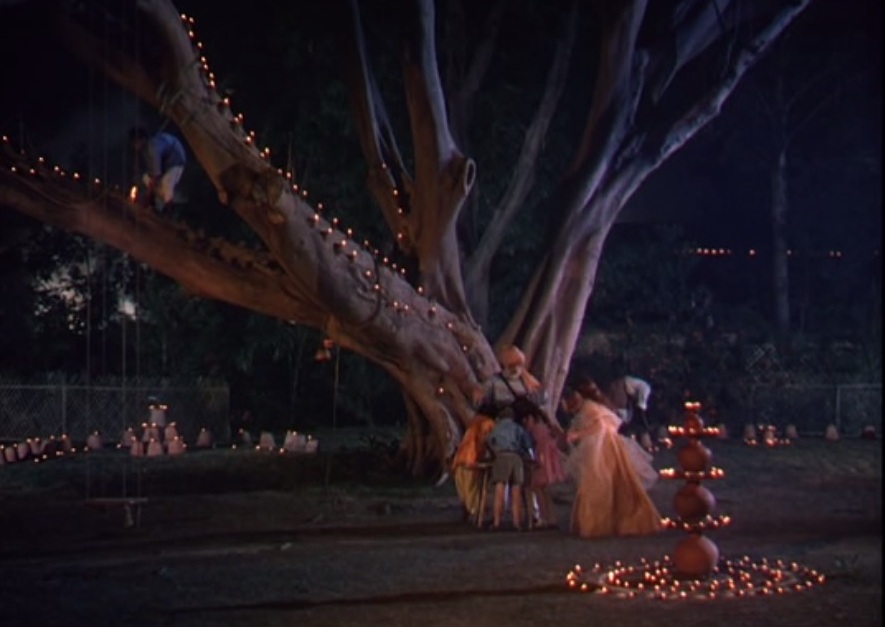
Diwali, from The River
It is in this book that Rumer meets James Haynes Dixon, who was a civil servant, albeit more successful than that title would suggest. After a long courtship, and having been given an ultimatum by James, Rumer married him on November 26, 1949. Rumer did not want to be married, but she could not imagine being without James. They had a long successful marriage, full, of course, of the vicissitudes which fill every marriage, which lasted until James's death. On October 10, 1973, the day of his death, Rumer wrote in her diary, “James died in Hastings Hospital. I do not want to be consoled—ever.”
This also is the book in which Rumer converts to Catholicism. She does not talk about this much, but throughout the book, you find little indications of interest. They visit a monastery, they meet a priest, they meet some nuns, and finally they come in. There is a bit about her reasons in A House with Four Rooms, but we get a much better look at her spiritual journey in the last two novels I want to write about.
The first of these is the one with which I began this essay, In This House of Brede. It's been a year or so since I read it, so I'm a bit foggy on the details, but this is the story of Dame Philippa Talbot, a successful career woman who enters a cloistered monastery. There are different story lines that take place throughout the book which are resolved, and we learn to know the sisters there, but I don't think that it goes into great spiritual depth. During the writing of this book, Ms. Godden visited the monastery frequently over a period of five years. She interviewed the nuns who were sequestered behind bars. She had a floor plan of the monastery so she became intimately acquainted with all the nuns comings and goings and the daily rhythm of their lives. When the book was finished, she sat with a panel of three of the nuns who went over every detail of the story until all their objections were taken into consideration.
Ms. Godden wrote:
People who have read In This House of Brede have told me they could not put it down. I could not put it down either, not for those five years. “Promise me” said James, “you will never write another book about nuns. Write one about a brothel.”
Ten years later I wrote a book about both.
The book that Ms. Godden wrote is Five for Sorrow, Ten for Joy. I first read it about 30 years ago before I had developed my current taste for finding grace in the midst of the darkness. I was looking for a nice Christian story, and found a story about the madame of a house of prostitution. I just didn't get it. Reading it again last week, I was amazed. As I read about the transformation of Elizabeth Fanshawe, military chaufeur to Lise Ambard, Mère Maquerelle of the whorehouse to La Balafr>é>e, notorious murderess, and finally to Soeur Marie Lise de Rosaire it was evident that Ms. Godden's conversion was very deep indeed, and that she had a profound understanding of the power of the grace of God and the intimacies of the spiritual life.
Soeur Marie Lise is a member of the Dominican Sisters of Béthanie, an order founded by Fr. Jean Joseph Lataste in 1864 to serve women in prison. The communities are (or were, I'm not sure there are any left) made up of both sisters who enter in the regular way, and sisters whose former lives were seriously sinful. No one but the superiors of the order know which is which.
Aside from the stories of spiritual transformation in the novel, there is a wonderful sense of the flow of the Church year with all of her feasts and fasting. The reader also enters into the rhythm of the work and life of the monastery from day to day, and from season to season. Of all the books that I have read for this authors series, and there have been 50 or more, this may be my favorite.
I will end this post, and my contribution to the 52 Authors series with the final paragraphs of House with Four Rooms.
Like everyone else I am a house with four rooms. As a child the physical room was barred to me, I had to fight my way to get into it. The room of the mind has always been mine. In the emotional, I have been enormously lucky; with the spiritual, it was a long time before I would do more than peer in; now it is where I like best to be alone.
All of us tend to inhabit one room more than another but I have tried to go most days into them all—each has its riches.
My house is, of course, slightly worn now but I still hope to go on living quietly in all of it, finding treasures, old and new until the time comes when I shall have, finally, to shut its door.
—Janet Cupo has been commenting on this blog for about as long as it's existed, and has her own excellent blog at The Three Prayers.
 Light On Dark Water
Leave a comment