Well, I finally saw Manchester By the Sea. It was as good as everyone has said, and it deserved the honors it got. But I don't want to see it again: so much pain, and for me the artistry, as good as it is, is not enough to make me want to experience it again.
Addendum, on re-reading this after posting it: why do I not feel that way about Bergman's equally pain-filled films? Why do I actually own copies of most of his best ones? I don't have a very good answer for that, beyond the fact that Bergman's work just moves me more, and more deeply, and that this is in part at the fundamental level of imagery, character, and dialog. And I'd also say that in many instances Bergman often seems to show more spiritual depth.
*
I wish the Personal Ordinariate of the Chair of St. Peter, commonly referred to as the Anglican Ordinariate, had a more concise and descriptive name. Or, failing that, a more vivid one, one with a bit of poetry in it. If you don't already know what it is, the name won't tell you. And that's a fairly big reservation to have about a name, although a pretty small reservation to have about the thing itself. We are not supposed to call it "the Anglican Ordinariate", because that apparently leads to the impression that we aren't Catholic.
If you don't know what it is, it's the structure so generously established by Pope Benedict XVI in 2009 to allow people in the various Anglican churches to come over to Rome and bring with them whatever Anglican traditions and practices were compatible with Catholic faith, which is quite a lot. Click here to learn more. Actually I should be using the plural, as the St. Peter ordinariate is one of three: one in this country, one in the U.K., one in Australia. Each is a sort of non-geographic diocese.
I also wish it had come about earlier. In 1980 John Paul II implemented a somewhat similar but more limited arrangement, the Pastoral Provision. I can't recall the details now, but its applicability and availability were limited in ways that the Ordinariate is not, and some (including me) have speculated that if the Ordinariate had been instituted in 1980 it might have attracted more Anglicans than it is doing. By 2009 most Anglicans (including me) who were open to Catholicism had already converted on their own. And those who have stayed, either in the Episcopal Church (or the Church of England, etc., as applicable), or in various "continuing Anglican" bodies, have made their peace with the situation.
It looked for a couple of years there as if the Ordinariates were going to languish and fade. And they may still. Certainly they aren't doing as well–i.e., attracting as many people–as was initially hoped. But recently things have been looking up a bit.
One significant development concerned Our Lady of the Atonement parish in San Antonio. It was the first parish established under the Pastoral Provision, and it has been very successful. It's a large and thriving parish with a well-regarded school. Some months ago a crisis arose there. The Pastoral Provision parishes are ordinary diocesan parishes, their main distinction being their liturgy. Atonement wanted to join the Ordinariate. The local bishop tried to stop them, removing their pastor and directing him
to dedicate some time to reflect on some specific concerns that I have shared with him. These specific concerns relate to expressions in the life of the parish that indicate an identity separate from, rather than simply unique, among the parishes of the archdiocese.
Apparently this meant, being interpreted, "I have no intention of allowing this parish to leave my diocese." The parishioners were up in arms. A crisis ensued. Appeal was made to Rome, and the decision did not go the bishop's way: not only was Atonement allowed to join the Ordinariate, but "the Vatican"–I'm not sure whether it was the pope or some bureau–decreed that all the Pastoral Provision parishes would become part of the Ordinariate. As, obviously it seems to me, they should. There aren't many of them, but I think several have been quite successful, so their inclusion strengthens the Ordinariate.
My own tiny local group, The Society of St. Gregory the Great, seemed for a while at death's door. Our founding priest had literally been there, having suffered a heart attack that would have killed him if he hadn't been near a hospital. Due to problems related to that initial attack, he has not been able to return to active ministry and now, though only in his mid-30s, is considered legally disabled. We have been in existence since 2012, had a few people come in early on, and then lost some of them. We could not, obviously, continue without a priest. But a local priest who was a former Anglican volunteered to celebrate Mass every other week for us. Then a few months ago an Ordinariate priest, retired from the Episcopal Church, moved to the area. And now we have Mass every Sunday again. And at Easter (well, actually the week after Easter, due to some logistical problems) we received two converts. And several new people have begun attending regularly, either Latin Rite Catholics who just like our liturgy, or potential converts.
So. As far as I'm concerned, the Ordinariate in this country at large, and locally, is Not Dead Yet. The mustard seed has sprouted, and may yet grow in to a tree, and the birds of the air come and lodge in the branches thereof.
*
Assuming that Pope Francis himself decreed that the Pastoral Provision parishes would become part of the Ordinariate, I'm grateful to him. But I thought he was somewhat unfair to some young people in remarks he made last week: "I think of the many young people in the Church today who have fallen into the temptation of rigidity."
I know such young people exist. But "many"? I would have said "a few." A miniscule number, surely, in comparison to those who are so far from being rigid that they have hardly any conception of what it means to be a Catholic. He is probably thinking of those inclined to be traditionalist in liturgy etc. But I know several young people (under 40 at least, some under 30) who want a rich liturgy, and who take the teachings of the Church seriously. I would not call any of them "rigid," self-righteous, or anything of that sort. My Ordinariate group would not exist without them.
*
Over the past year or so I undertook a couple of more or less organized classical music listening projects, getting acquainted with related works I either had never heard or had heard only piecemeal. One of these was Bruckner's symphonies. I had heard some of the earlier ones a couple of times and never been all that taken with them. This time I started with the 1st (I skipped the 0th) and listened to each one three times before going on to the next. Those three times typically weren't all that close together, just because life doesn't make such things convenient, and I took a long break after the 5th because I was getting a bit tired of Bruckner.
I wish I had made some notes as I went, because now I can't remember which symphonies, and which movements, I liked best. In general it tended to be whichever I had most recently heard. So if you'd asked me a couple of weeks ago I might have said the 9th, despite the fact that it's unfinished. Rob G's account of attending a performance of the 8th caused me to listen to it again last week, and I think maybe it takes the prize. Definitely I like it better than the 9th, and although if I work my way back down the list I know I'll find individual movements that I like as well, this may be my favorite as a whole. The Adagio seems almost literally heavenly.
It's hard not to compare Bruckner to Mahler, both of them composers of monumental late-Romantic symphonies, but as of now I have to say I like Mahler a little more. That's not necessarily healthy. Bruckner, a solidly faithful Catholic, is fundamentally serene, however effectively he may blow your socks off in his grandest moments. The jacket illustrations of Bruckner recordings tend toward mountains and other majestic scenes, and there's a good reason for that. But as I said after I'd heard Bruckner's first three or so, to a friend who also loves Mahler but doesn't (yet) know Bruckner, there's more pain in Mahler, more anguished yearning, and I guess I like that.
*
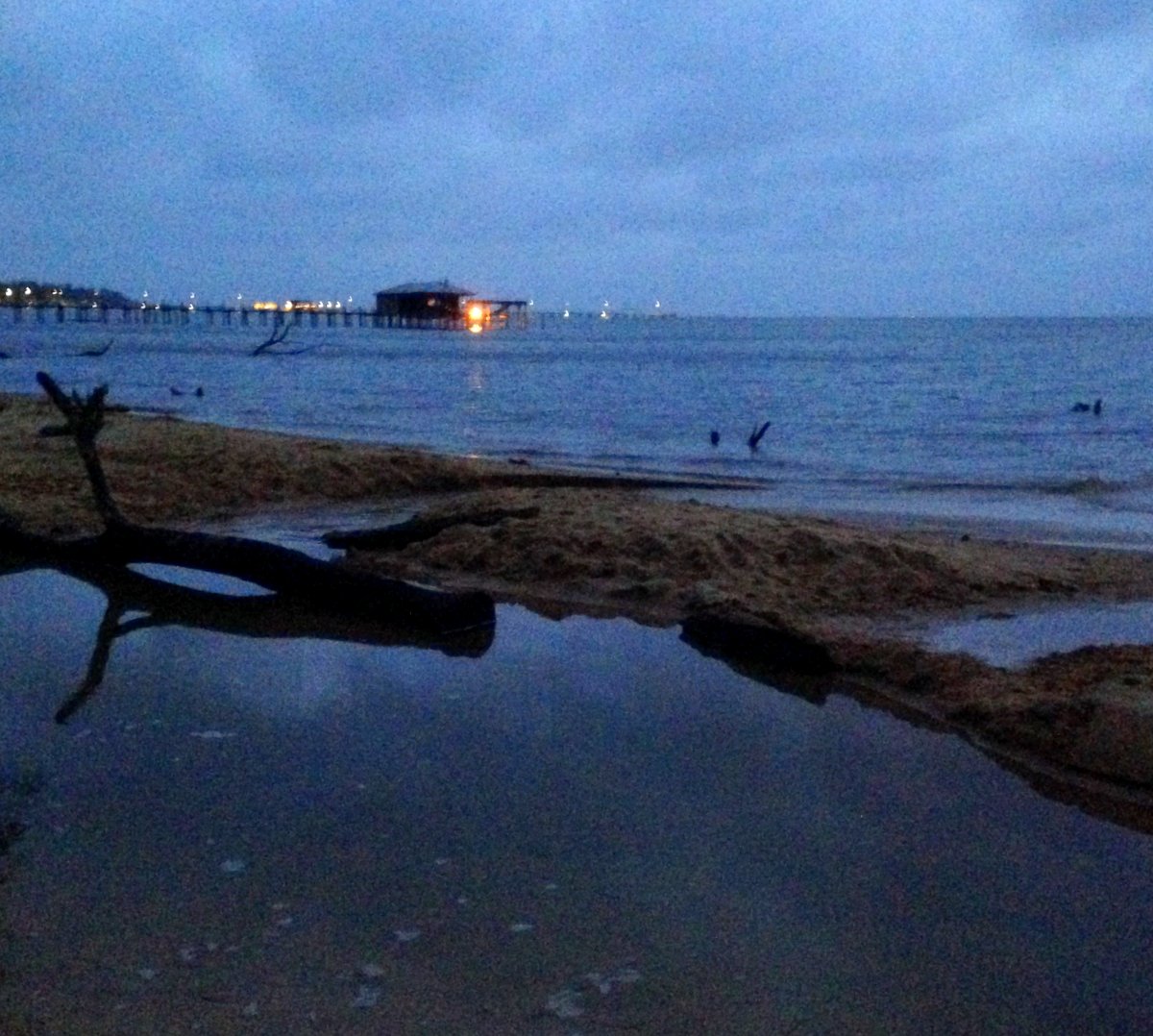
 Light On Dark Water
Leave a comment