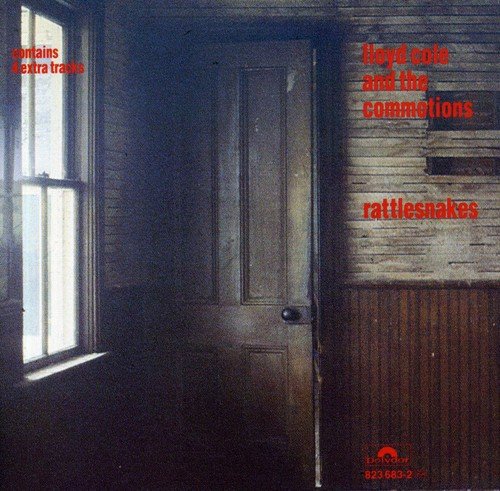
By the time this record came out in 1984 synth-driven pop had begun to dominate the music scene, and while there was a fair amount of guitar-oriented stuff circling under the mainstream radar, generally speaking you didn’t get to hear much of it unless you actively looked for it. I can’t remember exactly what prompted me to check this album out – I’m sure I had read a review somewhere – but I’m glad I did, because it became a favorite of mine, and Lloyd Cole grew to be a very dependable go-to artist for me.
Although I was a little put off at first by the album’s comparative polish (at that time rough edges tended to be generally viewed as a plus) I liked it all, finding it enjoyable both musically and lyrically. I was 23 when I bought the record (the same age as Cole was when he made it, actually) and I wasn’t quite sure how much of Cole’s lyrical shtick was tongue-in-cheek and how much was really autobiographical. That kind of thing matters far less to me now, but as it turns out Cole has said that it was both.
He can be a bit pretentious, but it’s mostly a fun sort of pretention. In the Wikipedia piece on the album he says, “I was a young man! I really was. You can just imagine me trying to wear a French trench coat at the time, thinking I looked very cool when, in fact, I looked really stupid. But maybe that's why people liked it."
Although Cole is English, the band was formed in Glasgow while he was at university there, so sometimes you’ll hear that the band was “Scottish,” which isn’t entirely untrue. When the album was released in the UK the opening track, “Perfect Skin,” became the album’s biggest single but both the title song and “Forest Fire” also got considerable airplay, and the album actually made it into the Top 20, peaking at no. 13.
The title track is quite representative of the album as a whole, while “Forest Fire” is one of my all-time favorite songs. I’ve also included “Four Flights Up,” a fun number that contains some good samples of Cole’s memorable lyricism, including the memorable line, “Must you tell me all your secrets when it’s hard enough to love you knowing nothing?”
Also worthy of mention are the soft and haunting “Down on Mission Street” and the album’s wistful closer, “Are You Ready to Be Heartbroken?”
Cole and his band did two more records, Easy Pieces and Mainstream, and while both are enjoyable and have their great moments, neither is as good overall as Rattlesnakes. The band then broke up and Cole moved to New York City, where he continued as a solo performer, producing four more albums, the best of which is 1991’s Don’t Get Weird on Me, Babe, arguably his best record after Rattlesnakes. In all he did seven albums between 1984 and 1995, all of them worth hearing except for 1993’s Bad Vibes, an ill-advised foray into a darker, harder-edged sound. I haven’t been much taken with his more recent acoustic material, but those records from his earlier period have been constant companions of mine over the years. Rattlesnakes has remained my favorite of those, and one of my favorite records period.
—Rob Grano has a degree in religious studies which he's put to good use working on the insurance side of the healthcare industry for the past 20 years. He's published a number of book and music reviews, mostly in the small press, and sometimes has even gotten paid for it. He lives outside of Pittsburgh, Pa.
 Light On Dark Water
Leave a comment