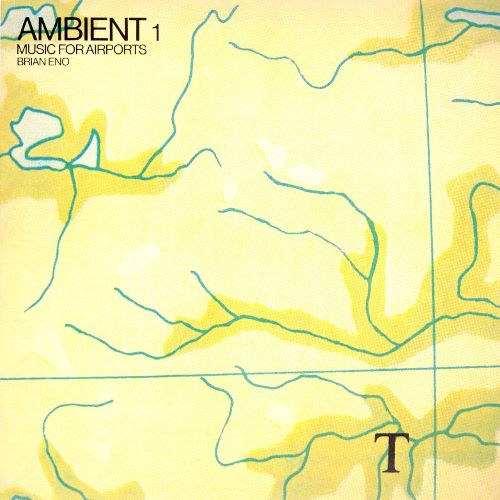
I'd been thinking since this series began that I would include at least one ambient album, just in the interests of making the scope very broad. I had in mind a few favorites as possibilities, and I finally started thinking about my choice a few weeks ago when Rob G gave us a techno album. (The association is that both techno and ambient tend to be all or mostly electronic.)
But in listening to those favorites I found at least one or two tracks that I didn't much like, that spoiled or disrupted the atmosphere. And since ambient music is at least 80% atmosphere, that's a pretty big flaw. There was, for instance, Steve Roach and Roger King's Dust to Dust, which conjures a western desert feeling, more accurately described as a western desert movie feeling. I like it, but it has a couple of rhythmic tracks that to me don't really fit. Here's a sample track, "Rain and Creosote," which also has a nice video. And Ishq's Orchid, which I have described as an auditory tropical vacation, and have sometimes called my favorite ambient album; it, too, has its infelicities. A sample: "Bhakti." (Both these use "environmental" sounds–real-world, non-musical sounds, like rain and birdsongs, also a common feature of ambient music). Some others I thought were just very unlikely to appeal to anyone who reads this blog–too weird and dark (there is a whole sub-genre called "dark ambient," to which I'm somewhat partial)
So in the end I decided that, as the song says, the original is still the greatest. Music for Airports, as people generally refer to it, was released in 1978, and has the distinction of being the first ambient album to be described explicitly as such. You can read Eno's account of what he was trying to do with the "ambient" concept in the liner notes for the album. I hadn't heard it for some time, and when I got out the CD and listened to it I thought it was if anything better than I remembered.
I think most of the sounds on it are "real," i.e. not produced electronically. Certainly the piano is, and I think the voices are, too. But the album is constructed with looped segments–tape loops, I assume, this being 1978. Also, this being 1978, the concept of "sides" was important. There are four tracks, two to each side of the LP. They're not named, but numbered by side and track.
I'm pressed for time, so that's enough talk. If you want more discussion, the album's Wikipedia page has some. Here's 1/1. Or should that be "1/1"?
–Mac is the proprietor of this blog.
 Light On Dark Water
Leave a comment