I've been having some unusually vivid dreams lately, and some of those have stayed with me longer than dreams usually do, and were more coherent than dreams usually are. One from a week or so ago can justifiably be called Kafkaesque: I was about to be executed for no reason that I knew of. I was in the custody of several people who were charged with carrying out the sentence. I didn't know any of them. There seemed to be some confusion about the place and manner of death, and I was led from one place to another, with my hands tied. Shortly before I woke up I was tied to some sort of pillar, and it seemed as if they were about to kill me in some unspecified way, but they untied me and led me off to some other place.
I was, naturally, not very pleased about all this, but I was not very upset, either, but rather sort of unhappily resigned, and I wasn't making much of an effort to get away. And although I didn't know what crime I was being punished for, I felt in a mild and vague sort of way that I had it coming.
Still, it was a relief to wake up.
*
Maybe the reason I had been sentenced to death was that I'm such a cold, callous, cynical person that I laughed out loud when I read that Britain has appointed a Minister for Loneliness who is to oversee the development of "a cross-government strategy on loneliness in England" (NPR story here; there are many others). I was about to explain why I laughed, but on second thought I think I'll resort to the Louis Armstrong rule: if you have to ask, you'll never know. Suffice to say that this is another entry in the list of instances proving that satire is futile today.
But I'm not as bad as I sound. I don't make light of the situation of elderly people who are all alone, which seems to be the main focus of the ministry. I'm sure it is a very real problem, and in another ten or fifteen years I might be one of these people myself. It's just the idea that it's a problem that government can and should address that strikes me as weird–and funny.
It makes me think of the "Julia" character who appeared in one of Obama's campaign ads, and the life envisioned for her. I think it's a useful Rorschach test. I can't find the original ad online, though I haven't looked very hard; surely it's out there somewhere. But, in brief, it presented the life of a fictional "Julia," her hand held and her material needs fulfilled at every step by a government program. I thought at the time that whether one reacts with pleasure or disdain to this vision is an indicator of whether or not one actually believes in the ideals of the American republic ("no" and "yes", respectively).
*
Julia is mentioned in this very interesting interview with Patrick Deneen about his new book, Why Liberalism Failed. I'm trying to cut back on the amount of time I spend reading and thinking about the social and political situation in this country, but I'll probably read this book. Liberalism, using the word broadly as denoting the views that are embodied in modern Western societies, and especially in the United States, is clearly in crisis, if not yet "failed," having run up hard against, among others, the problem of treating individual liberty as its only absolute, with every aspect of life considered to be a field for the exercise of that liberty. That the insistence on personal autonomy is most absolute and intense where sex is concerned, going even as far as to nullify the relationship between a woman and her unborn child, is surely going to fascinate future historians (if the world lasts long enough).
It's an old story to those of us who have been talking about this for decades, but the noncommittal stance, the attempted neutrality, of classical liberalism toward objective truth and, more importantly, objective right and wrong, always had a fatal weakness: it assumed and relied on fundamental agreement about fundamental things. Neither Jefferson nor Mill would ever have imagined that there would be a serious disagreement about whether marriage had anything to do with sex, or whether sex had anything to do with procreation, or whether one can change one's sex by declaring that it has changed. As shared cultural assumptions dissolve, the powers and duties of the state increase. The state, theoretically detached from fundamental questions and once expected only to protect individual freedom, is now required to decide between views which are so fundamentally opposed that they cannot permanently coexist.
The "social issues" are not silly side-shows; they have become matters of political life and death, questions which the government is expected to answer, and then to enforce its answer, with vast consequences. And that situation is the logical consequence of a paradigm that envisions the political order as comprising fundamentally only individuals, on the one hand, and the state on the other, with no standard beyond the rights of individuals considered to be decisive. In that situation it's not surprising that Julia, wanting and needing reliable support, should, in effect, marry the state. Here's Deneen:
The political philosopher Bertrand de Jouvenel once wrote that “state of nature” scenarios were obviously the imaginings of “childless men who had forgotten their own childhood.” He meant that the imaginary version of our true “nature” as radically individuated selves is in fact no-where to be found as our “natural” condition. We are first and foremost by nature relational creatures. And yet, we see a different reality now coming into being, not as the result of our “natural” condition, but through the efforts of a massive architecture that has been erected to make possible human lives increasingly lived in disconnection from permanent relations and absent constitutive cultural forms of membership and belonging.
The state becomes the main creator and supporter of this condition. A range of policies – economic, social and political – have as their aim the realization of this creature once only imagined in the state of nature, but now increasingly the default human of modern political and social world. The best representation of this phenomenon is probably found in the Obama campaign ad, “The Life of Julia,” which portrays the lifespan of a woman, from childhood to old age, whose complete independence was the result of a slew of government programs. She has no apparent relationships with other human beings (she seems to have a child for a brief span, but that nameless little person is taken away on a yellow school bus and never reappears), and the point of the ad is that her complete freedom is the result of the total lack of reliance upon any other particular human being.
Your relationship with the state is your only absolutely binding one. All others are, as Deneen says, "permanently reversible and easily exited." Why, then, should Julia, already looking to the state as her guarantor of material security, not look also to it for emotional security, by means of such things as a Ministry for Loneliness?
*
On a more pleasant subject: for years I've seen references here and there to a band called The Revolutionary Army of the Infant Jesus, but had not heard any of their music till quite recently. This piece in the Church Times (which I just noticed is from 2015) makes their music sound as interesting as their name suggests. To me, at least. Here's the video that the Church Times piece refers to:
There are other tracks on YouTube, and three of their albums, with samples, at their Bandcamp site. And Wikipedia describes their music thusly:
The group's music is a blend of folk and sacred music, industrial and ambient sounds, and samples that has drawn comparisons to neofolk artists like Current 93 and Death in June, as well as artists including Dead Can Dance, Godspeed You! Black Emperor, Henryk Górecki, and Arvo Pärt.
That package has my name on it.
*
I've been meaning to mention for several weeks a movie I want to dis-recommend: The Honeymoon Killers. This is one of the many movies on our Netflix queue that I don't remember putting there. I must have seen it recommended somewhere, but I have no idea where. It finally got to the top of the queue a month or so ago, and arrived unexpectedly in the mail. We (my wife and I) watched it, but I think the only benefit we can claim from the experience is that now we know that we don't like it.
It's a cheap film from the late '60s which for some reason struck the fancy of critics, and is now considered something of a classic–the DVD is from the Criterion Collection. As the title suggests, it's about a married couple (at least I think they got married) who commit a series of murders set up by the husband's wooing of a vulnerable woman who has money. He marries the woman, they kill her and collect her money. In my naive opinion it's an ugly piece of work in every respect, and if it had any appeal to me it would be in the so-bad-it's-good line, and I can't help suspecting the critical embrace it's received has something to do with the embrace of nihilism. You can read Criterion's review of it here, but I don't find that this applies to me:
You’re not sure you really want to do it again, but who can resist the thrill of confronting one’s own moral ambivalence? Compulsively diverting, it’s a movie that taunts you for having a good time.
I'd say rather that it's a movie that leaves you feeling dirty not because you had a good time but for the much simpler reason that you've touched something dirty.
*
Not wanting to leave you with that, I'll mention another movie I saw recently which struck me as completely delightful: Cluny Brown. It's a trifle, but a very enjoyable one. It's a 1947 romantic comedy starring Charles Boyer and Jennifer Jones. The dialog is witty, the characters sweet but not sugary, the satire accurate and funny, the plot happily improbable. It's not on Netflix and I'm not sure it's commercially available at all, but you can watch the whole thing on YouTube. Here's a link to the first ten minutes (it's not embed-able); if you like this, you'll enjoy the whole thing. I admit that I was just a bit disappointed with the ending, because I had wanted them to deliver on a certain promise they had made.
*
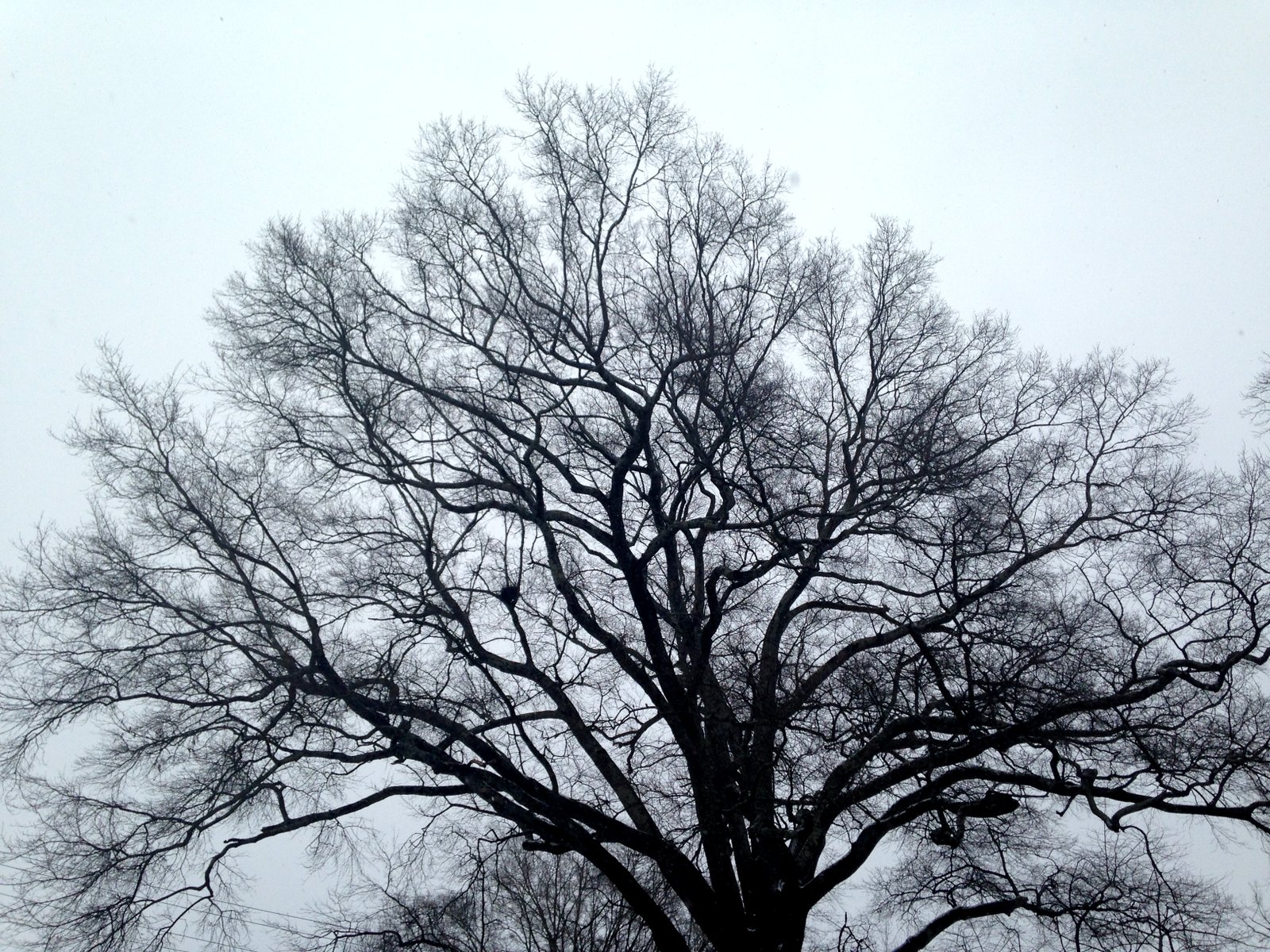
This picture was taken in north Alabama. You can find images like this down here on the coast if you look for them, but they aren't so plentiful, as so many of our trees keep many of their leaves through much of the extremely mild winter. It's an image I've always loved.
 Light On Dark Water
Leave a comment