In response to recommendations from Rob G and Janet, I recently read Julien Green's Each Man In His Darkness. Well, I guess it wasn't only in response to them. I've run across Green's name now and then over the years in discussions of modern Catholic novelists. It usually turns up toward the end, in an almost afterthought-ish sort of way: "Oh, and there's also Julien Green." I'd always think well I should check him out, too. And then I'd forget about him.
Well, it turns out he's really very good. As a brief much-too-neat but not-entirely-useless one-sentence description, I'd say he's a sort of combination of Greene and Waugh. More Greene, I guess. And not the humorous Waugh but the Waugh of Brideshead Revisited. What this book has in common with Brideshead is mainly the conflict between faith and desire, which of course is equally important in some of Greene's work. It's been a long time since I read The Heart of the Matter, and its plot doesn't bear much resemblance to that of Each Man, but shares with it, at least with what I recall, a grim sense of movement toward tragedy. And the protagonist is somewhat Greene-ian in that he is a Catholic haunted by a faith he'd rather ignore.
I couldn't figure out at first when or where the book is set. If this is stated in the narrative I missed it (which is certainly possible). Green was born in 1900 of American (and Southern) parents in Paris, and he wrote mostly in French. I assumed in the opening pages that the book was set in England (because the family names are Anglo), and in perhaps the 1920s or even earlier, as the protagonist, Wilfred Ingram, is met at a railway station by a horse and wagon. It soon became clear that that was not the case. The book was published in 1960, and I think its setting is meant to be contemporary and American. It may be New York–some large American city, at any rate.
Wilfred is in his mid-20s, single, and one of a few Catholics in an old and largely Protestant family. He works in a clothing store and spends his nights in what the novel describes, with a word which must have already been somewhat quaint in the 1950s, as "dissipation." That is, he goes out in search of women to have sex with, and he always finds one.
(In passing: perhaps I'm naive, but I'm a little doubtful that even an attractive and charming young man would, in the 1950s, have so reliably and so often found a willing woman, and never the same one twice, as Wilfrid does. Green was gay, and I suspect Wilfred's sex life resembles that of a good-looking young gay man in the metropolis more than that of a straight one.)
In the midst of this he attempts to squelch his Catholic conscience without abandoning the faith altogether. This struggle comes to a head when he finds himself in the grip of an obsessive passion for a married woman. The outcome of that struggle is strongly affected by his relationships with two homosexual characters, who can almost be said to represent the good and evil angels contending for his soul. That's an oversimplification, as the evil one is also Catholic, mostly fallen-away, and is bent on challenging Wilfred's faith to the maximum. And as things turn out…well, I don't want to give away too much. The other homosexual character is Wilfred's cousin Angus, who is in love with Wilfred, and who is, now that I think of it, the most Waugh-ian element in the novel: a well-off, jaded young gay man of no faith, but deep longing underneath a surface cynicism, and an essentially noble and generous character. There is also a decadent old uncle who puts one in mind of Lord Marchmain.
In short: a novel very much worth reading and placing alongside those of some of the other names I've mentioned. I'd like to read more Green. He wrote a lot, including nineteen (!) volumes of journals and a four-volume autobiography. Goodness…. Here is his Wikipedia entry.
WARNING: what seems to be the only edition in English of Each Man has an introduction by Giovanni Lucera which gives away the major events of the plot, including the climax. And this is a big deal because the plot is not predictable. So don't read the introduction first. Fortunately it's always my practice, when a novel includes an introduction or preface, to skip it and read it only after the novel itself.
*
Another recommendation from Rob G: he sent me the link to this piece in First Things by David Bentley Hart in which Hart recommends the English composer George Butterworth. In the past I would have filed this away mentally and maybe followed up on it sometime, or maybe not. But having access to a streaming service–Tidal in my case–which gives me access to some huge portion of all currently available recorded music allowed me to hear some of Butterworth's music right away. I looked for the orchestral pieces, because I have to admit, with some embarrassment, that the art song is not my favorite form of music.
Well, I found them, and they are exquisite. And I found them on this recording:
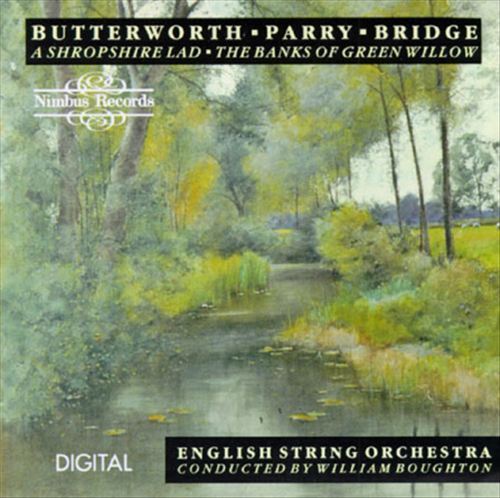
which, according to the review at Arkiv Music, is "very special." I'm always telling my friends who are connoisseurs of classical music that I'm not very sensitive to nuances of performance. But this one really grabbed me. It was the second one I listened to (I don't remember which was first), and it's the one I saved and listened to repeatedly.
And by the way I liked the work by Frank Bridge, a four-movement suite for strings, as much as the Butterworth. The one by Parry, a suite of dances in the baroque tradition, hasn't made much of an impression on me.
Here's one of the Butterworth pieces, not from the just-mentioned recording, but with pretty pictures.
And here's one of the songs, a link sent to me by another friend, who is probably going to roll her eyes when I tell her that although I love the song (and of course the Houman poem), I sort of wish the singer didn't do that crescendo in the middle. I guess maybe that was the composer's direction. Yes, I am complaining about the singing of one of the world's great baritones, Bryn Terfel. I'm sorry. I really am.
*
I've just acquired two more entries for my list of common phrases heard but not read, and rendered innocently according to the hearer's knowledge, or guess:
for all intents and purposes -> for all intensive purposes
of utmost importance -> of upmost importance
*
I've sometimes thought of starting a collection of Links On Which I Did Not Click. " Like this one: "Is Your Pre-Workout Under-dosed?" I have no idea what that means.
*
Less-Than-A-Hurricane Gordon did me a favor. If you read last week's post, you remember I had been trying to direct the creek that flows into the bay away from a course where it was causing erosion. The creek wanders around all the time, depending on wind and water. I had dug an outlet for it straight out into the bay, but the water level in the bay was fairly high and my ditch was filled in overnight.
 The storm dumped somewhere between 7 and 9 inches of rain in 18 hours or so. The resulting flood of runoff down the creek washed a path straight out into the bay, as I had wanted to do. That's the stream you see in the middle of this picture, taken a day or two after the storm, when the very high water had mostly receded, and from more or less the same place as the picture last week of another one of my attempts. Moreover, it shoved a great pile of sand up on the beach and more or less replaced what had been eroded by the creek. I am very pleased by this development.
 Light On Dark Water
Leave a comment