Lat week when I wanted to check certain details about The Summerhouse Trilogy but didn't have access to the book, I looked around on the web a bit for reviews or summaries which might help. I didn't find any, but I ended up looking through all the reader comments at Goodreads. Most were positive, and at least one reader says that she reads the book every year. But the negatives…well, they say much more about the reviewer than the reviewed.
Some seem not to have paid very close attention, as the full story is not "retold" in the three sections, but rather revealed gradually and cumulatively. Unless my memory is wrong, which it could be, or I missed something, the most startling bit is not revealed until the third section. But these folks didn't get it. Or maybe they're just that jaded:
I could have done without the third re-telling of the story.
I had hoped this final chapter would shed some light on things, but it really didn't. I wish I had given up after the first chapter spent time with a book I enjoyed.
And these two people, especially the second, seem to be the sort for whom anything not of the present day and culture is for precisely that reason dull and irrelevant:
Depressing first section in a supposedly funny British satire on trite callous middle class values.
Gah. This book did not age well at all. It was awful and prehistoric.
I don't see exactly how "callous" comes into it. I do have some sympathy for those who found the book dull, as much of it is subtle and without visible drama. Several readers complained about Margaret, the miserable girl of the first section–"a dishrag," one said. That's not unjustified, but it's an aspect of Margaret's problem. Still, these three apparently would have preferred a romance or thriller:
A perfectly adequate, well written, thoroughly dull book. Not even hashish, sex and suicide could save this book from the monotony of the characters.
I am still reading this book, which is a book club nomination. It is awful! The characters are extremely unlikeable (except for Aunt Lily, and that is only because she is intoxicated most of the time and wears garish clothes). Even the dog has no name. It is the most uninspiring, slow moving, non-interesting book I have read.
Blecchhhh! I can't believe I finished reading this book, or that anyone would think it was interesting enough to make a movie out of! I hated it to the very last page.
At least that last one did push through every hated page.
This one I rather liked, and would suggest to the reader that she keep thinking about the book:
The author is an English Catholic whose work I’ve seen compared to that of Flannery O'Connor. She does not provide a nice, tidy, Christian ending or even tidy Christian answers. If I had read this book in my youth, I think I might even have interpreted it as anti-Christian.
*
Detour is an excellent example of the noir genre, apparently considered one of the classics. It has a pretty simple plot, which makes it different from many of its type. A famous story has it that William Faulkner and another writer working on the script for The Big Sleep were puzzled by a plot point and asked Raymond Chandler for clarification–and he didn't know, either.
A young man and a young woman are working together as a night club act in New York. They plan to be married, but the young woman leaves for Hollywood, hoping to become a star, and the young man stays behind. (It isn't entirely clear to me why he didn't go with her, but never mind.) Later he decides to follow her after all, and begins hitchhiking across the country. He gets as far as Arizona when he gets a ride from a man in a big expensive car. Thus begins the detour.
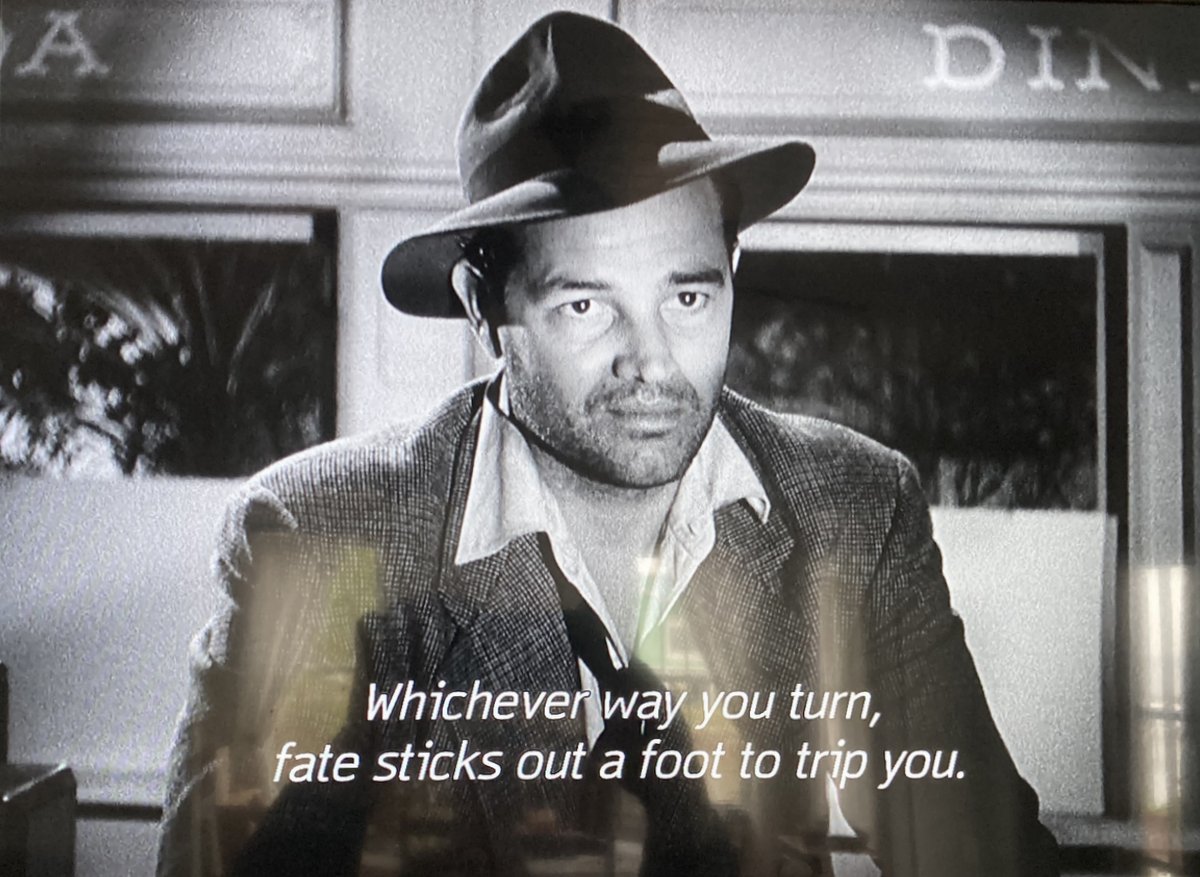
It's a low budget movie, starring people I hadn't heard of before (Tom Neal and Ann Savage), and it's not much more than an hour long, but it really works.
*
I'm often struck in these older films by little things indicative of the degree to which many things have changed since the films were made. Many big things are striking, too, of course, but I mean the almost trivial ones. When was the last time you heard someone say "Give me change for a dime"? Or one which I think I may have heard as a child or a teenager, but which has disappeared for very good reason: "That's white of you." I mean that it's disappeared as a compliment. You may still hear it today, but if you do it will be as an insult.
Before the young man leaves for California, he calls his girlfriend. Remember long-distance calls? His brief New York-Los Angeles call costs him five dollars. That's eighty-two dollars in today's money, according to this site, which says that the dollar has lost 94% of its value since 1945. That sounds like a catastrophe, doesn't it?
Another phrase you don't hear anymore: "sound as a dollar."
 Light On Dark Water
Leave a comment