Cluny Media is a publisher whose main line of business is the reprinting of Catholic classics, or classics which are in some way connected to and compatible with the Catholic tradition. And when I say reprinting I don't mean a sloppy scan of an old book run through a print-on-demand process. I mean very high-quality work. Here's how they describe their enterprise:
Our publishing philosophy is simple: A book, from cover to cover, should be an artifact, a work of art. Because our business is primarily to take the old and make it new, this philosophy demands a particular, careful process. Unlike the facsimile “republications” of other, similarly motivated publishers, Cluny editions are restorations. The restorative spirit especially animates the production and design elements of the publishing process.
Their "About Us" page goes into more detail about what they do, and why and how they do it. It's worth reading. And supporting.
Over the past four or five months I've bought several of their books, and can vouch for their quality: Caryl Houselander's Letters, Robert Hugh Benson's Lord of the World, and no less than five of Sigrid Undset's works that aren't gigantic novels set in medieval Norway.
This mini-binge began with my desire to re-read Lord of the World. I had read it ten years ago in one of those free Kindle editions which are not well formatted, which meant that it had two strikes against it before I even started reading: strike one was the fact that it was on the Kindle, as I don't like reading anything substantial on an electronic device anyway. I felt like I'd somehow missed something. The topic–the Antichrist and the Apocalypse–has been on my mind, and I wanted to read an actual on-paper edition this time. I shopped around and was led to the Cluny site, which led to the purchase of that book and then the others.
I can pretty confidently say that you'll be impressed with their list (click here), and pleased with the quality of the books. And I'm going to make one specific recommendation, of a title I was very surprised to see: Evelyn Waugh's Decline and Fall.
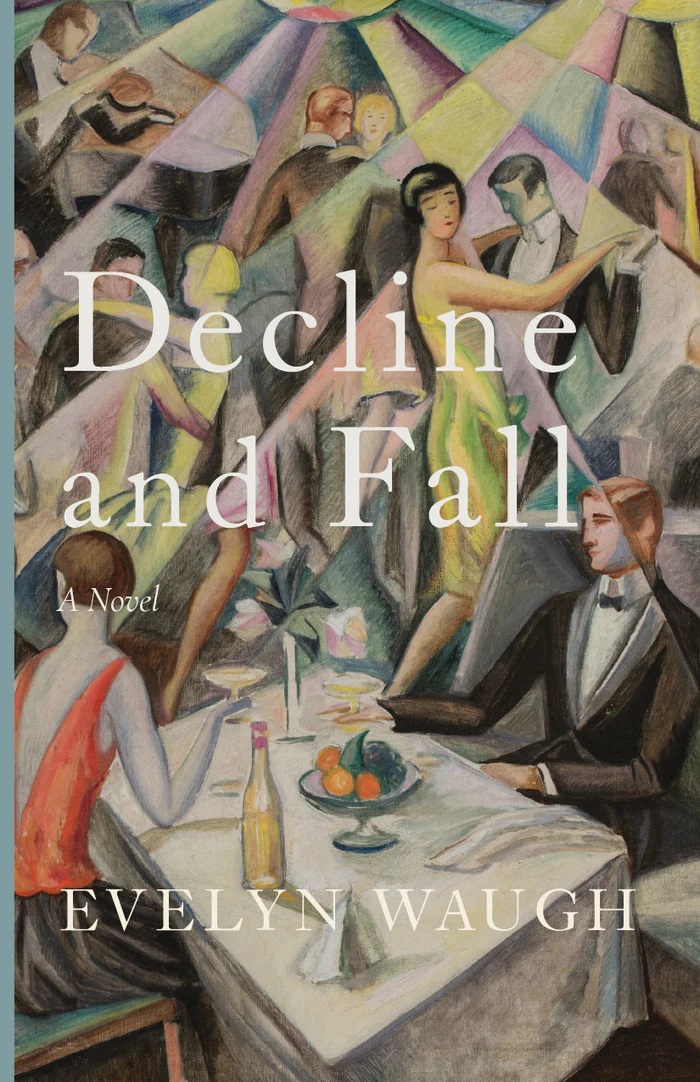
I was surprised because I would have assumed it's still under copyright, and that whoever owns the copyright would not readily allow anyone else to publish an edition. It was first published in 1928, so maybe the copyright has expired. In any case it's a very good and very funny novel, my favorite of his comic novels. And isn't that cover great?
I'll mention another title which I was a little surprised, and very pleased, to see: the three-volume A History of the Church by Philip Hughes. I'm not in the market for this set, because I own it, in a Sheed & Ward edition of the 1930s and '40s, and I have a strong attachment to it. Back around 1980, when I was seriously considering leaving the Episcopal Church for Rome, I wanted to read something substantial about the history of the Church. Somehow I decided on this one–I have absolutely no memory now of how that came about–and went to some trouble to get hold of it from an out-of-print books dealer. It did its job, and I proceeded.
It's very well-written, as you would expect of an educated Catholic priest of his time (1895-1967). Contemporary historians would probably consider that it goes way too easy on the Church–"triumphalist," they might say, or worse. There's something to that. But I thought it was very fair to the opponents of the Church, and unsparing of the Church's own failings, though it doesn't dwell on the shocking.
And it ends with Luther. The three volumes were originally to be titled The World In Which the Church Was Founded, The Church and the World It Created, and The Church and the Christian World's Revolt Against It. That basic plan was carried out, but I just noticed, in a footnote to the third volume, that it was intended only as "the first half of this third part." I don't know what the story of that is. But Hughes did later publish A Popular History of the Reformation, also available from Cluny. I have a copy but have never read it.
*
There's a new online poetry magazine: New Verse Review. It's published on Substack, which is very much the thing these days. I recognize several of the names associated with it, especially Sally Thomas, whose book of poems I praised here. I like the fact that the new publication not only favors metrical verse but narrative, and, I assume, longer lyric poems. Modern poetry tends to focus on a single epiphanic moment, and I'm in favor of stretching out a bit. Provided, obviously, that that doesn't mean making a not-very-interesting poem even less so by making it longer.
*
There's a new anthology of Rene Girard's writing: All Desire is A Desire For Being. That's a quote from Girard, and it knocked me out. It's something I've been trying to get at in a poem I've been working on (a longish poem, coincidentally), so I immediately wanted to read the book. I've only read one Girard work, I See Satan Fall Like Lightning, and I don't think that sentence occurs in it. The anthology was assembled and edited by Cynthia Haven, who knew Girard personally, knows his work, and has published a biography of him, Evolution of Desire. Here's an article in Church Life Journal, "We Do Not Come In Peace," which seems to be meant as a sort of introduction to the anthology.
 Light On Dark Water
Leave a comment