The full original title of the novel, as printed on the cover of the original 1836 edition, was
The Posthumous Papers of the Pickwick Club, Containing a Faithful Record of the Perambulations, Perils, Travels, Adventures and Sporting Transactions of the Corresponding Members.
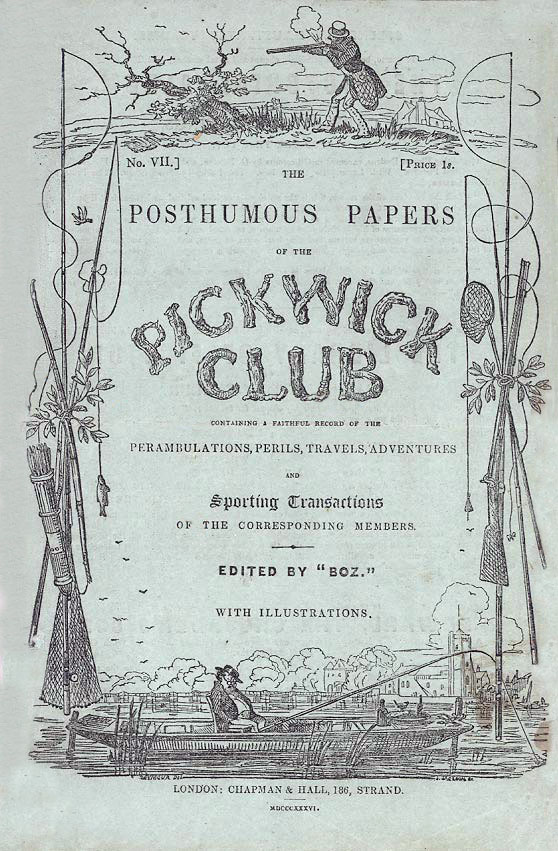
This was shortened to The Posthumous Papers of the Pickwick Club on the title page, and now of course the book is known by the even shorter phrase in the title of this post. The original one is a clue to the author’s overarching humorous intent, containing and satirizing the elements of an explorer’s or scientist’s voyage to distant lands. Here, for instance, is the full title of Darwin’s account of the voyage of the Beagle:
Narrative of the Surveying Voyages of His Majesty’s Ships Adventure and Beagle, describing their Examination of the Southern Shores of South America, and the Beagle’s Circumnavigation of the Globe, in three volumes
Dickens was only 24 when he wrote Pickwick, and his ability to portray convincingly a great variety of characters is an early instance of a gift which would only become more powerful and productive throughout his career, which was not as long as his admirers would have wished–he died at the age of 58 with The Mystery of Edwin Drood uncompleted, which has always discouraged me from reading it.
It would be easy to dismiss this as a light, even trivial, work. And anyone doing so would have some justification. Pickwick himself is an unmarried gentleman of some indeterminate (as far as I recall) age somewhere between late middle and early old. He is said to have been successful in some area of business or other, never specified, and now retired and needing no money beyond what he has–no longer bound to the wheel of regular employment, and free to pursue the higher ideals suggested by the full-length title of the novel. He is naive, earnest, and well-meaning, though often a bit pompous. The club which bears his name is composed mainly of younger men of high ideals and no particular accomplishment. The club, its members, and its titular head are the objects of gentle satire throughout, as may be inferred from the first paragraph:
The first ray of light which illumines the gloom, and converts into a dazzling brilliancy that obscurity in which the earlier history of the public career of the immortal Pickwick would appear to be involved, is derived from the perusal of the following entry in the Transactions of the Pickwick Club, which the editor of these papers feels the highest pleasure in laying before his readers, as a proof of the careful attention, indefatigable assiduity, and nice discrimination, with which his search among the multifarious documents confided to him has been conducted.
The plot, such as it is, follows Mr. Pickwick and several members of the club (“Tracy Tupman, Esq., M.P.C., Augustus Snodgrass, Esq., M.P.C., and Nathaniel Winkle, Esq., M.P.C”) through a series of adventures and misadventures, none of which exceed the bounds of what we might call domestic or social situations, except for the one which results in the imprisonment of Mr. Pickwick for breach of matrimonial promise. It’s almost all farce, what we might today call situation comedy. It’s easy to see Pickwick as a forerunner of Bertie Wooster, and Sam Weller, who becomes Pickwick’s improbably resourceful manservant, as the same of Jeeves, though without the latter’s sophistication.
I suspect, though I have not investigated the possibility, that I am not the only one who wonders if the character of Sam Weller may have had some influence on the creation of Tolkien’s Sam Gamgee. Both are of a lower social class than their masters, both play a role which the contemporary mind is likely to despise: a servant who is in some ways inferior to his master, not only in rank but in education and vision, yet who seems to have no resentment of his situation, and–worse from the contemporary point of view–to be utterly, fixedly, loyal to his master, as well as possessing practical skills in which the master is lacking. Such relationships have no place in the egalitarian world-view, but I have always found the paradigm quite moving. I say “the paradigm” because I’m very well aware that the reality is often very ugly. But there is a foundation of truth in the paradigm: we are all in that kind of relationship to God, at least in the inferiority if not the fidelity.
Certain concerns which seem to have almost–if “almost” is necessary–obsessed Dickens throughout his career are very much in evidence here, not in any sort of early or embryonic form to be developed later, but fully formed. He hates sharp lawyers and to a great extent the British legal establishment. He hates scheming and heartless businessmen and self-righteous hypocritical Christians, especially those of the “Non-conformist”–in British terms–evangelical stripe. I really don’t think hate is too strong a word. These people, or perhaps these types, are not depicted in nuanced ways. In detached critical mode, I might say that they are not very well-drawn characters, but caricatures, or even straw men, though very effective ones.
But detached critical mode is really not applicable to this thoroughly enjoyable story, or set of stories, told in prose of remarkable color and agility. I would paraphrase Johnson’s famous remark about London: he who does not enjoy Pickwick does not enjoy life.
I don’t think I need to summarize the travels and the semi-serious difficulties in which Mr. Pickwick and his followers find themselves. The contemporary reader will either delight in them or find them tiresome. I have a bit more sympathy for the latter than you might expect: a decade or so ago I made my first attempt to read The Pickwick Papers on a Kindle, in one of those too-numerous electronic editions of works which are not protected by copyright, and can be dumped onto Amazon as Kindle books with minimal effort. I couldn’t get interested in it at all, even finding it hard to follow. And I can’t explain why those difficulties were nonexistent when I read it in an actual paper volume.
That volume–two volumes, actually–was a 1911 edition which is extremely comfortable to read, but includes no notes whatsoever. I would have liked to have had those, as there are a great many references to people and places and things and customs which long ago ceased to be generally known, but which would have been among the ordinary features of everyday life for contemporary readers. When I met these I simply made a guess at their meaning, or ignored them completely. It was sometimes a little annoying, but I don’t think I missed anything essential.
I have one question which would probably not have been answered by notes: what is Sam Weller’s speech, and that of his father and a few others, meant to sound like? The attempt to render accent and dialect in prose is inherently risky if you can’t assume that the reader knows what they actually sound like. I used to be puzzled by writers rendering “I” as “Ah” when spoken by a Southerner. Some Southern accents (and some English and Scottish ones) do sound pretty close to that, but my own does not: rather, it begins with the standard sound, but more or less drops the second half of the diphthong rather than changing the first half. I have no real idea of what Sam’s accent would have sounded like in reality, and am puzzled by one feature in particular: the reversal of “w” and “v” in some words. “Very” is “wery,” for instance, and “well” is “vell.” Wery distracting to the contemporary American reader, at least this one.
The extent of the travels of Pickwick and his friends may not be obvious to those of us who don’t know the map of England wery vell (see what I mean?). I discovered an extremely useful resource for that aspect of the novel: a map of the journeys, which in addition to being informative provides both a comic and a serious view of the story: it occurs in a comically small circuit of southern England, if you’re comparing it to, say, the voyages of Captain Cook, or the Beagle, but a wide range if you’re comparing it to the rather narrow scope of the Pickwickians’ London habitat. It isn’t so much the geographical as the experiential distance traversed–two of the younger members get married, as does Sam–and Pickwick himself, if not so much changed as to be called sadder and wiser, is at least considerably more aware of the ways of the world than when he began his adventures. He remains, though, calmly incapable of cynicism.
 Light On Dark Water
Leave a comment