Sunday Night Journal — July 17, 2011
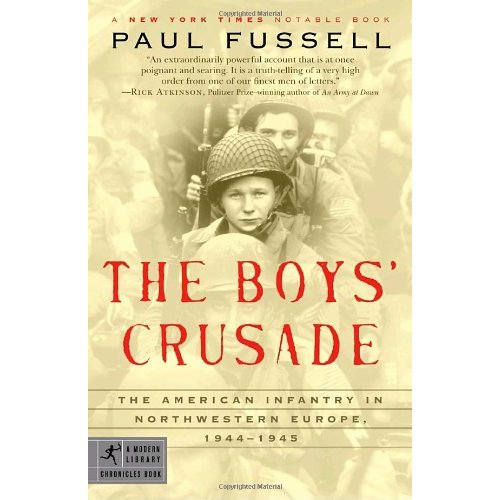
I know Paul Fussell’s The Great War and Modern Memory by reputation, but have never read it. When it was published in the 1970s, it was immediately considered an important book, and seems to have retained that status ever since, as I run across references to it from time to time. I’ve had it in the category of Important Books I’ll Read Someday for a long time. But it’s a lengthy work, and hasn’t made it to the top of my list. A couple of weeks ago I was in the library looking for something else and noticed this little book, which looked like it might serve as a good sample of Fussell’s writing on war. Be that as it may, it is certainly a worthwhile book in its own right.
Subtitled The American Army in Northwestern Europe, 1944-1945, it’s a broad overview of the Anglo-American campaign in Europe from D-Day to the end of the war. The two nouns in the title are carefully chosen, and the book’s thesis is a justification of that choice: a large number of the soldiers were in fact boys, and the campaign did, in the end, justify the designation of “crusade”—to which one must add “in spite of,” and much of the book is an enumeration of the many, many items that must follow those three words.
It is a record first of slaughter produced by mistakes, bad judgment, and sheer folly. At this point in the war experienced and well-trained troops were in short supply, and replacements (not “reinforcements,” the author notes) were sent into combat with little conception of what was facing them or how to face it, and often they died, sometimes horribly, before they had even engaged in anything that could reasonably be called combat, in the sense of a conscious and two-sided struggle. They were put into almost certain-death situations by the sometimes thoughtless and sometimes culpably stupid decisions of their commanding officers. Fussell is unsparing. He does not pretend that the campaign could have been waged without terrible loss of life, and he does not rant, but one senses a controlled anger in his account of incidents where troops were ordered to do things which were either impossible or pointless or both. It is one thing to give one’s life in a meaningful act of heroism, quite another to be herded blindly into a slaughterhouse, dispatched, and discarded. I thought over and over again while reading this book of Siegfried Sassoon’s line: The hell where youth and laughter go.
Fussell knows exactly what he is talking about. He “landed in France in 1944 as a twenty-year-old second lieutenant” (from his Wikipedia biography), and was wounded in action (similar to my father’s experience except that my father was not quite twenty when he entered the war near its end in 1945).
Like a lot of boys who grew up in the aftermath of the Second World War, I had a somewhat romantic view of it, reinforced by the sentimental and sanitized portrayal of it in movies and TV. In my teens and after, I read enough about it to begin to understand that the life of an infantryman was more often squalid and full of terror than noble or heroic. But still the idea of “the good war,” as Studs Terkel called it, persisted to some degree, as I think it does for many Americans. This is only one of a number of books—another is Eugene Sledge’s With the Old Breed—that strips away any hint of romance about the actual waging of the war. It isn’t only the experiences of the men on the ground that make the romance untenable, and it isn’t only the very visible wrongs of the deliberate bombing of cities by both sides. It’s the hell that caught up everyone involved, including civilians who were not targeted but just happened to be in the way. Did you know, for instance, that D-Day was preceded by massive bombing of areas in France far away from the intended landing site, solely for the purpose of deceiving the Germans?
How and why, then, does Fussell use the word “crusade,” and use it without irony, to describe this nightmare? I’ll let him explain:
As the war ignominiously petered out, the troops knew more about the enemy than they had known when, early on, they had sneered or giggled at the word crusade. They had seen and smelled the death camps, and now they were able to realize that all along they had been engaged in something more than a mere negative destruction of German military power. They had been fighting and suffering for something positive, the sacredness of life itself.
Hardly any boy infantryman started his career as a moralist, but after the camps, a moral attitude was rampant and there was no disagreement on the main point…. Major Richard Winters said after seeing the corpses at the camp at Landsberg: “Now I know why I am here.”
Officers and men agreed on this one thing.
Chesterton, describing the determination of Rome to destroy Carthage, asserts that beyond the ordinary commercial and imperial rivalries of the two powers there was a deep repugnance on the part of Rome toward the Carthaginian practice of child sacrifice. Whether or not this was true, Chesterton’s point is that there are abominations so intolerable, exceeding so far the bounds of ordinary human wickedness, that they simply must be resisted and destroyed. Nazi Germany was one such, Fussell seems to be saying. He does not suggest that the end justified the means, and that it rendered acceptable the wrongs and follies of the Allies. He says—if I understand him—only that the Nazis had to be stopped. That so much in the Allies’ conduct of the war was hardly consistent with the principle of “the sacredness of life itself” does not mean that the two sides were morally equivalent. It is one thing to fail to honor that principle in one’s actions; it is another to deny it altogether, and to act on that denial.
There was no desirable choice in this situation, only less and more undesirable. What remained of decency —that simple word that contains so much—in Euro-American civilization could either let Nazism have its way or go to war against it. This is the tragic view of history, the view that I for one would much prefer not to hold, but which seems to me the only one for which there is any evidence, so far as the things of this world are concerned.
 Light On Dark Water
Leave a reply to Francesca Cancel reply