Sunday Night Journal — October 30, 2011
I was about to say that a couple of months ago I mentioned that this album was available for streaming from NPR. Then I checked the post where I mentioned it and found that it was actually four months ago—late June. This sort of thing is happening to me more and more. The carousel of the year has been continually speeding up for some time, but lately it’s become almost disorienting. Just when I think I’ve begun to get used to it, and am no longer making seriously inaccurate guesses about how long ago something happened, it gets even faster, and I’m doing it again. Can it really be football season again already? More than halfway through football season, as a matter of fact. And how can I have wasted so much time?
Likewise, I was a little surprised to find that it’s been closer to three than to four years since I reviewed Gillian Welch’s Time the Revelator. But a melancholy reflection is an appropriate beginning for a discussion of her work. 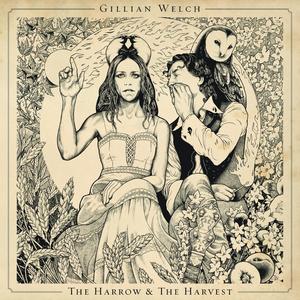
I liked Time a lot, though there were a couple of songs on it that I wasn’t very enthusiastic about—not that I disliked them, but I found them somewhat less interesting than the rest. On that score, The Harrow and the Harvest is better. In fact it comes pretty close to being perfect, in that every song is extremely fine and extremely well performed. To my taste, the only one that seems to lower the standard a bit is the lively banjo-based “Six White Horses.” But as it’s the only song on the album which could be described as anywhere near bright in mood, it provides a little needed contrast to the dark colors of the others.
Time the Revelator is ten years old now, and yet this new album sounds as if it might have been recorded the following year: similar songs performed in similar ways. I can imagine a critic complaining that there has been too little development, that the duo of Welch and her collaborator David Rawlings are not progressing, not discovering new things. That would be misleading on two counts. First, there is an album between the two, Soul Journey, which I have not heard, but which is said to be rather different in mood and style: more upbeat, and having more elaborate instrumentation, including drums. Second, and more importantly, though they may be doing the same sort of thing here, they’re doing it better. Yes, it’s a relatively small and subtle improvement, but it’s an improvement: not that every song here is better than every song on Time, but they’re even more consistently rich, and I think the new album is more unified. I’m used to musicians who do brilliant things early in their careers, and continue in the same vein but with less inspiration and conviction. Those few who continue to be brilliant usually change substantially, exhausting one style and moving on to something else: Tom Waits is the best example. It’s unusual to find a high level of achievement continued in a similar way at an equally high or higher level.
I supposed, on first exposure to Welch’s country-based voice and songs, that she had grown up in the south and that its musical culture had been part of her life, and was pretty surprised to learn that she was born in New York and grew up in Los Angeles, in the midst of the entertainment industry. Well, I thought, that just goes to show you how strong the music is, and how gifted she is, to have absorbed that whole way of expression. But I learned just now that there’s more to the story. Yes, according to the Wikipedia biography, she was born in New York City (on my birthday, which pleases me absurdly), and when she was three her parents moved to Los Angeles and became writers for The Carol Burnett Show. But she was adopted, and there is some reason to think that her biological mother may have been from North Carolina—which provides a starting place for an interesting train of thought about heredity.
This music is commonly referred to nowadays as Americana or American roots music: folk-based, but not directly imitative, comprised mostly of original songs with an obvious debt to either the country or blues traditions or both. In Welch’s case, it’s sometimes hard to tell what’s traditional and what’s original. Some songs that make extensive use of folk terms and phrases are obviously original, too sophisticated (lyrically or musically or both), to be folk songs. But I am really not sure about a few of them—the above-mentioned “Six White Horses,” or “Red Clay Halo” on Time, for instance. The latter doesn’t sound really sound like a folk song, but it could be an old Nashville tune from the ‘40s or ‘50s. In other words, the blending of traditional and original elements is pretty nearly seamless, which is high praise.
People would flat-out ask me, 'Don't you have any happy love songs?' Well, as a matter of fact, I don't. I've got songs about orphans and morphine addicts.
The album is also pretty dark, in a way that is certainly supported by the tradition but is also undoubtedly Welch’s own predilection. The speaker in Welch’s first-person lyrics is sometimes clearly someone else, but “Dark Turn of Mind” seems to be about herself:
I see the bones in the river
I feel the wind through the pine
And I hear the shadows a-callin’
To a girl with a dark turn of mind
But though almost everything here is dark, melancholy, and more resigned than hopeful, it isn’t hopeless. There’s a light out there somewhere. The girl with the dark turn of mind is happy at night. And in “Hard Times,” though the “Camptown man” who sang “Hard times ain’t gonna rule my mind” as he plowed his fields seems defeated at the end of the song, the story isn’t over:
But the Camptown man he doesn’t plow no more
I seen him walking down to the cigarette store
Guess he lost that knack and he forgot that song
Woke up one morning and the mule was gone
So come all you ragtime kings
And come on you dogs (dolls?) and sing
Pick up your dusty old horn and give it a blow
Playing “hard times ain’t gonna rule my mind”
It’s clear that Welch and Rawlings are pretty much equals in this collaboration: certainly in performance, and by their account, and by the crediting of the songs to both, in writing as well. So I don’t know why the duo is persistently known only by the name of one of them. Perhaps at this point it’s just for consistent branding. At any rate, Rawlings’s contribution has to be recognized. He is an extremely fine guitarist. He doesn’t sound anything like Richard Thompson, but like Thompson he applies a very far-ranging vocabulary and a lot of invention to fairly straightforward folk-based chord progressions, and the result has a lot to do with the fact that although most of the material here is similar not only in basic sound but in tempo and mood, I don’t get bored with it. And I really should: an album of consistently slow, somewhat lengthy songs, all very similar in musical texture, sounds on the face of it like something that I wouldn’t be able to sit through all at once. But within those limits there’s a lot of invention: beautiful melody lines, consistently rich and skillful lyrics, and of course Rawlings’s guitar.
As excellent as Rawlings’s playing is, I’ve always wished his tone were bigger and fuller. It’s very tight and trebly, really sort of flat, and I sometimes wish I were hearing the same notes played in a tone like, for instance, that heard on the old Ian and Sylvia albums. I have to admit, though, that the very bright tone fits well with Welch’s broad, soft strumming. She uses the sort of guitar I wish he did: a big Gibson. His, I just learned, is in fact a rather odd instrument, a 1935 Epiphone archtop, a smaller-than-average guitar and apparently not a particularly high-quality one in its day. Well, it’s certainly distinctive. It sounds almost like a resonator guitar.
I haven't said anything about Welch's singing, thinking somehow that it goes without saying that she is really, really good. But then I'm not assuming that everyone who reads this has heard her, so I should say it. She has a low, rich voice, not the sharp sort of sound one associates with country singers: more like a torch singer than, say, a Dolly Parton. And it suits the material perfectly. The fact that she has recorded with Emmylou Harris and Allison Kraus should tell you how she's regarded by her fellow artists.
Anyway: if you have heard and liked the earlier work of Welch and Rawlings, it is pretty certain that you’ll like this. A week or so ago they were on Austin City Limits, and the program can be viewed online at the PBS site. The first half features the very interesting band The Decemberists. In the Welch-Rawlings half, you can see Gillian buck-dance. And by the way, in case you were wondering, it’s “Gillian” as in “gill”, as in how fish breath, not “jill.” as in jack-and. I’m not sure which is standard. I thought I remembered Gillian Anderson’s name (The X-Files) being pronounced as “jillian.”
 Light On Dark Water
Leave a reply to Janet Cancel reply