Upstairs Downstairs 2 and Downton Abbey
This is sort of a follow-up to that post a few weeks about Upstairs Downstairs. I don't think I mentioned in that one that the reason we were watching the original series was that we had seen the new one which first aired last year. I'd noticed the ads for it and was curious; also I thought my wife might like it, though she had not seen the original back in the '70s. So we watched the three episodes, and that led to watching the original, and having done that we were curious again about the new version.
It's really pretty good, though as with most such follow-ups you have to get over the idea that it isn't as good as the original because it isn't exactly like itl. Perhaps it was because of that syndrome that I liked it better on second viewing. Jean Marsh as Rose Buck is the only character carried over from the old series: she returns to 165 Eaton Place as housekeeper for an entirely new family (nothing is heard of the Bellamys). It's set in 1936, and, as in the original, mixes contemporary events with domestic drama. "Contemporary events" of course must include the rise of fascism, and that ends up being a principal theme: a daughter of the wealthy family becomes infatuated with fascism and fascists (which naturally brings to mind the Mitford girls, Unity and Diana).
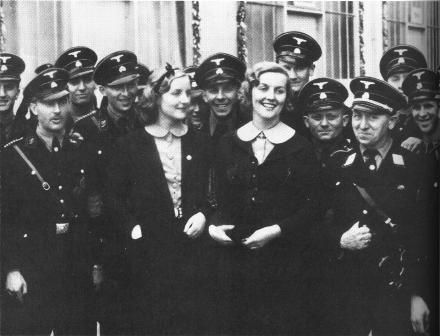
Unity and Diana Mitford at a Nazi party rally in Nuremberg, 1937 (source: Wikipedia)
The weakness of this three-part series is, for me, the second episode. It deals directly with Hitler's persecution of the Jews, and in my opinion the effort doesn't work very well: it involves a story which struck me as slightly implausible and generally heavy-handed. That's a somewhat harsh judgment, as I'm sure the writers were trying to approach this difficult subject with care. I think what caused me to react that way is that what is happening in Germany is made of direct consequence to the English household in a way that seems a little contrived and melodramatic. It's not necessary, as there are already two characters with fascist sympathies, and their development is sufficient to bring the great events of the time into the story. The first and third episodes are superior to the second. I've read that more are in production, and I'll certainly watch them.
And I have now joined the ranks of those watching the very similar Downton Abbey. Its first season, which showed last year, was apparently very popular, but I had somehow missed hearing of it. My wife hadn't, though, and had watched and enjoyed some of it over the net, so we started recording the new season when it began a couple of weeks ago.
Perhaps it's not fair to assert that the series is modeled on Upstairs Downstairs, but it's almost inconceivable that there was no influence, as it depicts the intertwined lives of a rich English family and their servants in the early 20th century. It's well-written, well-acted, well-produced–very well–but on the basis of three episodes I don't like it as well as either the old or the new UD. It's more like a soap opera, in that there is a more continual sequence of melodramatic twists and turns designed to make sure you come back for the next installment. And unlike Upstairs Downstairs it involves truly wicked things done by truly malicious people. In general its atmosphere is a little oppressive, almost menacing. People speak quietly, the lighting is muted, the lighting in the servant's quarters especially having that yellowish quality which seems favored by cintematographers when they want to induce anxiety. The old Upstairs Downstairs certainly included a realistic mixture of folly and sin and tragedy, but there was no real malevolence on the part of any character that I can remember, and there was a general sense of good spirits about it. I don't mean that there's something amiss when art deals with real evil, but there seems something slightly less healthy about Downton.
But I'll keep watching it. I want to know what happens.
War of the Planets
It's a widely held opinion that Plan 9 From Outer Space is the worst movie ever made. But last night I saw one that I think is more deserving of the honor: War of the Planets. I recorded it from the Turner Classic Movies channel a few weeks ago just because I find it hard to pass up an old sci-fi movie. Most of them are not very good but this one is truly awful.
I've seen Plan 9, and it is indeed truly dreadful. But it almost isn't a real movie at all, just a sort of mess. You feel like the people who made it weren't really trying and didn't really care how good or bad it was. But War of the Planets looks like a lot of work and a certain amount of money went into it, and it's truly awful. It would be entertaining to describe some of the funnier moments, but I really couldn't do them justice. As it goes on, you realize that someone thought that in the future astronauts would naturally update the language by preceding ordinary words with the word "space." As in "You're a space idiot."
There seems to be more than one movie called War of the Planets–this one was made in 1966, in Italy, though it's in English and was released by MGM. Here's the trailer:
As you can see, it's actually the war against green smoke. I don't recall the term "diaphanoids" used in the trailer appearing in the film itself, but maybe I missed it. And notice the way the guy pronounces "lasers"–"lazers." At other points, he says it correctly. I suppose there are probably a number of movies as bad as this one, but I do think it's the worst I've ever seen, in the sense I described above.
Chronicles of Marmite
My daughter and her children–two of them as of two weeks ago–were here this afternoon. I made myself a snack of toasted rye bread with butter and Marmite, and she wanted to try it. She took a bite and didn't think it was so bad. My wife had not yet tasted Marmite, although that had not stopped her from believing it to be quite nasty. I guess my daughter's example encouraged her; anyway, she, too, took a bite. There was a long pause while the taste registered on her, then she made a sort of choking cry and spat it out. I regret very much that I didn't think to have a camera ready to capture the moment.
Later my daughter tried it again, a whole piece of toast, and said it was "sort of weirdly good." That's a good description.
Liturgical Progress
Tonight for the first time at Mass I said "and with your spirit" instead "and also with you" without stumbling. Without stumbling audibly, at least–I thought "and also with you" but caught myself before I actually said it.
Sometimes it is, I suppose
The current issue of our diocesan newspaper has an article about "premartial sex."
 Light On Dark Water
Leave a reply to Mac Cancel reply