An Unexpected Vision
The past couple of weeks have been difficult at work, due to the departure of someone who not only was responsible for a lot of things that I don’t know much about but who will probably be impossible to replace. I should be working nights and weekends to try to compensate for her absence, but am stubbornly refusing to do so. Long hours are to some extent part of the package when you work in information technology, but I’ve reached a point in my life where I’m not willing to sacrifice for my employer what little time I have for other things.
I was very much looking forward to the weekend, and when I arrived at home I got an entirely unexpected vision of beauty. The picture below is of the street or road that I live on. “Street” for me implies pavement, and the pavement ends a little before my house. The street comes down a short but fairly steep hill, where the pavement ends, and takes a right turn before reaching my house. There are woods all around, and you can’t see beyond the turn. This is the view you get when you come around the turn.
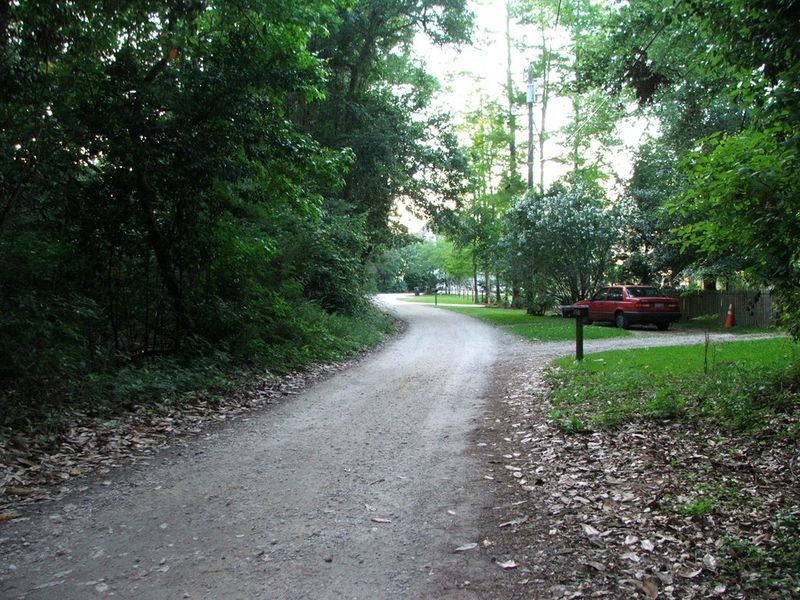
That’s my mailbox, driveway, and red 1992 Volvo (for which I paid $3000 five years ago, a pretty good investment as it has served me reasonably well). The orange traffic cone presumably belongs to the city; I don’t know how it got there. At the end of the road there’s a path through some trees, and then Mobile Bay. Apart from the presence of my car, this is the way things looked when I came around that turn at about 6:30pm on Friday. The picture was taken a few minutes later, and I’m including it so that you can better imagine what I saw: four children running down the road to the bay.
They were, I guess, ten or eleven years old, three girls and one boy. I’ve met the boy, who lives with his apparently single mother in one of the condominiums a couple of blocks away. I don’t recall having seen the girls before. The girls all had long hair and were wearing jeans or shorts and light blouses or t-shirts, the boy has thick curly hair and was wearing shorts and a t-shirt. When I saw them they were about even with where my car is parked. The last of the group, a girl with light brown hair, heard my car and stepped off into the grass, while the others kept going. Then she saw that I was slowing down and ran to catch up with the others. I could hear them calling and laughing to each other. I stopped, more or less where I took this picture a few minutes later, and watched them till they disappeared into the woods.
I realize as I write this that it’s going to be impossible for me to communicate to you how beautiful they were, and how they moved me: their freshness, their gladness, their seemingly effortless vitality, their grace and freedom. There is a point toward the end of childhood where the body and mind have attained a certain maturity but have not yet fallen into the fears and lusts and longings of adolescence, which seem to stay with us in some degree for the rest of our lives. I found myself wishing they could remain as they were forever. But that’s to wish that they never complete the journey. They made me very happy for a little while, and I said a prayer for them.
1 Samuel by Francesca Aran Murphy
I had planned to write a full review of this book today, but have changed my mind for two reasons. First, the weekend has been busier than I expected. Second, I mentioned to someone in email last week that I was planning to review it, and he asked what publication I was reviewing it for. So I started thinking, well, why not take a bit more time with it, and see if I can place it with Touchstone or some other publication, because I think the book merits the attention. I don’t know how many subscribers Touchstone has, but I’m sure it’s more than the number of people who read this blog. I’m therefore going to make this just a quick first draft of what will be a somewhat longer review.
I don’t know much about biblical scholarship, but this book strikes me as being exactly the way it ought to be done. I should admit that I actually have…let us say low expectations of it, because as a discipline it seems to have played a significant role over the past 150 years or so in undermining Christian faith. It is with a certain weariness and dread that I hear a homilist open his discussion of a scripture reading with “What Matthew (or Mark or Luke or John…) is trying to tell us here is…” What follows is likely to discard the literal meaning of the text in favor of some psycho-literary lesson, possibly of dubious value.
Dr. Murphy does not do this at all. In fact the book seems to engage in a sort of running argument with what I understand to be the conventional literary and historical approaches: the literary one which is all too literary, in that it treats the text as mere literature, the historical one which purports to sit in highly skeptical judgment of its factual truth. This book instead starts with the presumption that scripture means what it says, and that when it clearly treats events as having really happened it is not trafficking in myth and legend (or fiction). Most importantly, it presumes that scripture is intelligible, that the people who put it down were not fools or idiots—nor, on the other end of scholarly mistake, were they novelists, carefully crafting a narrative for literary and theological effect. It takes the biblical author’s historical situation and way of looking at the world as, yes, substantially different from our own, but, no, not so different as to be unintelligible. In short, it sets out to explain, not to explain away.
Broadly speaking, it is an extended and focused effort to bridge the gap between the biblical world and the contemporary believer. In the best tradition of modern theology, it makes ready use of modern discoveries in history and archaeology and languages, but it does not turn these tools against the text. And it doesn’t assume the necessity of what I have always, as a completely unschooled layman, regarded as the suspect practice of resolving disjunctures in the text by assuming them to be the work of multiple hands, in this case with differing agendas. Apparently it is widely held among scholars that the stories of Samuel and Saul, which seem at times to support and at times to condemn the Israelites’ desire for a king, must intermingle the writings of pro and anti-monarchic parties. But Dr. Murphy, in what strikes me as a genuinely literary and yet orthodox approach, tries to show (if I’ve understood her) that this ambivalence expresses something deeper, something about the possibilities inherent in the situation, something about the ultimately incomprehensible but metaphysically real freedom of both God and man.
An assumption of realism must direct our interpretation of the episode, if we want to read it within Christian tradition. The presupposition that the text is describing something that really happened is a tremendous gift to the historical biblical critic. It hinders the formulation of circular hypotheses about source documents and stimulates us to use our historical imagination to try to figure out what is really going on here.
To try to figure out what is really going on here. You would think that would be the primary mission of the scholar but it certainly doesn’t seem to be the case always.
This is not the sort of thing I ordinarily read, and with my chronic difficulty in concentrating I had to work at getting started in it. Once I’d gotten fifty or pages or so in, though, it became fascinating, though never easy; every page is dense with ideas and facts and references to other commentaries, from ancient times until the present. I’m somewhat in awe of the labor involved in the writing of it, not to mention the erudition manifested throughout. I really can’t imagine examining any text at such length and in such detail, and to follow it was a mind-stretching experience.
Challenging it is, but not dry. Those who have met Dr. Murphy online won’t be surprised to learn that flashes of wit appear throughout, sometimes most unexpectedly, as in the description of the Ark of the Covenant as a “bonsai temple.” Or the observation that “In the ancient world, they had to fall back on theater, since they did not have Home Box Office.” Nor will they be surprised by a number of references to The Wire and other contemporary dramas.
I haven’t said anything about the actual content of the book being studied, 1 Samuel. If you’re as biblically unlearned as I am, you may not immediately recognize that title as designating the story that begins with the birth of Samuel and ends with the death of Saul. I had never read it from start to finish. It is quite a story, and well worth the time spent reading this commentary on it, which naturally you’ll want to begin by reading 1 Samuel itself, unless you already know it well.
Quite a story indeed. My father, who was a churchgoer but ever inclined to questioning, used to say that the terrible behavior of Biblical figures like Saul and David was an argument for the truth of the Bible, or at least for the fact that the Hebrews believed it to be true: no one attempting to hoodwink or proselytize on behalf of a religion would have so openly exhibited the sins of so many of its major figures. 1 Samuel qualifies as a prime argument for that case.
 Light On Dark Water
Leave a reply to Louise Cancel reply