Report on Anglican Developments
I haven’t yet written about my experience with our local instance of the Anglican Ordinariate. I first mentioned it here on Easter Sunday (see this SNJ), shortly after it had come to my attention, and a great deal has happened since then. The first word I had, back in April, was that a seminarian, Matthew Venuti, who was an Episcopal priest and hoped to be ordained in June had founded a group called The Society of St. Gregory the Great, and would soon begin offering the Anglican service called Evensong or Evening Prayer, a descendent of the traditional liturgical rite of Vespers. That began shortly after Easter. It was held at St. Mary’s in Mobile, which is one of the two most beautiful churches in this area (the other being the cathedral), on Sunday afternoons before a regularly-scheduled 6:30 Mass.
An Anglican Use Mass was to begin in June when Matthew was ordained. Up until a week or so before the June 2 ordinations there was some doubt as to whether that would actually happen. I’m not sure what the problems were but I think they had something to do with the speed with which he had gone from being ordained in the Episcopal Church, to Catholic seminary, to ordination. In the end, though, he became Fr. Venuti, and following the ordination on Saturday June 2 he was the celebrant on Sunday at an Anglican Use Mass. And we now have a regular Sunday afternoon Evensong followed by Mass with the Anglican Use liturgy. There are also three Masses during the week.
We were doing Evening Prayer at a side chapel. The first Mass was in the main church. Now we are in a tiny chapel apart from the church proper, normally used for Adoration, and very plain, which is good. There are plans to erect an altar in the side chapel, positioned suitably for a liturgy in which the priest faces the altar. We fit in the tiny chapel because we are a tiny group, fewer than a dozen. Of these, not all are eligible for formal membership in the Ordinariate, which is restricted to former Anglicans (more on that in a moment). There are a couple of people who have never been Anglican who come because they love the liturgy.
So much for the facts; what of the experience?
Well, the Evensong services have been beautiful and deeply moving. My eyes filled with tears when I heard some of those prayers, and participated in them. For the first time in many years, I felt the full sentiment of formal communal prayer. I don’t mean to say that when I participated in such prayer in the usual Mass I was insincere. I intended what the words said but in an instrumental sort of way; as a rule, they did not, by their own beauty and richness, call up the emotion that ought to have accompanied them. Except when a prayer touched on some particular personal concern of the moment, they were a prayer of the mind but not the heart. There is a great difference between saying “Well, in the end, life really doesn’t amount to much,” and Macbeth’s terrible “Out, out, brief candle…” speech. That’s the difference between the functional English of the current liturgy and the poetry of the Book of Divine Worship, the Catholicized Book of Common Prayer used in the Ordinariate.
And we have had excellent music. Our little group is struggling with the Anglican chant settings of things like the Magnificat, but we’ll get there. For several Sundays we had an organist, which meant that even a dozen or so people could do pretty well with the hymns, also mostly out of the Anglican tradition. The organist has been out recently, but will return.
The Mass itself has been, for me at least, a more difficult adjustment than I expected. I think this is because, unlike Evensong, it is a variant of something I’ve experienced every Sunday (at minimum) for over 30 years. It’s enough like what I’m used to, and yet enough different, that I find myself getting confused. And the whole group, including our priest, is still learning the rite. At the first one, on June 3, I was still tired and feeling a bit dislocated after having been away for most of a week, and I felt like I was really not all there. But we have now had two Masses since then, and things are coming together.
There has been a whirlwind quality about all this, and I feel like I haven’t fully taken it in yet. It was utterly unexpected, and, coming as it does long after I had learned to live with the—what do I call it?–the normal English Mass, or the Novus Ordo in English, whatever the right term is—it feels, I’m sorry to say, a bit of an anti-climax. Where was this when I really needed it? I want to say. But I am grateful, and certainly will stay with it as long as I have a choice.
Moreover, it’s still in flux. We need more people if the thing is to continue, and naturally we want it to grow because we believe it is a great gift to the Church. And there is one very troubling thing about the whole project. I hadn’t realized, on reading about the Ordinariate when it was first established, that formal membership is open only to former Anglicans. I had envisioned it becoming a light to the nations who have to live with a Mass which is at best colorless, drawing anyone who would appreciate the beauty and dignity of its liturgy. This, I’m told, is exactly what happened at one major parish which came into the Church in the early 1980s under the Pastoral Provision of 1982, and a majority of its members are now Latin Rite Catholics who came in after the original Episcopal congregation became Catholic as a group. But the restrictions on entry into the Ordinariate have resulted in this parish having decided (again, so I’m told) not to become part of it.
This limitation would seem to box it in permanently as a niche for ex-Episcopalians, a niche which would always remain very small and perhaps dwindle away entirely in time. Nothing of course would prevent any Catholic from attending the liturgies, but no matter how many did so, the official head count of the Ordinariate would remain low, and there would be no possibility of recruiting new priests for it apart from the occasional Episcopal priest deciding to take the great leap.
Well, all that must be placed in God’s hands for now—like everything else, of course, but in this case requiring a distinct effort. And we will continue to work on those chants, and try to attract a few more people.

The congregation: that's my foot in the lower right, and there are two other people not visible in this picture, so, a total of nine, counting Fr. Venuti's six-month-old son.
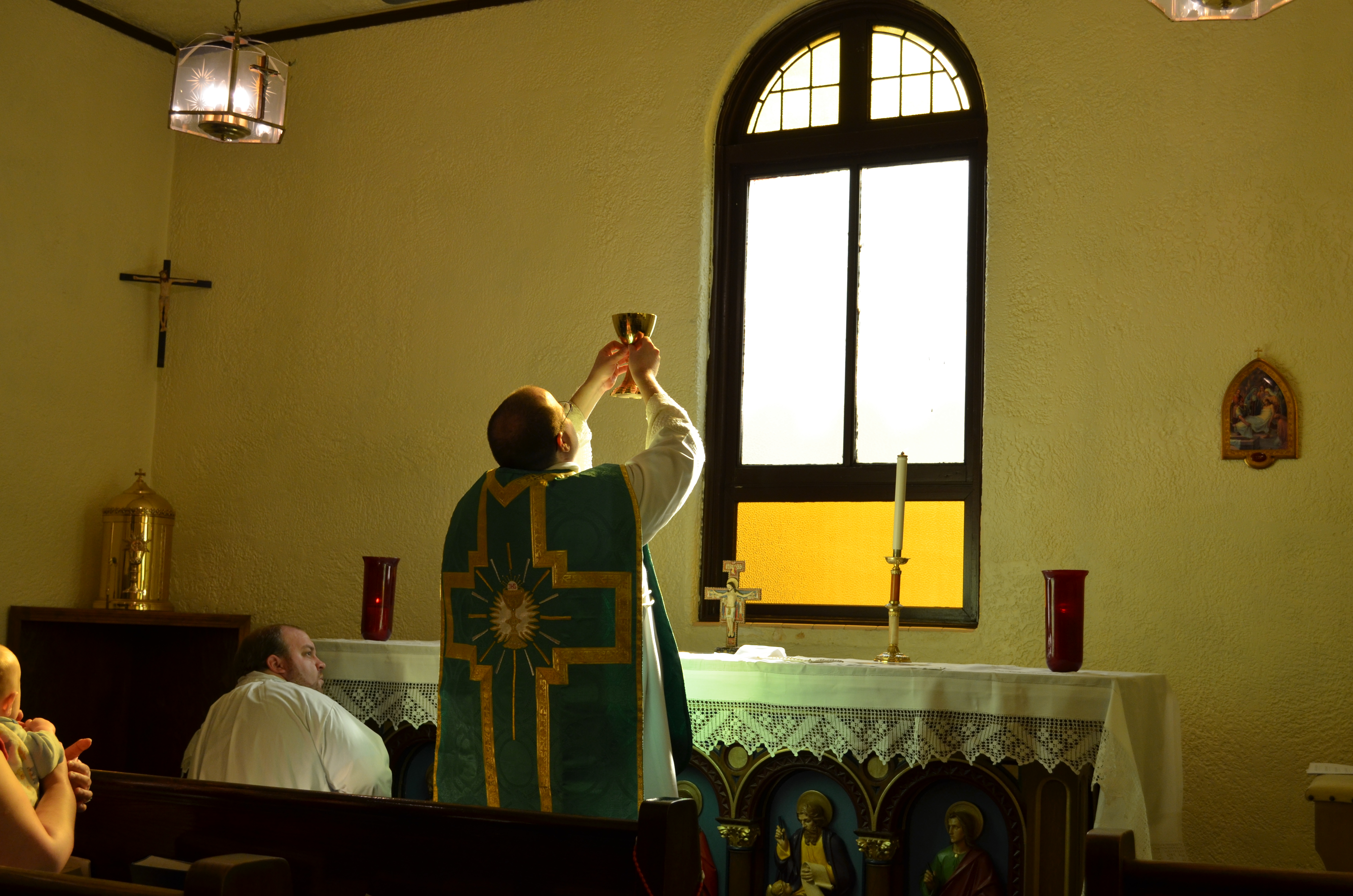
The Elevation: ad orientem, y'all!
The local paper did a story on Fr. Venuti, which was ok as far as it went, but it focused almost exclusively on him and the fact that he is married, with almost nothing about the Ordinariate. I'm about to write a letter to the editor.
You can hear the chanted Magnificat in the YouTube video below, beginning at 1:34:
 Light On Dark Water
Leave a reply to Louise on the iPod Cancel reply