A month or two ago I was browsing in the used book store run by the Friends of the Library at one of the local libraries and happened across two volumes which are the sort of thing I'm always hoping to find, and the main reason why I do such browsing: matched volumes of Ogden Nash's Good Intentions, from 1942, and Versus, 1949. I don't know if they're first editions or not, but they're certainly early ones, and look like they were printed sometime in the '40s.
There are two things I like about books such as these. One is the physical object itself–I like the way they look and feel. The cheap paperbacks of 60 or 70 years ago seem to be made more poorly than today's and are falling apart now. But the hardbacks seem better, in general, although I'm sure the best books being made today are as good as those of any time. The other of course is the content. I really don't think it's just nostalgia; I really think there has been a general falling-off in the cultural realm since the great upheavals of the 1960s. (I tried to get at this rather elusive sense of what's changed in this Sunday Night Journal.)
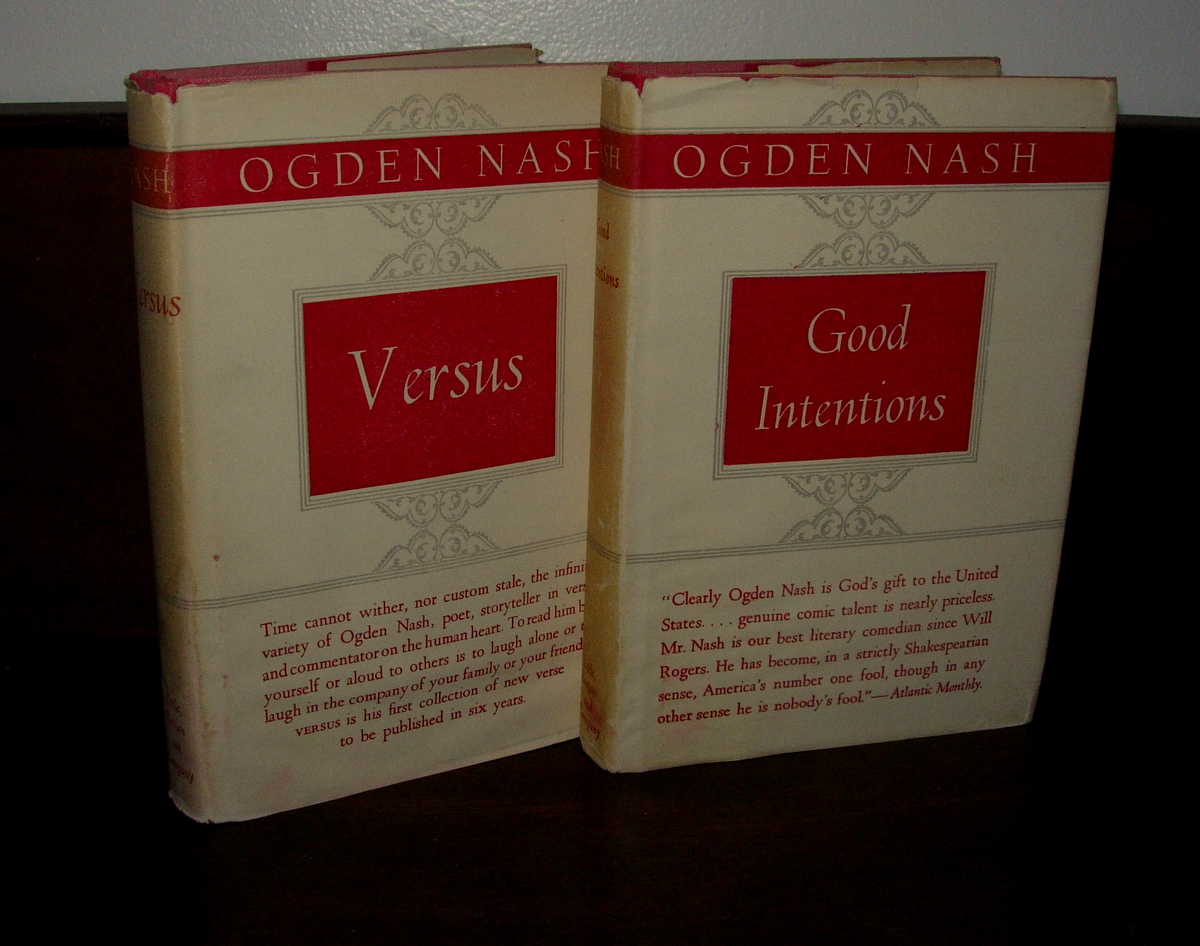
Ogden Nash was well-known enough when I was growing up that I was familiar with his name and the general style of his work. I didn't seek him out, or encounter him in a literature course: he just turned up, in the mainstream magazines found in an ordinary middle-class household. It is hard to imagine his playful and literate wit finding much of an audience today. I wonder if anyone under the age of forty (fifty? sixty?) today would recognize his name. I suppose Garrison Keillor's general presence and work might bear comparison, but Keillor's universe of allusion and reference is mostly confined to pop culture. And his work in recent years has been disfigured by culture-wars venom.
But all that aside: I've read one of the two books, Good Intentions, starting with the first poem and going all the way through, one or two or three at a time every day, and the best of them are great fun, and sometimes a bit more. In other words, they're just what you want in light verse. A good many are now too specifically bound to the circumstances of upper-middle-class WASP life in the 1930s and '40s to travel well, chronologically speaking. There are a lot of references to dinner parties, train stations, taxis, bridge, and cocktails, and even one complaint about the loss of a servant. It's not that these could not be made timeless, at least in principle, and sometimes they are, but the general drift of the poems is a wry observation about that specific thing in itself, and as they are no longer applicable to most of us they lose some of their force.
I suppose the same could be said of Nash's allusiveness, which is sometimes as thick as Wodehouse's, and at least as oriented to the contemporary (Lunt and Fontanne, Berlitz, Wurlitzer), and I have the feeling I'm missing at least some of it. But to call a poem "Allergy in a Country Churchyard" or "Frailty, Thy Name Is a Misnomer" is probably evidence of higher expectations of an educated but not academic audience than would be found today. And in some cases the poem is funny even if you don't know entirely what it's about.
Mr. Henderson
There goes Leon
Glowing like neon.
He's got an appointment
In somebody's ointment.
I had already gotten a good laugh out of that, and read it to my wife, when it occurred to me that "Leon Henderson" was too specific a name to serve as the handle for a generic bit of satire. With the usual help of Wikipedia, I quickly learned that Mr. Henderson was the "controversial and deeply unpopular" head of the Office of Price Administration when these poems were written, and it is not hard to imagine that a man heading a government agency by that name would be a fly in the ointment of a great many people.
Nash's great specialty is the long and seemingly formless line, often with rather twisted syntax, which ends in an unexpected rhyme, frequently with a word invented for the purpose
A husband is a man who two minutes after his head touches the pillow is snoring like an overloaded omnibus,
Particularly on those occasions when between the humidity and the mosquitoes your own bed is no longer a bed but an insomnibus….(from "The Trouble with Women is Men")
In general the poems alternate between this sort and brief epigrammatic ones like "Mr. Henderson." Both are great fun. I'm looking forward to Versus.
One thing that makes a writer like Nash seem more solid than most of our contemporaries is that he seems to be a Christian living in a Christian society: not that he is a devotional or even particularly religious poet, but that he has a place, and a philosophy, which he more or less takes for granted, and which impart something of their solidity to his work. There is very little mention of Christianity in the poems, and my guess–it's only that–is that he was a mainline Protestant of the old pre-1960s variety, not necessarily devout but casually faithful. Yet there is none of that aggrieved cynicism and anger that is pretty much a standard feature of the contemporary writer.
And there is one poem which is explicitly Christian, and which is so different from everything else in the book that one wonders why it was included. I'm going to include it here, even though its complete seriousness makes it unrepresentative, because I think it's excellent, and because it gives some idea of the sort of man who wrote all those amusing things. (Remember this book was published during World War II.)
Heil, Heilige Nacht!
How many years to Bethlehem?
Near a hundred score.
Can I get there by candlelight?
Not this war.The friendly, holy candle light
is bale fire now to death,
Its perilous glimmer long blown out
By sirens' breath.Through skies the Wise Men humbly scanned
Three keener hunters flit–
Heinkel and Dornier seek the gleam,
With Messerschmitt.No manger now, no cattle shed,
Too lowly to be found.
Take up the babe and hurry him
Deep underground.But cave nor grave is deep enough
To shield young flesh and bone.
Hurry him down, and o'er his head
Roll the great stone.What need of law to still the bells,
For how should bells be merry?
The day the child in joy was born,
The child we bury.Gentlemen of the High Command,
Who crucify the slums,
There was an earlier Golgotha.
The third day comes.
 Light On Dark Water
Leave a reply to Mac Cancel reply