Update: re-reading this, I think I gave away a bit too much of the plot, because I was trying to get to that main point mentioned toward the end. So consider this a somewhat spoiler-ish review. Also, in faintly praising it, I don't think I did justice to its purely dramatic appeal, which is definitely there. I suppose, on balance, I thought it was about 3/4 of an excellent movie, foundering somewhat on its message toward the last.
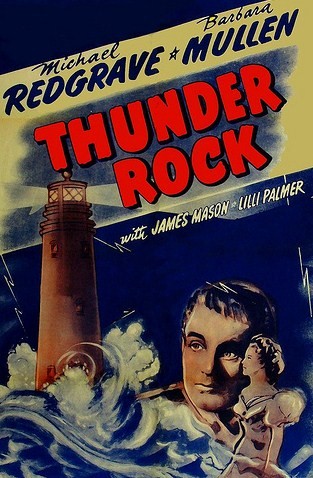
An embittered war correspondent lives in isolation as a lighthouse keeper on one of the Great Lakes. He receives a series of strange visitors who cause him to re-evaluate his life.
That is approximately the TCM description of this 1942 movie. And that, in conjunction with the fact that it stars Michael Redgrave and James Mason, were reason enough to cause me to hit the "record" button on the DVR. We watched it last night, and although I don't think I would strongly recommend it, it is interesting, and quite well made. Contrary to what you'd assume from the Great Lakes setting, it's an English production, based on a successful 1939 play.
The journalist, David Charleston (Redgrave) is actually not a "war correspondent," but a reporter covering European politics who had tried unsuccessfully to sound the alarm against fascism and the approaching war. Despairing and dissillusioned because so few people see what's coming, and so many will not listen to the evidence he presents, he has withdrawn from the world and never leaves the tiny island on which his lighthouse stands.
Fascinated by the story of a ship that in 1849 had been lost nearby, carrying a load of passengers who were mostly emigrants from Europe, he has studied the passenger list, and begun to imagine them and their stories, until they have come alive for him. They, along with the captain of the ship, enter the film as apparently real people.
Charleston believes that they lived in a better world than he does, a world which was not facing what seems to him the end of civilization. But as they become more their real selves, and less the embodiment of his presuppositions, he finds that he was mistaken, and that they were all facing social conditions that seemed as terrible to them as his situation does to him, and were running away from it when they came to America.
Several of the passengers were agitating for causes, e.g. women's rights, which seemed to them doomed, but Charleston is able to tell them that they eventually won, and that many of the injustices by which they were oppressed have been corrected. The story so far has had a certain propagandistic streak, though not enough to damage the dramatic interest, but at this point it falls into some pretty heavy-handed progressive cheerleading (with, naturally, an anti-Catholic note).
But that's also where the film transcends its own propaganda, reminding us that we do not know what is going to happen, and that even when the future promises grim events, and delivers on the promise, there is still more to the story. Beyond a present calamity, something better may await. It's a thought worth keeping in mind when reading the news these days.
TCM has kindly put a couple of clips online. They'll give you a good idea of whether it's something you'd like to see or not. Notice the music: I thought the score was pretty effective throughout (though I know the theremin will make some people laugh).
http://i.cdn.turner.com/v5cache/TCM/cvp/container/mediaroom_embed.swf?context=embed&videoId=317474
Go here to see another clip, this one from earlier in the story, where supplies are being delivered to the lighthouse.
 Light On Dark Water
Leave a reply to Rob G Cancel reply