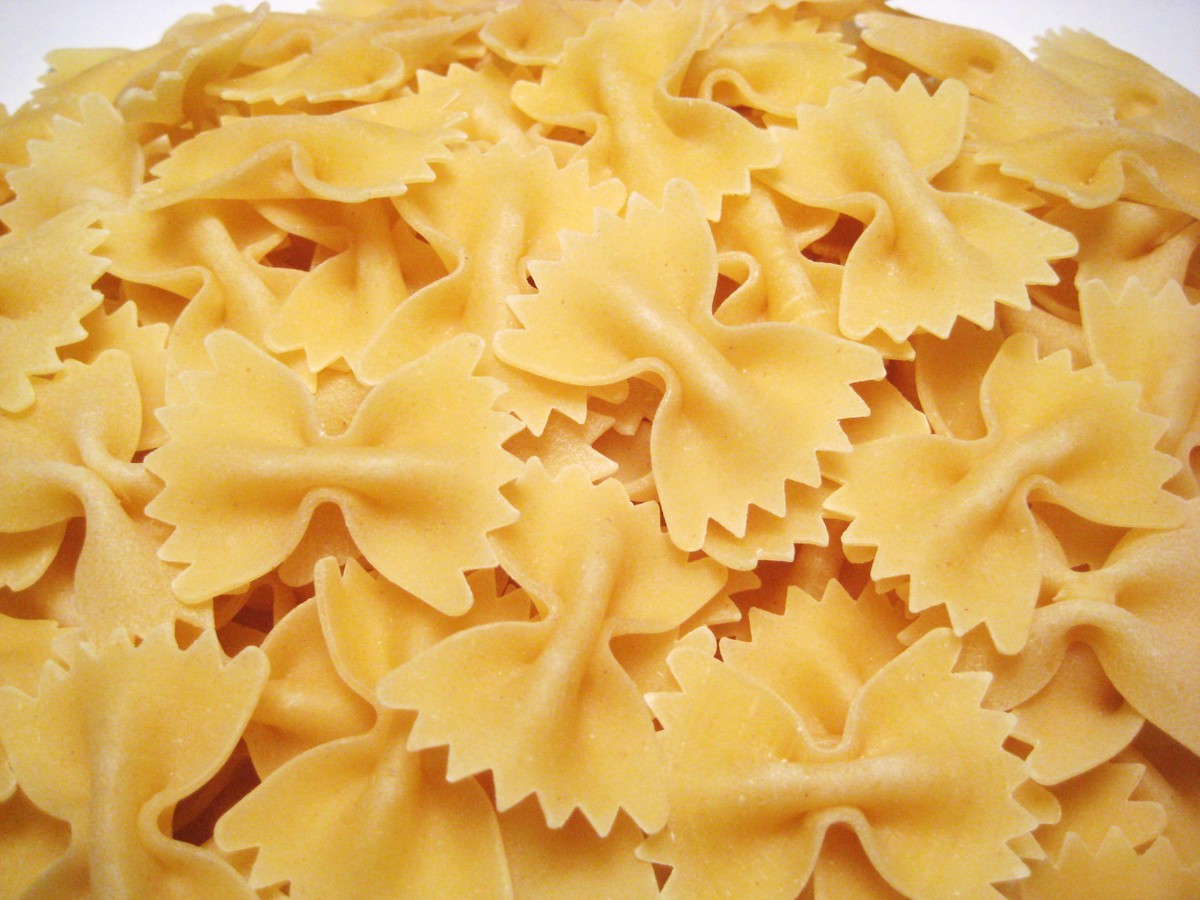
An Urgent Question

Are noodles pasta?

This arose in connection with an incident related on Facebook in which a British-born wife requested that her American-born husband bring her some noodles, and was displeased when he brought her a species of pasta. It turns out there are some significant variations in usage of the term "noodle." As Wikipedia says: "The material composition or geocultural origin must be specified when discussing noodles."

I'm not entirely sure what the wife had in mind, but I think it was some sort of Asian noodle. If you had asked me, I would have said, as several people in the discussion did, that noodles are a subset of pasta, namely pasta in an elongated cylindrical or tubular form–that is to say, recursively, noodle-shaped pasta. Where I'm from, one might refer, for instance, to "spaghetti noodles" when referring to the yellowish-white part of spaghetti, and "spaghetti sauce" when referring to the red part. And fan- or corkscrew-shaped pasta would not be called noodles.

But then there are flat noodles, too…still, they are noodle-shaped in being elongated.

I think "pasta" is a word of relatively recent introduction to middle-class America. At any rate I don't recall it being used when I was growing up. There was spaghetti and there was macaroni, and each had its characteristic noodle, and I don't recall other varieties of pasta, though at some point–in the '70s, maybe, with the advent of the yuppie–the word became widespread.

I'm interested in what the usage is in other parts of the country and the world. Do you think of noodles and pasta as two different things? If you asked for noodles and got pasta, would you be annoyed?

  Noodles

Noodles, and also pasta

AlsoNoodles

Also noodles, but not pasta?

 NotNoodles

Pasta, but not noodles


21 responses to “An Urgent Question”

  1. I think the two are more verbally distinct in England than in the USA. Because in England, we speak of pasta in relation to various kinds of Italiany dishes, and of noodles in relation to Asian dishes.
    A third thing exists in the USA, which is as yet uncommon in GB, and that ‘egg noodles’ or ‘Dutch noodles’. Those wide white flat things.
    So there are in the US, so to say, pastas which pass as noodles.
    Use your noodle.
    Or as you say here, go figure.

  2. Robert Gotcher

    We got a pasta maker for our wedding (1984). We always called it a noodle maker. It made spaghetti, macaroni, linguini, mostaccioli, fettuccine, lasagna, Manicotti, and bagels.
    We were married in Minnesota and have lived in Wisconsin since 1995.

  3. “…and bagels”??
    “in England, we speak of pasta in relation to various kinds of Italiany dishes, and of noodles in relation to Asian dishes.”
    Yes, that seemed to be the source of the conflict on Fb.

  4. Ok, here is my usage, which is apparently idiosyncratic to me and my sisters.
    Noodles: all of them, from shells, to egg noodles, to bow ties, to rice sticks, to lasagna noodles, to angel hair.
    Pasta: A word that I consider to only be used in restaurants. And by weird people.
    Spaghetti: any kind of noodle with red sauce. This is the one that really drives my fiance up the wall.

  5. I grew up in an Italian family, but don’t recall the word ‘pasta’ ever being used liked it is today, to refer generically to any or all of the various types. In our family each item was referred to by its own name: spaghetti, rigatoni, linguini, etc., or by its English description — bowties, shells, wagon wheels, etc.
    The word “noodles” was usually applied to the things which appeared in soup (of whatever shape) or as Grumpy said above, egg or Dutch noodles.
    I think the word “pasta” did become a more common thing in the 70’s. Growing up, however, the only reference to pasta that I can recall is “pasta fagioli,” which is an Italian bean and noodle soup. Most Italian people that I knew ran the two terms together into one word which was pronounced something like “pastafajol,” with the accent on the last syllable. Little kids inevitably would mispronounce it, leading to terms such as my family’s “pastapazool,” and my personal favorite, from a little neighborhood kid, “busta-bazoo.”

  6. “each item was referred to by its own name” — heh — “the Eskimos have 50 words for snow” (which I’ve heard is not actually true).
    I don’t know if egg noodles are significantly different from others. 90 seconds with Google turns up assertions that pasta, strictly speaking, does not contain eggs, while egg noodles do, along with assertions to the contrary.
    I’ve been told that when I was little the grownups were amused at my pronouncing “spaghetti” as “pahsgetti”. I think one of my children did that for a bit, too

  7. A noodle to me is a long, thin bit of pasta, as in spaghetti or vermicelli. Wheat noodles are more Western, rice noodles more Asian, but it’s the shape that makes them noodles, in my view.
    We use ‘pasta’ is a generic word to cover everything from macaroni to spaghetti to fusilli and so on. Although I am not sure that I would call those long Asian noodles ‘pasta’. Hmm.
    Maybe ‘pasta’ is what is eaten with sauce, which could include noodles, but if eaten in a soup (or with a spring roll) then it is just noodles, but not pasta?

  8. Craig touches on a significant point: one would never refer to Asian noodles as pasta.

  9. Yes, that’s why the caption on the Ramen picture is “Also noodles, but not pasta.”
    I think the soup vs. sauce distinction, though an attractive solution, breaks down–I’m pretty sure I’ve seen non-noodle-shaped pasta in soups.
    I’m curious enough to wonder, but too lazy to investigate, whether there is always a significant difference of composition between Asian and European noodles.

  10. And as to the shape: there is a reason why it’s “pool noodle,” not “pool pasta”:
    http://en.wikipedia.org/wiki/Pool_noodle

  11. Sorry, SophieMiriam, once again I started ignoring the spam catcher and once again it snuck in and blocked a legitimate comment. I must say yours is the most amusing usage, and definitely idiosyncratic. So pasta shells with marinara sauce is spaghetti, huh? Your fiance must learn to see that as cute and amusing, not up-the-wall-driving. After more than 35 years, I still enjoy the distinctive way my wife says “puhtaytuh.”

  12. While I would only use “pasta” of Italian dishes and “noodles” of Asian dishes, I would be unable to distinguish sauceless noodles from sauceless capellini if presented with plates of the two.

  13. Which would indicate either that there is little or no difference in taste, and probably not a great deal in composition, between the two, or that you aren’t very discriminating when it comes to noodle-y pasta-y stuff. Clearly an experiment is in order.
    There is a kind of noodle used in Chinese food which is more or less the same shape as spaghetti but darker in color and more distinct in taste. I can’t come up with the name right now, though it’s very common. I might be able to tell those two apart.
    I was about to say I don’t know what capellini is, but I looked, and it’s what’s called “angel hair pasta” in the US. http://en.wikipedia.org/wiki/Capellini
    I’m hungry.

  14. Louise

    I’d eat them all quite happily. 🙂

  15. Now that’s wisdom.

  16. Anne-Marie

    I have an Italian-American friend who claims that nobody Italian uses the word “pasta,” but that instead all these items are referred to as “macaroni.” So he eats elbow macaroni, bowtie macaroni, etc. I should ask him whether the long skinny ones are noodle macaroni or spaghetti macaroni.

  17. Yes, I would like to know the answer to that. It would be very funny to find that Italians don’t say “pasta,” since use of the term sort of implicitly says “this is what knowledgeable people say.”

  18. The Italians that I know who say “pasta” have all picked it up over the past 2 – 3 decades because of its American usage. No Italians that I know use the term “organically” or “naturally.” The older Italian folks even seem to use it a little uncomfortably!
    Mac, are the Asian noodles you’re talking about Soba noodles? There are also Udun noodles, which are like spaghetti but thicker. I think they’re made from rice i/o wheat.
    What Anne-Marie says about Italians using “macaroni” for the other shapes rings true with me. Also, no one called capellini “angel hair pasta.” Everyone just called it “angel hair.”
    There’s an Asian version of angel hair that I think is called mei-fun. Again, not sure if it’s wheat or rice based.

  19. So how did the “pasta” thing get started? The “foodie” phenomenon, which seems to have involved, still does I guess, a lot of almost academic lore about the cuisines of various cultures? It was the late ’70s when I first encountered a couple who would fit that term, though I don’t think the term appeared till later.
    I don’t recognize either of those terms for the Asian noodle. The term I’m struggling to remember is probably for a dish that includes them, not the noodles themselves.
    I’m not sure why I added “pasta” to “angel hair” above, because I don’t recall hearing it that way, either. I think I may have heard people say “angel hair noodles” or “angel hair spaghetti”.

  20. The most well known Asian noodle dish is probably lo-mein, which does generally have a spaghetti-type noodle.

  21. Yes, that’s it. I knew it was something very common.

Leave a reply to Rob G Cancel reply