(It seems a little crass to publish this somewhat frivolous post when someone I know, if only through his writings and through mutual acquaintance, is close to death. But that's the way of it, as both Frost ("Out, out–") and Auden ("Musee des Beaux Arts") have noted in their well-known poems: the rest of us go on. That does not mean that we're not thinking about Stratford Caldecott and his family, and continuing to pray for them.)
***
For six more days after the storm lessened we still had fairly rough weather; nor did the sun once show himself during all that time. For the season—it was now the middle of June—the storm was unusual; but being from southern California, I was accustomed to unusual weather. In fact, I have discovered that the world over, unusual weather prevails at all times of the year.
–Edgar Rice Burroughs, The Land That Time Forgot
Or, as my grandfather used to say of the weather, "There's no such thing as a normal year." Either statement pretty well sums up my skepticism about the more extravagant claims about the effects of global warming.
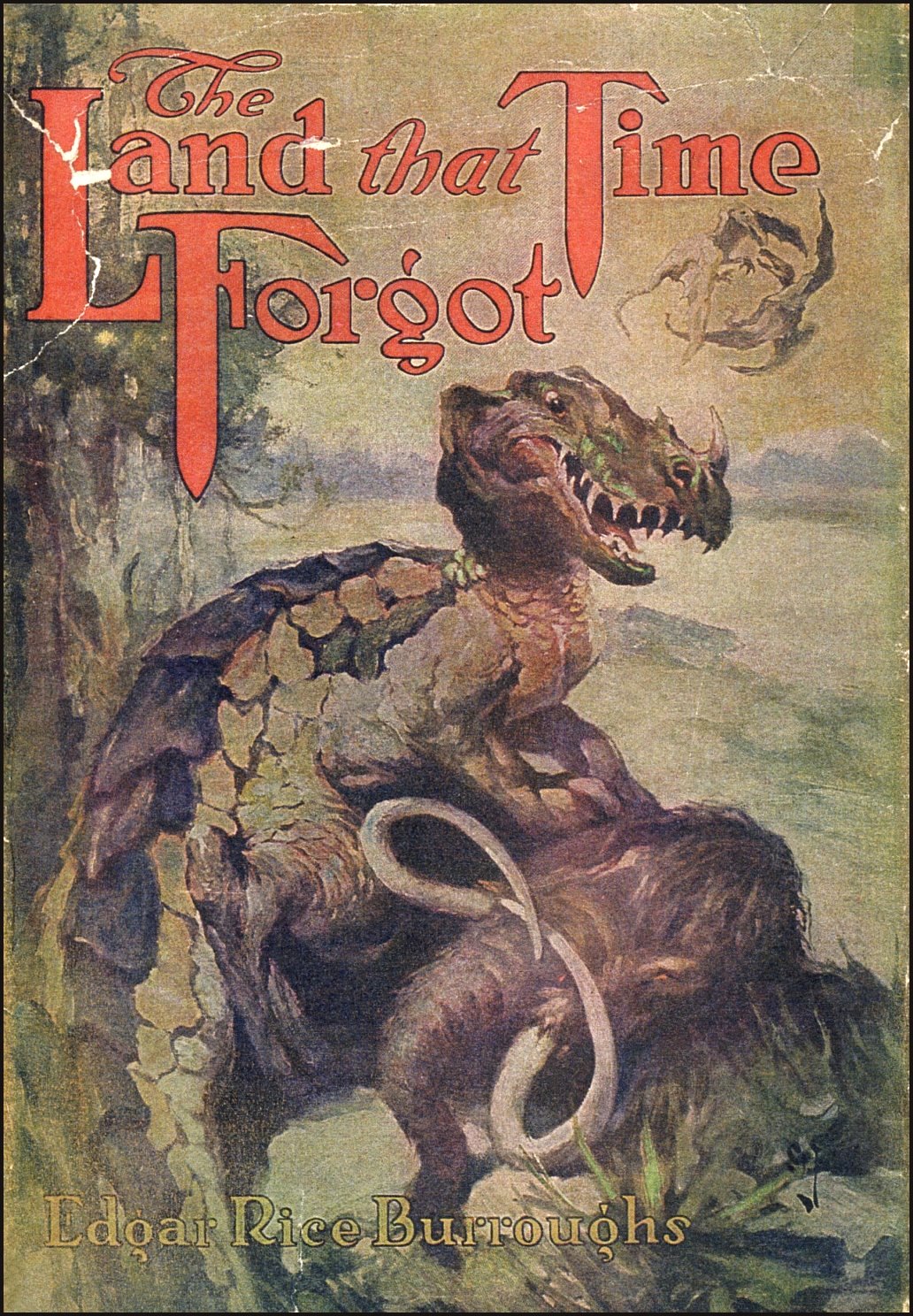
I had never read anything by Edgar Rice Burroughs until one day last week when I went out for lunch and wanted something light to read, and this was handy. This short novel begins with a lengthy adventure involving the capture of a German submarine during World War I, then turns into a hiddne primeval continent story somewhat like Arthur Conan Doyle's Lost World (which I have not read, but when I was twelve I saw the preview of the movie, so I know all about it). Dinosaurs, ape-men, Neanderthals, sabertooths, and mammoths all run around hunting each other in this pocket of non-standard evolution. That latter part was a bit of a letdown to me, not because it was badly done but because I just found it less interesting. Likewise, the whole Tarzan idea never interested me much outside of the comic books, nor does early sci-fi of the sort Burroughs presumably did in his Mars novels. The Land That Time Forgot is the first of a trilogy of short novels about that island, "Caspak," and I don't know that I'll read any more; I'd rather have more straight-up adventure, like the first half of this book. But I have to say the man can tell a story. I can see why he was so popular.
I also liked this bit:
I could have gone on my knees to her and begged her forgiveness—or at least I could have, had I not been Anglo-Saxon.
There is, by the way, a certain amount of casual matter-of-fact racism in the book where the primitive peoples of Caspak are described–Africans viewed as lower on the evolutionary ladder than Europeans, etc. And quite a hot hatred of the Prussians against whom England and the U.S. were fighting at the time.
 Light On Dark Water
Leave a reply to Janet Cancel reply