Having spent over five years of my life on a close reading of de Lubac, it is going to be hard for me to keep this post to a reasonable size. There is so much I can say! Because it seems that part of the point of this series is to elicit in others a desire to read, I had hoped to find some of the most beautiful and moving quotes. The problem is, I can’t decide. For me, almost any passage has the same power, the same intensity, the same lyrical beauty. I could almost just open any book and quote whatever I find and it would all be the same.
Henri de Lubac was a French Jesuit theologian whose ideas on faith and revelation, the Church, the supernatural, nature and grace dominated the conversation among Catholic theologians in second half of the 20th century, influencing all the major documents of Vatican II and especially the pontificates of St. John Paul II and Benedict XVI.
A good dose of de Lubac can help you more deeply appreciate and understand Vatican II. For instance, from de Lubac comes a clear articulation of the idea that pervades Gaudium et spes that the Church plays a decisive role in the unity of the human race and that any effort to unite men outside of a connection to Christ is doomed to end in destructive, coercive totalitarianism.
The human race is one. By our fundamental nature and still more in virtue of our common destiny we are members of the same body. Now the life of the members comes from the life of the body. How, then, can there be salvation for the members if, per impossibile, the body itself were not saved? But salvation for this body, for humanity, consists in its receiving the form of Christ, and that is possible only through the Catholic Church.
—Catholicism
De Lubac taught in 1936 that man cannot understand himself fully unless he knows Christ. “By revealing the Father and by being revealed by him, Christ completes the revelation of man to himself” (Catholicism, 185). This phrase would be enshrined in Gaudium et spes 22. “Christ the Lord, Christ the new Adam, in the very revelation of the mystery of the Father, and of his love, fully reveals man to himself and brings to light his most high calling.” St. John Paul II would repeat this quote from GS 22 throughout his pontificate in almost every one of his encyclicals and other major writing.
The extensive treatment of modern manifestations of atheism in Gaudium et spes 19-21 reflects de Lubac’s work in The Drama of Atheistic Humanism and The Discovery of God. Lumen gentium, the Vatican II document on the Church begins with a chapter on the Church as “mystery” and ends with a chapter on the Church and Our Lady, which is exactly what de Lubac had done in The Splendor of the Church (1953). De Lubac’s public defense of Teilhard de Chardin during the council at the invitation of Bl. Paul VI helped make more attractive the subtle presence of some of Teilhard’s evolutionary eschatology in Gaudium et spes.
After the Council, de Lubac rejected theologies such as that of Schillebeeckx, that emphasized too much the invisible presence of grace in the world in such a way as to diminish the distinctive effectiveness of the visible Church in bringing about salvation. He has observed also the loss of faith and nerve that has occurred even in the Church, resulting from the capitulation of theologians to the intellectual currents of the age.
De Lubac was one of the key influences on the post-conciliar theological movement that shaped the pontificates of St. John Paul II and Benedict XVI, the Communio circle. De Lubac was a kind of elder “uncle” to the theologians who followed Hans Urs von Balthasar in establishing the Communio family of scholarly journals, including Wojtyła and Ratzinger.
De Lubac’s specialty was intellectual history—the history of ideas. Whether it be the thought of the Church Fathers, the history of interpretation of St. Thomas, Buddhism, or the history of modern atheism, de Lubac delved deeply and sifted carefully to find the essence of a figure’s thought and to brightly highlight the lines of development in a given trend and to show how ideas grow, develop, and sometimes corrupt. De Lubac is able to express the solidity and vitality of dogma in the midst of the ever-changing stream of human thought.
His focus is on words or concepts, such as “supernatural,” or “the body of Christ,” or “the Church,” or “Faith.” He piles up quote after quote from church fathers or other theologians or philosophers or essayists. Using a dialectical method, each quote is explained to bring out some previously hidden aspect of the concept or to make clear a path that, if taken, will lead to the destruction of the idea. It reminds me of the way interlaced images appear on a computer screen. They begin unfocused, but with the basic outline of the image visible. With each “swipe” of the image, the details become more and more clear.
He was also a master at subtle criticism of others. He never said a bad word or a word of obvious criticsm of Rahner or Maritain, but every now and then he would throw out a mention of them which made it clear to the discerning eye that he was in strong opposition to some aspects of their work. For instance, during the War he strongly objected to a theory of the cult of the leader proposed by a priest in a small booklet. Yet, his critique was subtly couched in what appears to be a positive review of the book:
We are sure as well that there is no fundamental disagreement between the author and us. But if these and other analogous distinctions had been clarified, it seems to us that this would have dispelled completely the ambiguity in the atmosphere into which the reading of this little book plunges us, and we would have been able to enjoy with unalloyed appreciation the admirable pages for which any Christian reader would be grateful to Fr. Doncoeur for having provided such a benefit.
De Lubac’s most famous work is Surnaturel (1946), which attempts to clarify the meaning of the sometimes hidden and misunderstood deep, spiritual desire in the hearts of all men for God. He taught that according to St. Thomas all men had an innate natural desire for the beatific vision and 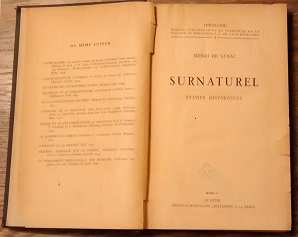 that therefore any human effort to establish the conditions for happiness will fail and become destructive unless they leave room for the centrality of the pursuit of the triune God. The desire itself is not completely understandable to man prior to the Revelation of Christ, because it stems from our being made in the image of a God who is ultimately incomprehensible, even if to a degree understandable.
De Lubac’s analysis is closely aligned with his understanding of what it means specifically for man to be “spirit.” “Spirit” does not simply mean “intellectual.” Nor is it a “part” of the human person. It is the deepest, most unifying aspect of our creatureliness that is oriented towards God himself.
This tripartition [spirit, soul, body] is obviously not to be understood as implying three substances, or even three ‘faculties’, in man: it is discerned rather as a threefold zone of activity, from the periphery to the center, or, to use a traditional and irreplaceable word, to the ‘heart'.
–Tripartite Anthropology, 117
When reading books by de Lubac on the subject of the natural desire, such as Mystery of the Supernatural,or in his reflections on atheism in The Drama of Atheistic Humanism, you can recognize and feel the desire as it weaves its way throughout the history of thought and the history of man, as man makes his choices based on the desire either for things that can actually satisfy to his beatitude or that will not ultimately satisfy to his ruin.
A firestorm erupted following the book’s publication. De Lubac had been critical of a theory that says that pure human nature can be made happy in something less that God himself. Both traditional neo-scholastics such as Réginald Garrigou-Lagrange, OP and so-called Transcendental Thomists, such as Karl Rahner, SJ, accused de Lubac of undermining the freedom of God to confer grace on whomever he wishes. Some thought that some passages from Bl. Pius XII’s 1950 encyclical Humani Generis were directed against de Lubac. De Lubac was relieved of his teaching duties and forbidden to write on the supernatural by his Jesuit superiors for several years in the 1950s. As a result we got the glorious Splendor of the Church and his writings on Buddhism.
De Lubac believed that much of the criticism of his work came from an over-rationalization of the faith. He was very sensitive to the limited ability of man to understand fully the mysteries of the faith, whether it be grace, the Church, the Trinity, or the mystical body of Christ. The following quote is long, but it gets at the heart of de Lubac’s approach to theology and to faith and revelation:
This idea of mystery is perfectly acceptable to reason once one has admitted the idea of a personal and transcendent God. The truth we receive from him about himself must exceed our grasp simply because of Its superior intelligibility; intellecta [having been understood], it can never comprehensa [having been fully understood]…. Revealed truth, then, is a mystery for us; in other words it presents that character of lofty synthesis whose final link must remain impenetrably obscure to us. It will for ever resist all our efforts to unify it fully. This is baffling to a philosophy of pure rationality but not to a philosophy which recognizes in the human mind both that potential absolute that makes it declare the truth, and that abyss of darkness in which it remains by the fact of being both created and bodily. 'Either … or', says rationality, believing that it can get to the bottom of everything, because it makes itself the yardstick, and thinks that its own limits are the limits of being itself. It accuses Christian thinking of 'a kind of hunger for what is absurd and contradictory; thinking that what is incomprehensible must therefore be unintelligible, it considers the doctrine of mystery to be a 'sophism', an unwarranted overstepping of the bounds of common sense and reason….The objection is reminiscent of certain theologians of our own day, who hasten to speak of contradiction as soon as they hear phrases that seem even slightly paradoxical; in so doing they reject any truth that surprises them, without perceiving that to be really logical they should be rejecting numerous other incontestable truths, both of faith and reason, which only fail to surprise them because they are so used to them.
—Mystery of the Supernatural, 222-4
Where should you start when reading de Lubac? His writings on the Church are beautiful and 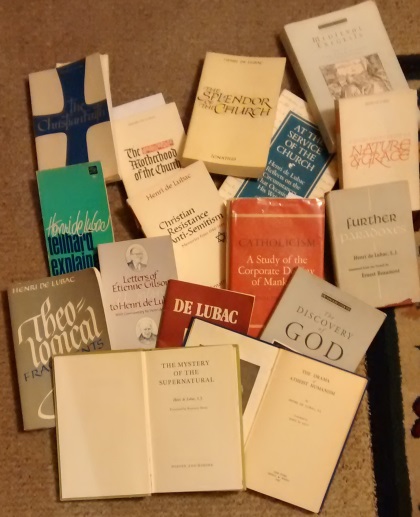 spiritually uplifting. I’d start with Splendor of the Church. I am especially moved by his extended meditation on what it means to be a vir ecclesiasticus, a man of the Church, in Chapter VII, “Ecclesia Mater.”
"For myself," said Origen, "I desire to be truly ecclesiastic" He thought-and rightly- that there was no other way of being Christian in the full sense. And anyone who is possessed by similar desire will not find it enough to be loyal and obedient, to perform exactly everything demanded by his profession of the Catholic faith. Such a man will have fallen in love with the beauty of the House of God; the Church will have stolen his heart. She is his spiritual native country, his "mother and his brethren", and nothing which concerns her will leave him indifferent or detached; he will root himself in her soil, form himself in her likeness and make himself one with her experience. He will feel himself rich with her wealth; he will be aware that through her and her alone he participates in the unshakeableness of God. It will be from her that he learns how to live and die. Far from passing judgment on her, he will allow her to judge him, and he will agree gladly to all the sacrifices demanded by her unity.
Being a man of the Church, he will love the Church's past. He will meditate over her history, holding her tradition in reverence and exploring deep into it. Granted, the last thing he will do will be to devote himself to a cult of nostalgia, either in order to escape into an antiquity which he can reshape as he likes, or in order to condemn the Church of his own day, as if she were already grown decrepit and her Bridegroom had cast her off. Any attitude of that kind will repel him, spontaneously. He may, certainly, take pleasure in going back in spirit to the age of the new-born Church when, as St. Irenaeus put it, the echo of the Apostles' preaching was still audible, and "Christ's blood was still warm [and] faith burned with a living flame in the heart of the believer." But for all that he will be sceptical about those myths of the Golden Age which give such a stimulus to the natural inclination to exaggeration, righteous indignation and facile anathematizing. In any case, he knows that Christ is always present, today as yesterday, and right up to the consummation of the world, to continue His life, not to start it again; so that he will not be forever repeating "It was not so in the beginning". His questionings are not directed to a "dumb Church and dead Doctors", and he will have no "petrifaction" of Tradition which is for him no more a thing of the past than of the present, but rather a great living and permanent force which cannot be divided into bits.
—Splendor of the Church, pp. 242-244
Doesn't this remind you of some of the words of Pope Francis?
Motherhood of the Church also has some beautiful passages. If you are interested in the French resistance to Nazism in WWII, de Lubac’s memoirs of his participation, Christian Resistance to Anti-Semitism, are a must read. De Lubac’s spirited analysis of Feuerbach, Nietzsche, Kierkegaard, Comte, and Dostoyevsky can be found in The Drama of Atheistic Humanism.
–Robert Gotcher and his wife, Kathy, live in Milwaukee, where they've been raising their seven children, four of whom are "out of the house" more or less. He teaches writing and Latin at a seminary. He wrote his dissertation on de Lubac and Vatican II. He is originally from Oklahoma, but has lived in Kansas, Indiana, Kentucky, Minnesota, and Innsbruck, Austria.
 Light On Dark Water
Leave a reply to godescalc Cancel reply