Ronald Blythe, born in 1922, published his first book in 1960 and more than half a century on is still at it. His most recent release was a privately printed collection of poems, which came out late last year. In the interim he has written fiction, literary criticism, biography, and nature and travel books. And since the 90s he has written the column “Word From Wormingford” for the Church Times in England, and many of these essays have been combined and released in book form.
I first came across Blythe’s work in the late 90’s in the much-lamented Common Reader catalog. I didn’t actually read him, however, until about five or six years ago. Word From Wormingford (the book) had sat on my shelf for nearly ten years without my having looked at it, and when I finally did pick it up, I did so because I had been reading a lot of Wendell Berry at the time, and I had the notion that Blythe was a sort of English Berry. Although there are some similarities I was mostly wrong, although I would say that folks who like the one would probably like the other.
What you find in Blythe is a rare combination of literary erudition, keen observational skills regarding both men and nature, and a sort of peaceful piety that borders on the devotional. When one reads one of his pieces, he is as equally likely to come away with a recommendation for an unknown poet or novelist, as with a desire to learn more about some forgotten English saint or a wildflower that you recognize but never knew the name of. What is most appealing to me about his work is his obvious love for everything he writes about–literature, nature, the cycle of the Church Year, his particular place in rural England. His writing exudes charity, in the original and best meaning of that word.
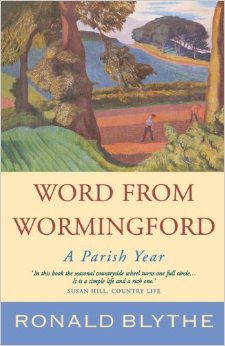
Three examples, chosen rather at random, from Word From Wormingford:
Sexagesima:
The old don’t like to be hurried away after the service. They want to huddle and chat and beam and ‘belong.’ My dreams take a sociological turn and I think, looking at the aged women, there go the last of the gleaners, and the last of those who rang for tea. ‘Eighty – why that’s nothing these days!’ But it is and they know it. They know it by their prayer… George Herbert was only thirty-nine when he found words to say, ‘The day is spent and hath his will on me:/ I and the sun have run our races.’
During a nighttime Lenten walk:
A Quaker friend apprenticed to horse farming in the thirties remembers his master getting up at two o’clock sharp every morning to reassure his beasts. A word here, a pat there. And I can recall the stockmen’s lanterns as they made their rounds. ‘Fareyouwell, then.’ Max the cat will accompany me on these strolls when he feels like it, now and then shinning up a tree to show off. On a light dark night I can just make out a Norman church whose windows, wrote Adrian Bell, ‘are no more than dream holes, the walls so thick that the light has the effect of being poured in through a funnel’. Well, that is how they liked it, our ancestors, a bright Saviour in a richly gloomy cave.
The autumn equinox:
St. Matthew’s collect contains a favourite finger-wagging word–‘inordinate.’ It is getting at the apostle’s past as a taxman. Not for us covetous desires and inordinate love of riches. Nor for us inordinate affection, although quite how one is to keep this within bounds I have failed to understand. Some friends, the cat, some books, this landscape familiar to me since boyhood, are all in receipt of my inordinate affection and the cat would not be pleased with anything less. But if I am not covetous, it is because I have all I need. So no virtue in this. The epistle is far from equinoctial. No equality of light and night there. Light reigns. The autumn days are days to savour. There is a sweet rot in the air. Grey squirrels are allowed to do what we must not do, lay up treasure in the earth.
All of Blythe’s “Wormingford” writing has this quality. I’ve not read any of his fiction, but his literary criticism and biographical writing carries it as well. In a way, he’s like a meeker, milder C.S. Lewis – similar sensibilities, but more heartfelt, less strictly rational. He’s a very “peaceful” writer, and makes a wonderful companion at those times when you want to slow down and enjoy something for its own sake, even if you do learn much in the process.
For the “Wormingford” writing Word From Wormingford is the place to start. It has been followed up by many volumes, but it started off as a trilogy, the second and third books being Out of the Valley and Borderlands. As far as the literary writing goes, I’d recommend Characters and Their Landscapes (also known as From the Headlands) and Divine Landscapes. His most famous book is Akenfield, which is a fictionalized account of the life of an English village from 1880 to the mid 60s. It’s very good but a little different from his other works, as it is somewhat journalistic in style.
—Rob Grano has a degree in religious studies which he's put to good use working on the insurance side of the healthcare industry for the past 20 years. He's published a number of book and music reviews, mostly in the small press, and sometimes has even gotten paid for it. He lives outside of Pittsburgh, Pa.
 Light On Dark Water
Leave a reply to Marianne Cancel reply