Of Interest to Dylan Fans

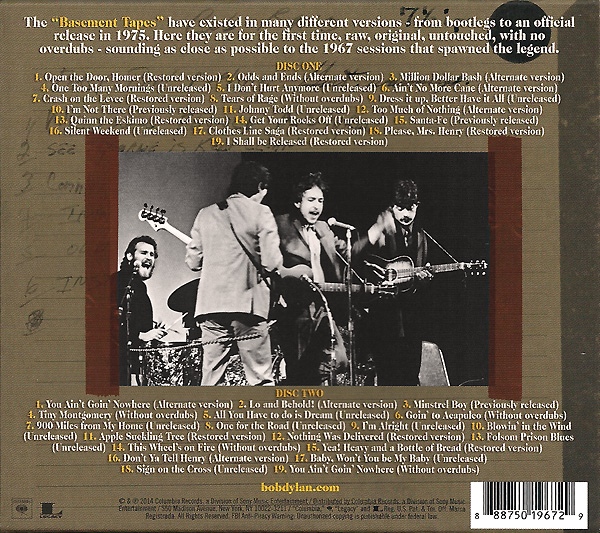
In the guise of a review of the recent Basement Tapes re-issues, and in an unlikely place–The Weekly Standard–this is one of the better things I've ever read about Dylan. It's called "AWOL from the Summer of Love." And in case you don't read it, here's what seemed to me a very significant bit (in part, I admit, because I came to the same conclusion a while back): 

If Dylan was the voice of a generation, it was not of the generation we think. He belonged to the generation before the one that idolized him, as did The Band. For them, the pre-baby boom frameworks of meaning were all still in place, undeconstructed and deployable in art…. His virtues are not so much of the world he left us with as of the world he helped usher out.

I've heard most of the Basement Tapes stuff on bootleg LPs, and really didn't think I was that interested in hearing it again. But now I'm thinking about that 2-CD set.
Bob_Dylan_and_the_Band_-_The_Basement_Tapes_Raw_03


53 responses to “Of Interest to Dylan Fans”

  1. Thanks for posting. I am fascinated by all things Dylan and will enjoy reading the article!

  2. I’ve not read the article yet but your quote from it makes sense. You could say, then, that while Dylan was ushering a world out, The Beatles were simultaneously ushering a new one in. I imagine that if you were old enough, aware enough and paying attention at that time, these changes would hit you hard and stay with you.
    This may explain why someone like me, who was born in 1961, has never been particularly struck by either Dylan or the Beatles. I was too young to live it firsthand, but it was present enough in my formative years for me to be at least familiar with it, and thus I’m at an age where the era, musically speaking, has neither any nostalgic nor any “retro” appeal to me.

  3. You’re welcome, Charles.
    “I imagine that if you were old enough, aware enough and paying attention at that time, these changes would hit you hard and stay with you.”
    No kidding. No one who wasn’t at least in his early teens in the mid-’60s can really grasp what it felt like. It was a very unusual cultural moment which of course can’t be repeated, though an awful lot of people have wanted it to be. I was at the right age to be most affected, seven years younger than Dylan, in my mid-teens when I started listening to him. I didn’t hear much of him till his career was well under way. I’m not sure but I think the first of his albums I bought was Bringing It All Back Home, which was the beginning of that post-folkie period. It had a huge effect on me.

  4. Makes a lot of sense. In the mid-60s I was elementary school age. My parents listened mostly to what was then called “popular” music — Sinatra, Perry Como, and other singers of that sort, as well as some big band and popular instrumental/orchestral music. (I wish I still had his album collection!)
    My exposure to folk at that time came from an uncle who listened to a lot of country, but who’d buy the occasional folk album. The stuff he didn’t really like he gave to my sister and me. Hence, in addition to our parents’ music, we cut our teeth on The Kingston Trio, The Limeliters, The Brothers Four — that sort of thing. I remember not particularly liking the country records he sometimes passed our way.
    The first “rock” record I ever bought, other than the odd 45, was Creedence Gold, after hearing a friend’s parents play it at their house. I was in 6th grade.

  5. He’s coming to Memphis.
    AMDG

  6. Robert Gotcher

    Although I was born in 1959, the “60s” had a strong impact on me because I had an older sister who was going through “all that.” She wasn’t the Dylan/folk type, though. More of a “top 40” type. She did have a copy of Zappa’s Freak Out! though!

  7. I got the big 6-CD set of Basement Tapes from the library, but it’s too much for me. Not everything in there is gold. But the smaller set is attractive. Just looking over the list I realize how many wonderful songs are there. “Million Dollar Bash”!

  8. I looked at the track listing for the 6-disc set and saw a lot of stuff I know I wouldn’t be interested in, such as four alternate takes of “Open the Door, Homer.” But I have a nagging feeling that there is something there that I would really love and isn’t on the 2-disc set. Well, I’ll just have to tough it out.
    I wish I hadn’t lent my original bought-in-1967 copy of Freak Out! to that guy I worked with in 1988 or so who never gave it back. That would be a real nostalgia piece. In fact I’m almost tempted to go try to find a copy on Discogs or Amazon or eBay.

  9. I heard people like The Brothers Four before I ever heard Dylan, or the original folk/country/blues people he was trying to emulate early on. It took me a little while to make the transition, but the slicked-up performances became unlistenable. Though I think some of the Kingston Trio’s stuff might still hold up. Haven’t heard them for a long time.

  10. We had a couple Kingston Trio records but the one that we wore out was called “At Large.” My sister eventually got it on CD but I’m pretty sure one of us still has the original LP floating around somewhere.
    Another one we really liked was The New Christy Minstrels’ “Land of Giants.” Sounds very dated now, but as little kids in 1967 or whatever we loved it. A lot of those songs still ring around in my head.

  11. He’s coming to South Bend!
    happy Laetare Sunday! I need to get some tickets before they sell out

  12. And likewise to you.
    I don’t know what Dylan’s shows are like now, but 10-15 years ago they were excellent.
    I liked the New Christies, too, when I was 14 or so, but they’d probably make me cringe now.

  13. Yeah, I can still listen to the Kingston’s with some appreciation, but the Christy’s are pretty much pure nostalgia.

  14. Daniel Nichols

    Actually every influential sixties musician was born during WWII. I have pondered why this trauma sparked so much creativity.
    And I liked the white bread ‘folk’ music, until I got my hands on the real stuff.

  15. That’s been a sore point with me for years when I run across those people who give “the Baby Boomers” blame or credit for everything that happened in the 1960s. It’s not just the musicians, it’s all kinds of cultural and political figures. Some were born in the ’30s or even earlier. Timothy Leary b. 1920. Abbie Hoffman b. 1936. Etc.
    And while I’m at it: that whole pop history division of recent history into “generations” is silly.

  16. Robert Gotcher

    I’ve never understood the strong feelings people have about things like Peter, Paul and Mary vs. the “real” folk music. I like Woodie Guthrie and Peter, Paul and Mary and I don’t see any reason why I shouldn’t. Of course, some people may say that Guthrie is a sell-out and that he was popularizing what was real folk music. Infinite regression.
    I just like them for different reasons. Same with the Nashville Sound vs. the “outlaws” and all that.
    I like rock’n’roll and the “pop” music of Dean Martin, etc. Why not?
    My “beef” with PP&M is political, not musical–or personal. Although I just feel sad for Mary Travers.

  17. It’s not a question of abstract principle for me, but just of what works artistically. You’re right that “real” vs. “commercial” is not an accurate distinction. A whole lot of what was considered pure folk music in the ’60s was commercial in the sense that the performers had every intention of getting paid, selling records, getting on the radio, etc. If they didn’t, it wasn’t because they were too pure but because it just didn’t work out. I could give you a lot of instances.
    My dislike of some of the “white bread” performers is…well, it’s hard to summarize, but they just tend to make the material sound hokey in their effort to polish it, and lose the real flavor. I don’t put PP&M in the unlistenable category, btw. To my ears some of their stuff still sounds good. And as I mentioned earlier I think I’d probably like some of the Kingston Trio stuff if I heard it. The only one I’ve heard for many years is “Scotch and Soda,” which I like a lot. But it doesn’t have the “folk” pretensions.
    Why do you feel sad for Mary?

  18. Robert Gotcher

    “they just tend to make the material sound hokey in their effort to polish it, and lose the real flavor.” I get that. I think of, for instance, of the New Christie Minstrels “Green, Green,” which comes off hokey, I guess. I think some commercial folk of the sixties was better artistically than some others.
    I think the real problem is if the singers have “folk pretensions.” “I’m doing Something Important that will Change the World.” Gag me with a spoon, as the Valley Girl would say.
    Mary Travers had an abortion in 1964 to save her career.

  19. Robert Gotcher

    for instance, I like the Weavers, even though they are commercial sell-outs. Or whatever.

  20. “…some commercial folk of the sixties was better artistically than some others.”
    Oh yeah, definitely. In my opinion Ian and Sylvia were far and away the best of all those artists. They were doing something basically pretty similar to PP&M et.al., but for the most part their music still seems as good to me as it did then.
    That’s sad about Mary T. I was sort of struck by the illogic of “Logic teaches us that beginnings are not the end result, they are only beginnings.” If we’re going to talk “end results,” how about Ambrose Bierce’s definition:
    “Worms’-meat: the end product of which we are the raw material.”
    But of course even that doesn’t take it far enough: “dust to dust”.

  21. Daniel Nichols

    Sorry, when I spoke of the real stuff I meant the album I found at the public library when I was a yoof, from Folkways or maybe Smithsonian of field recordings from the Scottish highlands. Pretty sure I would have responded as enthusiastically to field recordings of blues or field hollers from the American south, which I did not discover until much later.
    Though I would add that for some reason I cannot quite explain early Dylan or Leonard Cohen (born, appropriately in the Great Depression) sound more authentic than the Limelighters or the Brothers Four, the way that the Chieftains sound more authentic than the Clancy Brothers. Or John Lee Hooker sounds more authentic than Eric Clapton singing the same song. Or the way Greg Allman, in his early twenties, could sing more authentic blues than just about any white person before or since. Which is a great mystery. Was he just an excellent mimic, or did he have some insight beyond his years? Who knows.
    And I can hardly believe that Abbie Hoffman was born ten years after my mom.

  22. Robert Gotcher

    What makes music “authentic?”

  23. It doesn’t mean much without some context–authentically what? In the folk music context, more authentic means closer to the source. But that doesn’t imply that, for instance, the music of the Beatles is not authentic in some other sense.
    Would like to say more on this topic but have to work. Maybe later.

  24. Robert Gotcher

    So if you play someone else’s music you aren’t as authentic. Or, is perhaps the idea that a “folk” music comes from a certain culture and if you aren’t part of that culture, you can’t play it authentically?
    So, a Cape Breton fiddler who is of Scottish descent who plays a Scottish tune (rather than a Cape Breton tune) not authentic? Or is less authentic than a Scottish fiddler who plays the same tune.
    But if the Cape Breton fiddler is not of Scottish descent he is less authentic than the one of Scottish decent? Or is a Cape Breton tune more authentic for the Scottish descent Cape Breton-person?
    Or, if my daughter, who does have a little Scottish blood but doesn’t come from a Scottish culture plays a Scottish tune, she’s not authentic–or is less authentic, even though she was trained for years by “authentic” Scottish fiddlers. But she can never really “get it” because she doesn’t come from the culture.
    Is a Cape Breton fiddler of Scottish descent who plays a Cape Breton tune being more authentic than if she plays a Scottish one?
    Is Old Blind Dogs authentic? They come from the Scottish culture, but they compose their own tunes most of the time and are heavily influenced by World Music and bluegrass.
    What do you make of the Avett Brothers or Mumford and Sons or Nickle Creek? Authentic? Inauthentic?
    Chet Atkins comes from an Appalachain culture. Is the his music inauthentic or “not Appalachian” because it is heavily influence by Jazz and pop?
    We talked about the history of “The Lion Sleeps Tonight.” Was it originally a folk song, though the originator recorded it for commercial purposes and asserted rights over it when it was stolen by Pete Seeger. But wait, I thought folk music couldn’t be stolen.
    Isn’t the oh-so-commercial ’60s music the folk music of our day? My kids treat it as such. If so, who can sing it “authentically?” If not, why not?
    Is it impossible that a white guy can play the blues as good as a black guy because there is something intrinsically black about it?
    Is there a Platonic ideal of each type somewhere that only certain people have a key to access?
    The word “authentic” is very difficult for me to get my head around.

  25. Umm…not sure where to start. I didn’t intend to imply anything remotely like that. I’m not using “authentic” in any quasi-mystical sense, just the simple factual sense. If there’s a certain style of music, or for that matter any art, that’s indigenous to a certain culture, whatever they do is “authentic” in that context. The more you change it, whether because you think your way is an improvement or just because you’re a different kind of person, the less “authentic” it is in relation to that culture. Doesn’t mean it’s bad, just means it’s not the original. Or if you imitate it perfectly, that’s authentic, too, in this sense. Chances are pretty good that you can’t, because folk music is usually really closely tied to the culture that produced it. More likely, you’ll change it in subtle ways even if you didn’t set out to.
    I’m aware that there have been arguments for at least 60 or 70 years (80? 90?) about whether white people can play jazz etc. but I don’t get the impression that anybody much worries about that anymore.

  26. My difficulty probably has something to do with the fact that I don’t see cultures hermetically sealed or monolithic.

  27. They’re not, but that doesn’t mean they aren’t distinct from each other. Very distinctive under pre-modern travel & communication conditions. But I think you’re arguing with something I’m not saying.

  28. Robert Gotcher

    I’m not really arguing so much as using a socratic method to better understand the role that the value “authenticity” plays in music appreciation. If authenticity is a value, how to you identify it? What is it?
    I like Bach. But, as it turns out, (almost) no one these days ever hears Bach’s keyboard music the way he intended, because our keyboards are all tuned with even temperament, which means that the mathematical relationship between the notes is exactly the same no matter what key you are playing in.
    Even tempered tuning was not developed until after Bach. He used a new tuning called “well temperament.” The mathematical relationship between the notes in a scale were slightly different in different keys. Each key, then, had its own quality, somewhat like each of the eight chant traditional modes has its own mood. So, in “The Well-Tempered Clavier,” which almost all professional pianists use to develop their skills, each piece in the various keys takes advantage of the peculiarities of the differences in relationships between the notes. We miss that completely because we don’t have that tuning and even if we did our hearing isn’t attuned to those peculiarities.
    Some harpsichordists will tune their instruments to well temperament, so you may hear Bach in its original form if you hear one of them played.
    So, in some sense, all the Bach we hear is inauthentic. I don’t know what to make of that.

  29. “If authenticity is a value…”
    I don’t think it is, at least not intrinsically. It’s kind of the other way around in this discussion–in this context (American folk music) “authentic” might be a description of what I prefer, but it’s not the reason I prefer it. I mean, Clarence Ashley is more authentic, in the sense of being closer to the source, than The Limeliters. I like Clarence Ashley a lot better than the Lamplighters. So in that sense I prefer the authentic. But not for that reason. I just think it’s better music.

  30. Authenticity in classical music before 1800 or so is another kind of question. Or rather two kinds. There’s the question you raise about Bach’s “clavier”s, which has to do with whether we’re actually hearing what the composer intended, so authenticity is on the face of it a good thing there. Then there’s the question of whether music of the time should be performed on instruments of the period. Whether authenticity there is a good thing or not is very much a matter of debate, as I’m sure you know. It’s of interest historically, for sure, but in the opinions of many many listeners and musicians and critics it doesn’t make for better music. Similarly with piano vs. keyboard–the people who think Bach’s keyboard music is best heard on the harpsichord are definitely a minority. The piano is inauthentic for that music, and most listeners are more than happy with the inauthenticity.

  31. Robert Gotcher

    I’m not sweating the tuning thing, either. I like it no matter.

  32. Daniel, your account of hearing real Scottish music prompted me to dig out an album I haven’t listened to for probably thirty years: Irish music gathered by a collector in the 1950s and called The Lark in the Morning. It’s great, and seems to be very authentic in the sense I’ve been talking about, and I appreciate it even more now. And among the performers are…Liam Clancy and Tommy Makem, before they had formed the band. An interesting example of the continuum between folk and popular. The album is apparently considered significant–it even has a Wikipedia page.

  33. Daniel Nichols

    I do not think I am using ‘authentic’ in the way you are overhearing it Robert. It is really a matter of whether you ‘get it’, which mysteriously does not always correspond to who you are or what culture you are from (though it helps). The kind of cleaned up ‘folk’ that you cite, white college kids mostly, just rings false, though it can be pleasant enough. That Minnesota Jewish kid channeling Okie music in 1963 just GOT IT in a way that the New Christies did not. Ditto Gregg Allman singing the blues, though as a Georgian he did have a natural advantage.
    But even if I was using the word the way you are hearing there would be nothing remotely inauthentic in the organic makers of music you cite. Nothing is static, and those who try to fossilize certain forms of music are misguided.

  34. Is the “it” you “get” a non-musical value or quality?
    I think what Dylan learned from Guthrie is that while you may learn licks from others, you have to make the music your own. I mean, Dylan’s music doesn’t channel Guthrie or whatever “tradition” Guthrie was in. Guthrie himself was not just channeling. I mean, he’s an original. Same with Allman, I presume, although I don’t really know his work. So, the question is one of musical genius, I suppose. New Christie Minstrels were pleasant, but they weren’t geniuses.
    Two examples. I’d say Johnny Rivers was a genius. He made the things he covered his own and he put life into them that came from his life. He didn’t degrade them even though he made them “say” something that the original may not have said. (I anticipate disagreement on the value of Rivers, by the way. So be it.).
    Another example: so Crosby, Stills, Nash and Young covered Joni Mitchell’s “Woodstock.” I really like both. They are very different, but both excellent. CSN&Y took an excellent song and made something else excellent of it. I don’t even know if they “got” what Mitchell was doing.
    If PPM does a Dylan song, it may not express exactly what Dylan “meant” by it, but it may be equally as good–and as insightful. The Byrds, on the other hand, not so much. 🙂
    Anyone who has lived long enough and is sufficiently self-aware can “get” the blues, I think. The blues is one way that comes from a particular culture to express a universal human experience. But so long as I can make a connection with that experience within myself and relate it to my performance of the blues, I can “get” it. Now, if I’m not a good musician, I won’t be able to do it very well. Part of the problem with the white folkies in the sixties was probably a combination of youth and lack of self awareness–not to mention musical ineptitude.

  35. Actually I don’t think Dylan got it in his early recordings. He got it as a listener, probably, but not as a performer. I think his first album is fairly terrible, actually. It was when he had more fully absorbed the traditional stuff and was shaping something of his own that he began to get really “authentic”, in the sense this time of producing something that has a strong inner integrity or coherence, that seems to be more of a piece with the whole man.

  36. Robert Gotcher

    I like Freewheelin’. Don’t know if it is authentic or not, but Dylan’s voice sure comes through.

  37. I like it, too, mostly. It’s a huge leap forward from the first album. Better than The Times, to my taste. I always tend to think Times came before Freewheelin’, because I like it less and he generally seems less developed as an artist on it, but it didn’t.

  38. Have you guys seen ‘Inside Llewyn Davis’? Kind of a downer of a movie, loosely based on the life of Dave Van Ronk, but it seems to capture the feeling of that early folk scene pretty well. And the music’s great, for the most part.
    And then of course there’s ‘A Mighty Wind,’ which is a mockumentary about that whole scene, and very funny.

  39. I haven’t seen Llewyn Davis. I need to put it on my list. Lots of people have recommended it, but somehow I haven’t been able to get enthused enough to see it. Might Wind I actually found somewhat disappointing overall, although very funny in places.

  40. I don’t know much about Johnny Rivers, btw, apart from his hits, but I’m sure this is the first time I’ve ever heard him called a genius.

  41. “I haven’t been able to get enthused enough to see it.”
    TBH it’s not really a “likeable” film. It’s well-acted and directed and everything but it’s just sort of a downer. You feel bad for Llewyn because he’s basically a failure, but a lot of his failures come from his own arseholishness, so he’s hard to root for, despite his talent and his doggedness.
    Having said that, I did see it twice, the second time largely because I liked the musical performances so much.

  42. Robert Gotcher

    “genius” is undoubtedly an exaggeration. I really meant that he was really good at what he did and that it was “authentic,” even though he was doing covers a lot of the time.

  43. That was special Louise!

  44. Oh my goodness.
    Those are both authentically something, but I can’t think what.
    I see in the sidebar there that there is a version of “Whiter Shade of Pale” featuring the same performers as that last one. I dare not play it.
    How about a palate cleanser?
    https://www.youtube.com/watch?v=rwnNdqpCF8Q
    This is not a folk song, btw–Hedy West wrote it ca. 1960, though she probably based it on folk sources.

  45. Robert Gotcher

    Well, now I know you are all mean. I’m having an all-classical lent, so I can’t look at these!

  46. “Those are both authentically something, but I can’t think what.”
    Heh!
    Glad you liked it, Paul.

  47. “I see in the sidebar there that there is a version of “Whiter Shade of Pale” featuring the same performers as that last one. I dare not play it.”
    No, I didn’t either!

  48. I am, too, Robert–supposedly. And I’ve stuck to it pretty strictly, but I didn’t even think about it when Paul and Louise posted those.

  49. Not sure that counts as self-indulgence, though, so you’re probably fine.

  50. True, except maybe for the last one. And since I was provoked, it doesn’t count, either.

Leave a reply to Chales Kinnaird Cancel reply