Etienne Gilson (1884-1978) was a Christian philosopher. Between the publication of his PhD thesis in 1909 and his last works of philosophy in the late 1960s, he helped to create genuine historical research in Mediaeval philosophy and theology, he wrote dozens of sparkling works of history and of philosophy, and he pugnaciously championed the influence of Christian faith on philosophical reason.
Gilson’s great achievement was to make the theology and philosophy of Saint Thomas Aquinas interesting to people who are not trained Thomists, or professional scholastics. Back in the 19th century, Pope Leo XIII had pushed forward a revival of Thomism with his encyclical Aeterni Patris (1879). Between 1879 and 1914, the ‘Leonine’ revival of Thomism made Thomism fascinating to an elite handful of seminary professors, deeply boring to hundreds of seminarians the world over, and a ‘Name’ which stood for ‘Dry’ to everyone else. To the ordinary folk, Thomas was Saint Trés Sec. The seminary professors were intoxicated by the very thought that Thomas’ ideas had been bottled in the Middle Ages and were thus free from the impurities of rationalism, of empiricism and of German romanticism. Bottled so long ago and laid up in the ancient Cathedral vaults to await the thirst of modern times, Thomas’ thought was, the professional scholastics claimed, not merely of its own time, not just ‘Mediaeval,’ or ‘Vintage 1255’ but a perennial wisdom which existed outside and beyond the temporal vicissitudes of philosophy and theology.
Gilson was born in Paris in 1884. He had deep roots in Burgundy and a love of the Romanesque Cathedrals of that region, like Vézelay. Once when I tried to probe one of his surviving Toronto colleagues about where Gilson stood in a dusty quarrel of the 1950s, the old man stonewalled by saying, ‘all Gilson and I ever talked about was wines and cheeses’. Gilson brought the mediaeval thinkers like Thomas and Bonaventure and Scotus to life for his non-scholastic contemporaries. He did this by treating the mediaevals, especially Thomas, not as ‘marble’ exemplars of perennial truths but as living teachers who address our modern conundrums. By the way, Gilson would not like like this line in eulogy. He called himself as a paleo-Thomist, and saw his own approach to Thomas as very different from that of Jacques Maritain, the self described ‘apostle of saint Thomas for modern times.’ Gilson’s approach to Thomas was much more rooted in Thomas’ texts than that of Maritain. He did not put words into Thomas’ mouth or put anachronistic questions to Saint Thomas and invent answers for them.
But nonetheless, Gilson perceived the connecting threads between ancient and modern problems. He was beloved in the secular bastion of the Sorbonne, where he taught for fifty years, invited to give prestigious lectures at Harvard, in Indiana, at Princeton and at Aberdeen (where he gave the Gifford lectures) and read by his educated contemporaries because he brought the mediaeval ‘Age of Faith’ to life before their eyes. He was a genuine philosopher, driven by authentic fire to know, and he communicated his delight in thinking things through from first principles.
In the 1940s and 1950s, Gilson was prized by the secular Universities for his defence of the compatibility of faith and reason. In those same years, many of his Catholic peers amongst the professional Scholastics regarded him as as unduly fideist, too prone to insist upon the theological sources of the reasoning of Christians like Thomas Aquinas. And this was the paradox: those very Scholastics insisted upon Thomas’ Aristotelianism with a view to ensuring a hearing for Thomas amongst the seculars, and yet it was the ‘fideistic’ Gilson who brought Thomas, and even Aristotle, to life for his contemporaries. Gilson claimed that Thomas’ thought does not simply rest on Aristotle’s reasoning: rather, Thomas turns the ‘water’ of Aristotle’s philosophical thinking into the wine of theology. Gilson said, in 1959:
Christian mystery … does not follow reason, it precedes it, accompanies it as it moves along; it wraps it round and eventually shows it salutary perspectives which reason left to itself would never suspect possible. ….I rememb[er] a passage in … Thomas’ Commentary on the De Trinitate of Boethius. St. Thomas was (even then) being accused of pouring the water of philosophy into the wine of Holy Scripture. He replied simply that theology was not a mixture in which a constituent kept its own nature. A theologian doesn’t mix water with wine, he changes water into wine. We ought not to be disturbed by this manifest allusion to the miracle at Cana. St. Thomas is speaking for all theologians conscious of the supernatural function they are performing.
Gilson argued over and again that, that, as a theologian, Saint Thomas turned the water of philosophy into the wine of theology. Theology is not watery wine – wine with a little bit of the water of reason thrown into it. It is water transformed into wine by the touch of faith.
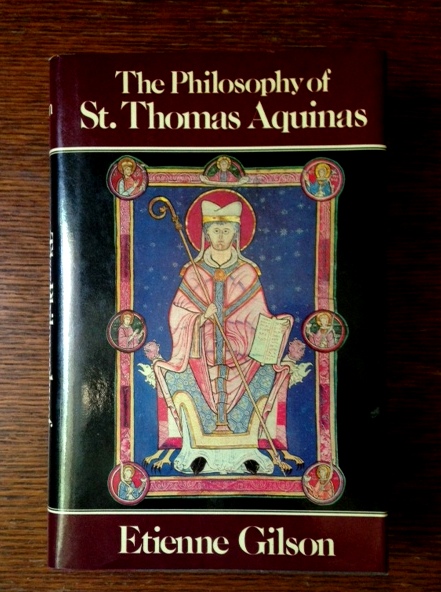
[Ed.: This is my own copy of a Gilson book, the only one I own, unread these many years. Now I'm inspired to read it.]
Which of Gilson’s books should you read? Some of his books are for the professionals, such as Being and Some Philosophers or – I would say – The Christian Philosophy of Saint Thomas Aquinas. I love both of those books but it is difficult to imagine someone reading them purely for the pleasure of it, without intending to write a paper or an essay about them. Some of Gilson’s writing is dated, like his book about Dante. Some of his philosophical writing is too difficult for amateurs and some of his history writing is out of date. Nonetheless, a surprising number of his books remain in print, and some of his books are still being translated from the French down to the present. Here are two or three books by Gilson which many people with a taste for philosophy could enjoy.
The Unity of Philosophical Experience was given at Harvard in 1936 for the ‘William James’ lecture series. It is about a series of ever graver assaults on the possibility of metaphysics – at the hands of psychologists who reduce metaphysics to psychology, worshippers of mathematics who think maths explains everything, ‘theologists’ who reduce metaphysics to theology (making God everything and nature nothing) and ‘sociologists’ who reduce metaphysics to the study of society. And yet, every attempt to kill metaphysics and replace it with some supposedly higher discipline (sociology, psychology, mathematics, even theology) fails: metaphysics defeats its ‘undertakers’ because, Gilson argues, questions about being and reality will not lie down and die on command. Philosophical experience is rooted in reality, in existence. The laws which unify philosophical experience root it in existence. Existential questions, or questions about being, ‘what is,’ are the ones which drive metaphysics. Existence is a vital reality which is larger than any of the tombs prepared for it, by the particular disciplines like psychology or sociology. I have never succeeded in describing The Unity of Philosophical Experience without making it sound more difficult than it is. It is a bit like C.S. Lewis’ A Pilgrim’s Regress: it’s about a series of reductionist attempts to say ‘metaphysics is ‘really just’ something smaller than the effort to respond to being as a whole.
I first read The Unity of Philosophical Experience as an undergraduate, and I thought it was a history book, detailing the decline of philosophy as a result of a sequence of disasters, beginning with theologism, with its nominalism and voluntarism, on through the psychologism of William of Ockham, the Mathematicism of Descartes, the moralism of Kant and on to the ‘sociolatry’ of Comte. A little later I came to ‘Grad School’ in the States and was taken aback by the venom with which a CUA graduate responded to my reference to Gilson. Like me, he had mistaken The Unity for an historical narrative. Unlike me, he was sufficiently sophisticated to be repulsed by the one sided caricatures of Avienna, Scotus, Bonaventure, Descartes and Kant which he found in it. In fact, Gilson says very clearly that the Unity (and likewise Being and Some Philosophers and God and Philosophy) are not history books at all, but works of philosophy. As in A Pilgrim’s Regress, the figures which Gilson treats are ‘allegorical,’ meant to stand in for certain tendencies or ideas. The ‘Ockham’ or the ‘Scotus’ of The Unity is not the real, three-dimensional Ockham or Scotus, but one aspect of those thinkers, studied from very close up and detached from the wider body of their thinking. I give The Unity of Philosophical Experience as an example of a book which any educated person could enjoy because it deliberately simplifies and paints a philosophical story in primary colours. The reason Gilson’s books have lasted is his aesthetic sense, his ability to paint a picture which draws the eye to the center of events, their existential core.
The Spirit of Mediaeval Philosophy is Gilson’s ‘Gifford Lectures’, given at Aberdeen in 1931-1932. Starting with the apologists and Athenagoras, and running right down to the Franciscan Scotists and William of Ockham himself, Gilson argues that the ‘spirit’ of mediaeval philosophy is Christian faith, and that this faith enabled it to delve deeper into existence and its mysteries than any previous human thinking. Now, I’m a theologian and I use words like ‘delve’. But what Gilson means to say is that the theological genesis of mediaeval philosophy enables it to argue and reason to intellectual heights which had never hitherto been assaulted. The philosophers of the Middle Ages believed themselves to be living in a created cosmos. This enabled them to perceive that things are good, that they are oriented towards ends, that they are knowable, and above all, that things exist in and of themselves.
Living in a cosmos they believed (from Genesis) to have been freely created in time by God, the mediaeval philosophers woke up each morning feeling lucky to be alive. So they noticed that things are not just in here (as concepts), and not just out there (as objects) but exist, as individual acts of being. Every existent thing is like a ‘one off’ art work: it exists at all not just because stuff is out there but because God created it. God does create kinds of things – he does a line in trees, say, and a range of fish. But that there are kinds and ranges of things is not just a given, because God creates natures and kinds of things by making them exist. The mediaeval philosophers were able to notice existence because they could ‘see the Masters hand’ working in and through their ‘sacramental cosmos’.
The Spirit of Mediaeval Philosophy is a book length defence of the influence of Christian faith on philosophy. It is a defence of the possibility of ‘Christian philosophy,’ the product of believers’ reasoning. The old Heineken advertisments used to claim that this beer ‘reaches parts other beers cannot reach’. This is Gilson’s claim for philosophizing within a Biblical, sacramental cosmos: it will reach parts other philosophies cannot attain. Faith gave the Christian thinkers the ability to articulate the metaphysical, existential intuitions common to all humanity. The Spirit is not a ‘faux history book which is a philosophy book in disguise. It is a genuine history of mediaeval thought which uses that history in defence of the possibility of a fruitful and provocative relation of faith to reason.
Thirdly, I would recommend Painting and Reality. Well, I would doubt that any one who does not work in a university would have the time to read Gilson’s Painting and Reality from beginning to end. A few chapters of it would suffice. This is the book in which Gilson combines his great aesthetic sense with his interest in existential questions. He studies art and painting as examples of pure acts of ‘existing’ which come forth from their creator’s hands as physical objects, as ‘kinds of things’ and as ‘existential personae’, characters in the drama of existence. Gilson stresses that paintings do not merely flow from concepts in their maker’s minds, but physically, from the maker’s hands. Many of the people who read this blog would enjoy a few chapters of this master piece.
—Grumpy is a professor of theology in the Midwest.
 Light On Dark Water
Leave a reply to Mac Cancel reply