Penelope Fitzgerald (1916–2000) started her writing career rather late in life at the age of 58, shortly before her husband died. She was a member of the very accomplished Knox family, which included her father, who was the editor of Punch, and his three brothers, one of whom was the famous convert to Roman Catholicism, Monsignor Ronald Knox. She herself took an Oxford First and also seemed set to accomplish much. But then she went to work at the BBC during World War II, married shortly thereafter, had three children, and held on through a difficult marriage that found her having to provide most of the family’s economic support. She even lived in public housing for a long spell, and she wasn’t able financially to quit working as a teacher until she was 70.
Fitzgerald is not considered a Christian writer, but I think she should be. Most critics, at least, have missed that as the wellspring of her novels. They’ve found them little jewels, beautifully written in a spare, incisive way, with touches of subtle wry humor, but they’ve also been mystified by what they’re supposed to mean, and often come away thinking hers is a pessimistic vision of the human lot. I can see why this happens if her Christian belief is not taken into consideration because she does usually leave things hanging in mid-air, unresolved, events seemingly more due to chance than anything else, and so her books have a rather unsettling effect overall. But if a belief in Divine Providence and even the possibility of miracles is put into the mix, things look different, even if still not super clear.
Fitzgerald unfortunately didn’t help to dispel this confusion because, as even she admitted in a couple of interviews, she’d not done her best to get her Christian perspective across, and she blamed that on a lack of courage on her part, since belief was considered ridiculous to many, or even most, folks nowadays. I would think, though, that the settings she chose for her later novels, the ones critics think most highly of, would have given a hint of that Christian perspective. I’ve read only one of her early novels, Offshore, the one for which she got the Booker Prize, and it is based on her own life, the time she spent living with her family on a barge on the Thames. It’s mostly about the eccentric lives of those in the barge community in the changing world of the late 1950s/early 1960s , and there’s not much about belief in it, other than the fact that the children in the book attend a religiously run school and a small appearance by a priest concerned with the children’s lack of regular attendance there. But the three later novels I’ve read—The Gate of Angels, The Beginning of Spring, and The Blue Flower—all feature faith lived or at least faith talked about.
The Gate of Angels is set in 1912 Cambridge and London and spends quite a bit of time talking about the effect of science on belief. Its main character is a young man who has lost his faith and is set to spend his life as a celibate don, until he is knocked unconscious in a bicycle collision with a young woman, wakes up in bed beside her (they’d been put there by the man who found them injured, thinking them married), and immediately falls in love with her. She is a young, disgraced nurse from London, and soon is shown in a court case to have engaged in sexual misconduct. The romance is nipped in the bud, the broken-hearted young man is back on the don career path, and she is leaving town. But then something happens and …; well, I won’t give away the ending, other than to say that we’re left to wonder about the blind chance of it all. Or maybe not so blind, if we can see Providence in there somewhere.
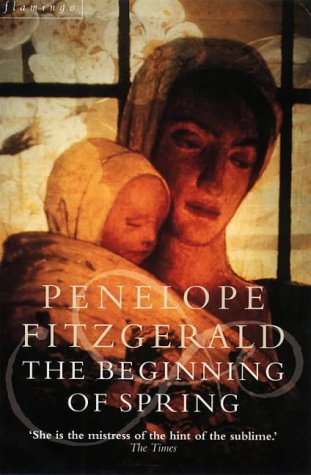
In The Beginning of Spring (my favorite of her books) the setting is Moscow in 1913, at a time when life there was still thoroughly infused with Orthodox Christianity. Its protagonist is a man born to English parents who had come to Russia to set up the printing business he now runs, who is faced with his English-born wife’s suddenly leaving and taking their children with her and then sending the children back to him. First, a taste of how Fitzgerald can perfectly capture setting with the sparest of strokes:
Up until a few years ago the first sound in the morning in Moscow had been the cows coming out of the side-streets, where they were kept in stalls and backyards, and making their way among the horse-trams to their meeting-point at the edge of the Khamovniki, where they were taken by the municipal cowman to their pastures, or, in winter, through the darkness, to the suburban stores of hay. Since the tram-lines were electrified, the cows had disappeared. The trams themselves, from five o’clock in the morning onwards, were the first sound, except for the church bells. In February, both were inaudible behind the inner and outer windows, tightly sealed since last October, rendering the house warm and deaf.
Here in the description of the blessing of the printing business is an example of the way she circles around the matter of faith:
The priest came out in his stole, the deacons in their surplices. The censer was lit with a piece of red-hot charcoal from the canteen samovar. The fragrance of the smoldering cedar of Lebanon reached every corner of the room where men, women and children stood motionless.
Some of them, Frank knew, were agnostics. The storekeeper had told him that, in his opinion, soul and body were like the steam above a factory, one couldn't exist without the other. But he, too, stood motionless. The priest offered a prayer for the God-protected Tsar and his family, for the Imperial Army, that it might put down every enemy of Russia beneath its feet, for the city of Moscow and for the whole country, for those at sea, for travellers, for the sick, for the suffering, for prisoners, for the founders of the Press and the workers there, for mercy, life, peace, health, salvation, visitation, pardon and remission of sins.
Because I don’t believe in this, Frank thought, that doesn’t mean it’s not true. He tried to call himself to order. Thomas Huxley had written that if only there was some proof of the truth of religion, humanity would clutch at it as a drowning man clutches at a hencoop. But as long as mankind doesn’t pretend to believe in something, they see no reason to believe, because there might be an advantage to pretending—as long as they don’t do that, they won’t have sunk to the lowest depths. He himself could be said to be pretending now, still more so when he had attended the Anglican chapel , with the idea of keeping [his wife] Nellie company. Why he had felt alarmed when [his daughter] Dolly told him that her teacher said there was no God, he didn’t know. The alarm suggested that as a rational being he was unsuccessful. Either that, or he had come to think of religion as something appropriate to women and children, and that would be sinking to a lower depth than Huxley had dreamed of. Perhaps, Frank thought, I have faith, even if I have no beliefs.
Dignity and solemnity, a religious urge, followed by confusion, almost dismissal, and then not, or maybe. The use of “motionless” in that passage, by the way, said it all for me.
The Blue Flower, which won the National Book Critics Circle Award in 1997, was Fitzgerald’s last novel. Although it is the one most highly praised by critics, I find it the most mystifying of all. Set in Germany between the last decade of the 18th century and the first of the 19th, it follows the short life and tragic love of an actual German Romantic poet named Novalis, who falls in love with a girl of 12, waits years for her to reach marriageable age, but then she dies a horrible death from tuberculosis before that can happen, and then more family members die terribly young, and then the young poet himself dies. That all sounds very sad, but it didn’t leave me feeling hopeless, just confused about what I should feel. Although there’s some talk of faith, as usual with Fitzgerald it’s ambiguous, so that’s not why the sadness didn’t overpower. Maybe it’s because we get caught up in Fitzgerald’s marvelously rendered details of life in that long-ago time, or maybe the characters are simply too archaic and their concerns therefore don’t seem quite real. Anyway, I’ll leave this with the much-quoted opening of the book:
Jacob Dietmahler was not such a fool that he could not see that they had arrived at his friend's home on the washday. They should not have arrived anywhere, certainly not at this great house, the largest but two in Weisenfels, at such a time. Dietmahler's own mother supervised the washing three times a year, therefore the household had linen and white underwear for four months only. He himself possessed eighty-nine shirts, no more. But here, at the Hardenberg house in Kloster Gasse, he could tell from the great dingy snowfalls of sheets, pillow-cases, bolster-cases, vests, bodices, drawers, from the upper windows into the courtyard, where grave-looking servants, both men and women, were receiving them into giant baskets, that they washed only once a year. This might not mean wealth, in fact he knew that in this case, it didn't, but it was certainly an indication of long standing. A numerous family, also. The underwear of children and young persons, as well as the larger sizes, fluttered through the blue air, as though the children themselves had taken to flight.
—Marianne lives in New Zealand
 Light On Dark Water

Leave a reply to Anne-Marie Cancel reply