I love reading children’s books. I loved them when I was eight and could walk to the library whenever I wanted, and I loved them even more, I think, when I read them to my children, or before giving them to my children. Sometimes I still read them, even though all my children are grown and married.
When I was young, I loved to read books about children from other cultures—to be able to enter other worlds. Diversity, of course, is one of the buzzwords of the day. It is constantly urged on us by the powers that be, and it feels forced. But at that time it was perfectly natural. I wasn’t reading books about different cultures because of a perceived need to be inclusive, but because the books were good and I was captivated by the characters and their lives.
After reading Grumpy’s post on Laura Ingalls Wilder, I thought that I would follow up with a post about two authors from different cultures whose books might be called the Catholic Little House books and the Jewish Little House books. The latter were probably my favorite books when I was about nine, but I only found the former after I had begun homeschooling my children. I originally intended to write about both authors in this post, but as I see it’s getting fairly long, I think I’ll write about the second in a couple of months.
Anne Pellowski was born in 1933 in Arcadia, Wisconsin, only 60 miles away from the Big Woods in Pepin County, Wisconsin where Laura Ingalls Wilder was born. Her great grandparents were the first settlers in the Latsch Valley where she lived. She is well-known for her books and workshops about storytelling, and was the founder and director of the Information Center on Children’s Cultures of the US Committee for UNICEF. She quit this position in the early 1980s to work on her writing and workshops.
I first became acquainted with Ms. Pellowski’s Latch Valley Farm series in 1995 in In Review magazine, a small periodical about children’s literature published by Bethlehem Books. When I read in an article by Therese Ladell about this series featuring a family of Polish Catholic immigrants who were farming in a valley in Wisconsin, I couldn’t wait to get hold of the books for my youngest daughter. I think that I found them in the library, but it took me a long time to collect the 5-book series which was at that time out of print.
Rather than follow one character as she grows up, Ms. Pellowski wrote stories about a year or two in the lives of four young girls in her family that span the years between 1876 and the 1960s. The earliest book in the series, though the fourth written, is First Farm in the Valley: Anna’s Story. Anna is the six year old daughter of Frank and Anna Pellowski, the first settler in the valley. She was about four years younger than Laura Ingalls Wilder and lived, as I mentioned earlier, only about 60 miles away from the Ingalls house in the Big Woods.
There are, of course, similarities between Anna’s story and Laura’s. They lived on a farm and though they lived in a farmhouse, there is an old sod house where the family had first settled, and there is a chapter about a Fourth of July celebration that is very like the one in the Little House books, but there are many differences too. For one thing the family is more settled and prosperous than the Ingalls ever seemed to be. They are surrounded by a community of families who followed them into the valley, and Frank and Anna are very glad to have the other families there. Thirteen families would have been just about the thing to make young Pa Ingalls want to move. The Ingalls family had been living in the United States since the 17th century, but Frank and Anna Pellowski and their parents had recently left Poland to escape Prussian persecution. They still spoke Polish. Laura had two sisters, and a brother who died in infancy; Anna had three sisters and four brothers.
The main difference between the Ingalls and the Pellowskis, though, was the difference between the Protestantism of the American frontier about which Grumpy has written in her post, and the Catholicism of the Pellowski family which is deeply woven into their daily lives. They, of course, go to Mass; they pray the Angelus; they fast during Lent and Advent. One of my favorite chapters, The Seeds Get Blessed, is in the second book (chronologically), Winding Valley Farm: Annie’s Story (Annie was Anne Pellowski’s mother.). The chapter is about Rogation Day when the farmers bring their seeds to church to have them blessed before planting.
Sitting in the front rows were the…girls, wearing white dresses and holding baskets of leaves and pussy willows. Before long, the priest came out, preceded by the altar boys and two deacons. Everyone stood up, and the priest started to sing the Litany of the Saints…
“Sancta Maria,” chanted Father Gara. Down the steps marched two altar boys, and behind them came the girls in their white dresses, the deacons, more altar boys, and then Father Gara. Row by row, the people filed out of the pews and joined in the procession, answering the priest in the chant of the litany.
…
Around the outside of the church they went and up to the fields…. There they stopped and Father Gara sprinkled holy water in all directions, while everyone held up their seeds. Then they marched back to the church, singing a hymn in Polish.
“I like this a lot better than just sitting in church,” thought Annie. “I wish we could march around every Sunday.”
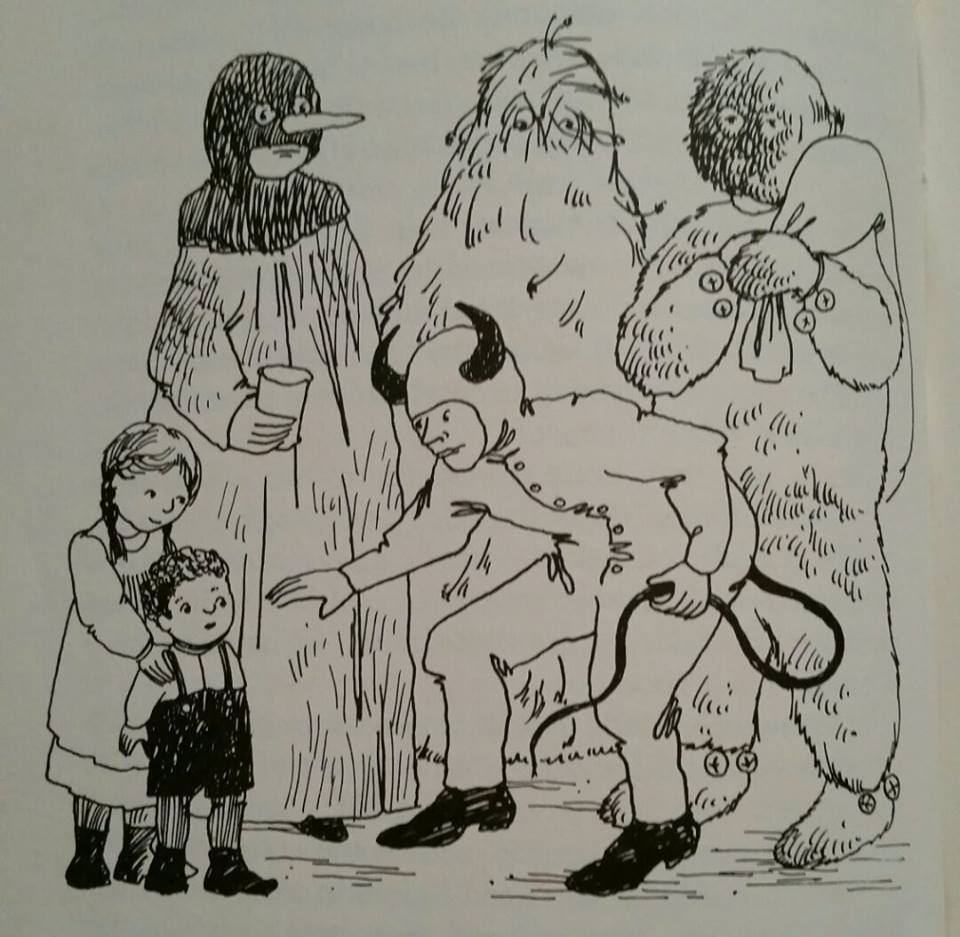
There is one tradition in the books that seems to clearly be some sort of pagan ritual that has taken on Christian trappings. During the traditional Christmas Eve dinner (described here), strangely costumed figures called gvjozdka come to the door and test the children to see if they deserve presents and if they pass, they might get a piece of candy or an orange. In the first book the gvojozdka are just wearing sheepskins, but in the second, they wear more outlandish costumes and are accompanied by a devil who tempts the children.
Like the Little House books, the Latsch Valley books are not always cheerful. There is death here as there is in every life: a grandfather, a newborn baby, many children in a diphtheria epidemic. A schoolhouse burns; accidents happen; there are financial difficulties; but always the family and community pull together.
There is one particularly poignant scene in Stairstep Farm: Anna Rose’s Story, which is set in the 1930s. Anna Rose’s grandfather has died and the family is gathered at his home for the wake. The children are quietly playing a kind of tag outside called Starlight, Moonlight! The Searchers are seeking the Ghosts.
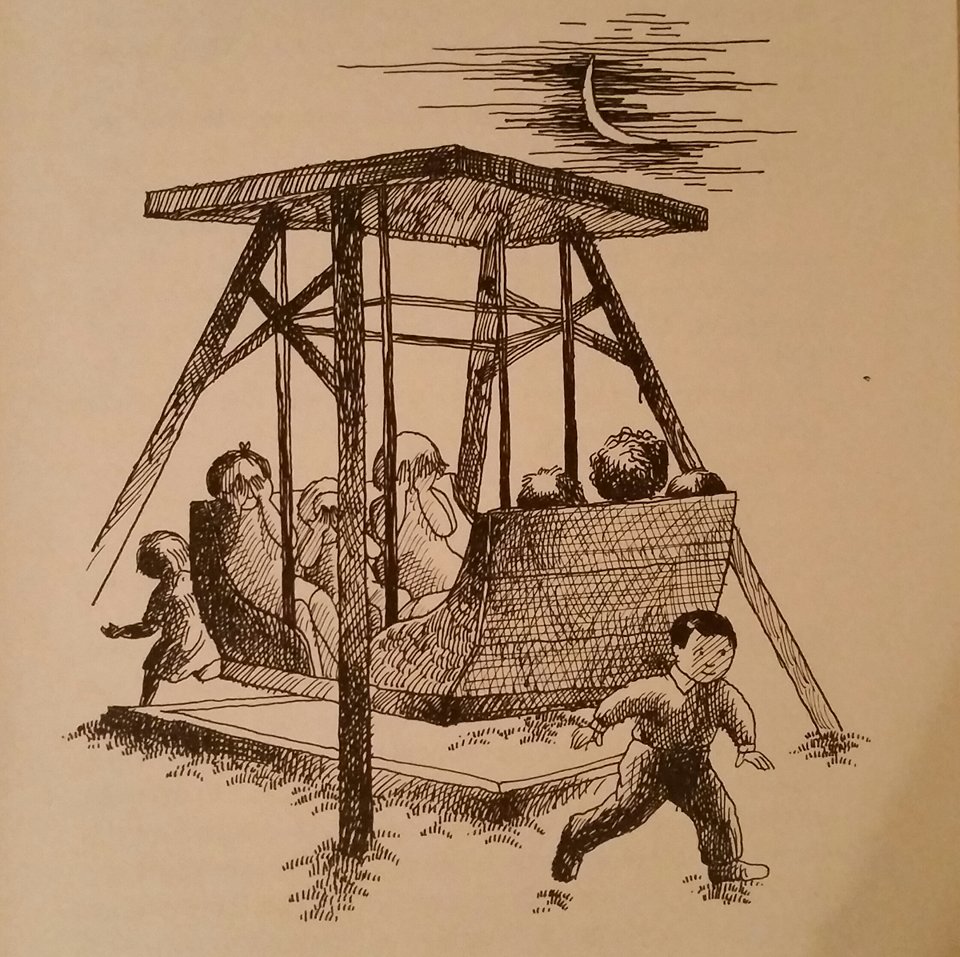
It was time for Anna Rose to be a Ghost again….
“Aren’t we too close to the house?” asked Anna Rose.
…From the open windows of the front room floated the hushed sound of voices, singing in a subdued way, as if they were holding back part of the song. Grandma Olszewski led each verse in her clear, sweet voice. The others would follow as soon as she gave them the first few words. On some verses, only the men sang, deep and low and mournful. When the women sang alone, it was soft and high and sad, too, but in a different way.
Suddenly, across the front yard came the voices of the Searchers, chanting as they set out:
Starlight, Moonlight!
We’re out to see the Ghosts tonight!Again and again they repeated it. The lively rhythm contrasted with the solemn, measured beat of the singers inside. The pungent scent of the ripening raspberries joined with the waves of music coming from both sides. Overhead sparkling stars of the warm August night made just enough light to cast shadows, but not enough to see things clearly. It was so mysterious and beautiful that Anna Rose did not want to play the game any more. She wanted to sit and listen and feel.
I have been in many choirs in my life, and I have sat around many campfires singing, but I’ve never experienced a group of family and friends sitting around singing like this. I wish I had. This scene captures something—an atmosphere that seems to be gone from the world, or at least a large part of it–and it’s a great loss.
As I was reading this third book, it seemed to me that Ms. Pellowski was being rather hard on Anna Rose. She seemed to judge the little girl’s actions more strictly than she had those of the girls in the two previous books. Then, I realized that Anna Rose was Ms. Pellowski, and that the reader sees more of Anna Rose’s inner life than he does of that of the other girls.
The fourth and fifth books of the series, Willow Wind Farm: Betsy’s Story, and Betsy’s Up and Down Year, are set in the 1960s and are the story of Ms. Pellowski’s niece Betsy and Betsy’s brother and eight sisters. Sadly, we begin to see a bit of the dissolution of the '60s begin to creep in. There is less about the faith, and there is a rather mysterious chapter that implies that one of the girls took some pills from her grandmother. The father has to go to work to make ends meet, and the mother has to work in the fields. Then she has to go to work, too. The economy, the oikonomos of the family that we have been discussing is breaking down. While these books follow one another chronologically, they are the first and the last that were written, and the latter was written before the former. Despite the obvious cracks in the family armor, though, there is still much that is good in the Betsy books. Unfortunately, I didn’t get a chance to re-read them before writing so I can’t remember them clearly, but flipping through the books, I can tell that I will have to read them again.
While I was looking up biographical information about Anne Pellowski, I found to my delight that she is still alive. I might write her if I can find out how to do so. The Bethlehem Books website (her current publisher) says that Frank Pellowski has over 800 living descendants. I wonder what they are all doing.
During the course of writing this post, I also got information here and here.
—Janet Cupo has been commenting on this blog for about as long as it's existed, and has her own excellent blog at The Three Prayers.
 Light On Dark Water
Leave a reply to Mac Cancel reply