E.B. White was a great comic novelist. In working on this piece I read his trilogy of fantasy animals twice, and came away with the conviction that these are comic masterpieces. They are of course fantasy novels, in which animals talk and write. The fantasy world of these novels belongs within the genre of comedy. Re-reading E.B. White's trilogy was like the experience I had when our local arts cinema in Aberdeen had a season of Jaques Tati movies. I had seen them all individually, but now I saw them all again, serially, over a few months. The total experience was one of uplift – the natural equivalent of grace. I felt something similar in my re-immersion in White's comic-fantasy world. It is a world which steeps the reader in a kind of 'natural grace'.
I dare say some reader will point out that 'natural grace' is a contradiction in terms but I shall be on my way to Santiago of Compostella and unable to return fire.
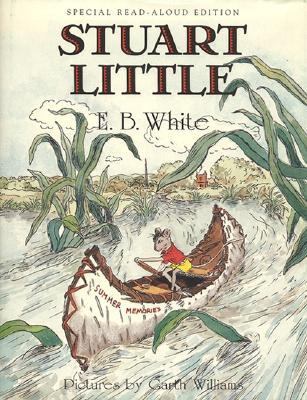
Stuart Little is the first of the three, published in 1945. Of the three, this one is the least of a 'children's book'. Now, I know that someone could say that any good children's book is equally a children's book and an adult's book: it is simply a good book a child could read too. In fact, someone did say that to me, and perhaps she is right. But to me, Stuart Little comes across as a pure joke. The joke is that Mrs. Little gives birth to a mouse, who from birth has the habits and demeanour of a man. This is taken with absolute seriousness, and there is no attempt at all to get the reader affectively to empathize with Stuart and his diminutive condition. There is no 'emotion' in this book. Stuart is depicted with rather a cold eye. There's no warmth here, in the way that we see warmth in Charlotte's Web.
The Little family, Stuart's parents and older brother George are depicted as ineffective in their efforts to accommodate a mouse as family member. They cheerfully use Stuart's size to their advantage, sending him down drains, and using him to rescue ping-pong balls. Stuart's mother cries for him, but Stuart is never really a member of the family. And that is exactly how it would be, if a woman gave birth to a mouse. This is part of the greatness of E.B.White's comic imagination. On the one hand, the greatest extremes of lyrical fantasy. But on the other hand and simultaneously, there is a stoical realism about human nature and its foibles.
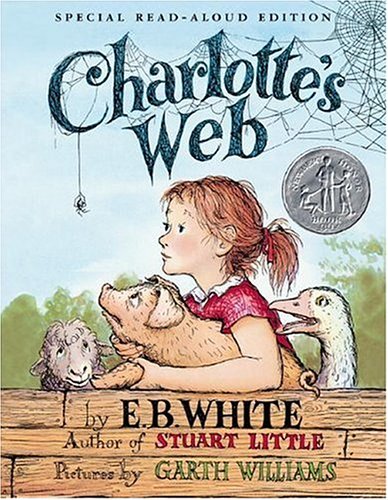
On my first re-reading of Charlotte's Web, I was disappointed in Fern. Fern is the little girl who saves Wilbur the pig's life by refusing to allow her father, Mr. Arable, to take an axe to the runt. She raises him. And then, in Wilbur's very moment of triumph, at the end of the book, when he is given the Fairground medal which saves his life, Fern has lost interest. She has gone to the Ferris Wheel with a boy. Fern has grown up over the book, growing out of her love for the farmyard animals amongst whom she once sat for hours. A boy, Henry Furry, is now more interesting to her than Wilbur. On re-reading the book, I realized that this is E.B. White's great realism at work: the way of the world is that Fern will grow up, and take more interest in humans, and human love, than in animals. Anything else would have been a dreadful fate for the girl. Imagine a 40-year-old Fern Arable, still sitting around the pig pen!
And so it is throughout Charlotte's Web. It is a much more affective and in some ways a more sentimental book than Stuart Little. Surely most of its readers simply do not want Wilbur the pig to die, and recall it as the tale of a pig's triumph over being made into bacon. But the truth is that Charlotte, who saves Wilbur, dies on the night after her protege's triumph. Spiders live only a short while, and the book remains true to this fact of life. The book describes Charlotte, dying alone, in the fairground, after everyone else has gone home. Nothing else could have happened. The pig could not have resisted being forced into his box and driven back to the farm. That is the way animals live, and for all their talking and writing, E.B. White sticks with the laws of animal life. One of the most refreshing aspects of Charlotte's Web and The Trumpet of the Swan is their depictions of the natural life of the seasons.
Stuart Little is a kind of comic version of the Blue Flower. It ends as Stuart begins his journey in search of a bird whom he has loved and who is now clearly unobtainable. Nonetheless Stuart sets out boldly in quest of the unattainable.
Charlotte's Web is about a spider saving Wilbur the pig's life by making the farmers think HE is miraculous by weaving praise of him in her web. The true miracle, that a spider can write 'radiant' in her web, goes unnoticed.
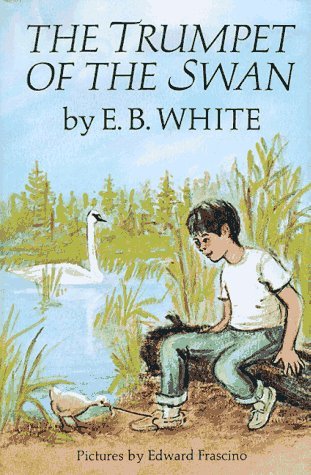
The Trumpet of the Swan is the last and funniest of the three books. The funniest character is Louis' father. The cob is a great idealist. He steals a trumpet for his mute son Louis and yearns to repay his debt to the music store and restore his honour. He gives grandiloquent speeches, thus creating the opportunity for take-downs by his wife. My favourite is when the cob says 'I glide swanlike' and his wife snaps 'You are not likely to glide mooselike'.
No comic hero ever smiles, or laughs or apparently sees the joke of himself. That is why animals make perfect comic heroes: it is entirely realistic for neither Stuart nor the cob nor Louis to recognize how funny their aspirations are.
—Grumpy is a professor of theology in the Midwest.
 Light On Dark Water
Leave a reply to Mac Cancel reply