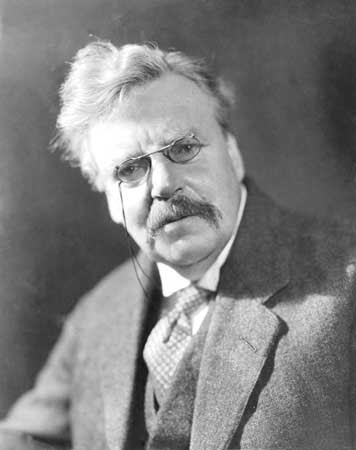
“Anything worth doing is worth doing badly” said Gilbert Keith Chesterton and that gives me the strength to tackle this post, when a fear of not being able to do it well enough would prevent me from even starting.
From 6-8 August, I attended the American Chesterton Society's (ACS) Conference in San Antonio, Texas (a mere four hour drive from my house!) entitled “A Miscellany of Men.”
I had a blast! There were some people there I had met last year, so it was great to see them again and I met plenty of good people at this conference too.
The talks I particularly liked were:
Chesterton and Orestes Brownson
Chesterton and William Cobbett
Chesterton and Distributism
Chesterton and Oscar Wilde
Chesterton as a Model of Lay Spirituality
I'm giving these titles here in case anyone might be interested in hearing them when they become available to download for just a couple of dollars each from the ACS website (here is the link). Kevin O'Brien gave such a passionate talk on GKC and Orestes Brownson, using illustrations of the struggles in his own life, that we gave him a standing ovation.
The talk on William Cobbett (1763-1835 – basically one century before Chesterton) was very interesting to me, because I had only recently heard of him as one of the early historians to challenge the official Whig History of England. I had just bought Chesterton's biography of Cobbett at the book table and GKC's dedication moved me so much I was in tears:
To all the present-day Cobbetts, wherever they may be, who let neither fortune nor favour stand in the way of their defense of the Truth, in season and out, and its proclamation from the housetops. Take courage: for Truth has already overcome the World.
I nearly didn't bother attending the talk on Chesterton and Distributism, because I felt I'd heard it all before. However, I changed my mind, attended, and am pretty glad I did. It was given by John Medaille (pronounced May-die: he wants a hospital named after him!). The Dismal Science hurts my brain at the best of times and especially at 4pm on a Friday afternoon. Consequently I really didn't understand much, but I picked up enough to realise that this was an important talk. He spoke of needing to explain Distributism as a real alternative to modern economics and to demonstrate it as such he applied its principles to cost accounting. Yes, it was getting more dull by the nano-second. I can't explain it to anyone else, but I think that anyone who is truly interested in Distributism would do very well to listen to this talk when it is put up on the ACS website, and that's why I've included this information here.
Joseph Pierce gave a talk entitled Chesterton and Oscar Wilde. I highly recommend it – again, when it becomes available to download. He mostly speaks of Wilde's lifelong love affair with the Catholic Church and by itself, the list of Decadents who eventually converted to the Faith is worth listening to the talk for. Chesterton was no great fan of Wilde, but he did have this to say:
The time has certainly come when this extraordinary man, Oscar Wilde, may be considered merely as a man of letters. He sometimes pretended that art was more important than morality, but that was mere play-acting. Morality or immorality was more important than art to him and everyone else. But the very cloud of tragedy that rested on his career makes it easier to treat him as a mere artist now. His was a complete life, in that awful sense in which your life and mine are incomplete; since we have not yet paid for our sins. In that sense one might call it a perfect life, as one speaks of a perfect equation; it cancels out. On the one hand we have the healthy horror of the evil; on the other the healthy horror of the punishment. We have it all the more because both sin and punishment were highly civilized; that is, nameless and secret. Some have said that Wilde was sacrificed; let it be enough for us to insist on the literal meaning of the word. Any ox that is really sacrificed is made sacred.
The American Chesterton Society has done great work in keeping the work of Chesterton alive and spreading the good news. Lots of people have converted to the Catholic Faith at least partly because of Chesterton, so it is valuable work. Its website has been nominated for best resources website at Best Catholic Websites. I include their blurb here:
The American Chesterton Society (ACS), founded in 1996, works to promote interest in G.K. Chesterton (1874-1936), one of the 20th century’s greatest writers. A convert to the Catholic Church, Chesterton wrote over a hundred books during his lifetime and published over five thousand essays in newspapers and magazines.
One of the most quoted writers in the English language, yet one of the least studied, G.K. Chesterton foresaw and wrote about the issues we struggle with today: social injustice, the culture of death, the decline of the arts, assaults on religion, and attacks on the family and on the dignity of the human person.
One of the talks from last year's conference which I really loved was by David Fagerberg:
He has a book of the same title and naturally I bought a copy. Here are a couple of GKC quotes from the book, which I only found as I was skimming through it this morning:
Once I found a friend
“Dear me,” I said, “he was made for me.”
But now I find more and more friends
Who seem to have been made for me
And more and yet more made for me,
Is it possible we were all made for each other
all over the world?
(from one of his early notebooks in his youth)
A Man Born on the Earth
Perhaps there has been some mistake
How does he know he has come to the right place?
But when he finds his friends
He knows he has come to the right place.
I often feel that Chesterton really is everywhere. By now I have read quite a few of his books and certainly many quotes. He wrote about so many things that I often think of what he would say, when I'm at home looking after the children, when I'm at the store, when I'm with friends and family and especially when I am online!
I first read Chesterton some time in the nineties, I think. I would have read some of the Fr. Brown stories, but didn't read anything else of his until some time in 2002. For some reason, my husband had bought me a subscription to the St. Austin Review and one edition was devoted to Distributism. This certainly had me interested in finding out more, so I next read more about this topic and also tried to read Orthodoxy and The Everlasting Man. Initially, I didn't have much success, but then I worked out that Chesterton does not write “linearly.” He sort of meanders about, it seems to me. So then I decided just to follow him around and I've been doing that ever since! I re-read Orthodoxy, or parts of it fairly regularly. After these, I read his biographies of St. Thomas Aquinas and St. Francis of Assisi, which I enjoyed. More recently I have read What's Wrong With The World and so far this is one of my favourites. I love reading a chapter or two regularly. (It can be read online at Project Gutenberg.)
From the chapter “The Emancipation of Domesticity”:
The shortest way of summarizing the position is to say that woman stands for the idea of Sanity; that intellectual home to which the mind must return after every excursion on extravagance. The mind that finds its way to wild places is the poet's; but the mind that never finds its way back is the lunatic's. There must in every machine be a part that moves and a part that stands still; there must be in everything that changes a part that is unchangeable. And many of the phenomena which moderns hastily condemn are really parts of this position of the woman as the center and pillar of health. Much of what is called her subservience, and even her pliability, is merely the subservience and pliability of a universal remedy; she varies as medicines vary, with the disease. She has to be an optimist to the morbid husband, a salutary pessimist to the happy-go-lucky husband. She has to prevent the Quixote from being put upon, and the bully from putting upon others. The French King wrote—
"Toujours femme varie Bien fol qui s'y fie,"
but the truth is that woman always varies, and that is exactly why we always trust her. To correct every adventure and extravagance with its antidote in common-sense is not (as the moderns seem to think) to be in the position of a spy or a slave. It is to be in the position of Aristotle or (at the lowest) Herbert Spencer, to be a universal morality, a complete system of thought. The slave flatters; the complete moralist rebukes. It is, in short, to be a Trimmer in the true sense of that honorable term; which for some reason or other is always used in a sense exactly opposite to its own. It seems really to be supposed that a Trimmer means a cowardly person who always goes over to the stronger side. It really means a highly chivalrous person who always goes over to the weaker side; like one who trims a boat by sitting where there are few people seated. Woman is a trimmer; and it is a generous, dangerous and romantic trade.
I don't wish to start a quarrel in the commbox about the role of women in the home v. women in the workforce. I simply include these large passages because they are directly applicable to my own life as a homeschooling mother and I have found much comfort in them when I have really needed it:
To put the matter shortly, woman is generally shut up in a house with a human being at the time when he asks all the questions that there are, and some that there aren't. It would be odd if she retained any of the narrowness of a specialist. Now if anyone says that this duty of general enlightenment (even when freed from modern rules and hours, and exercised more spontaneously by a more protected person) is in itself too exacting and oppressive, I can understand the view. I can only answer that our race has thought it worth while to cast this burden on women in order to keep common-sense in the world. But when people begin to talk about this domestic duty as not merely difficult but trivial and dreary, I simply give up the question. For I cannot with the utmost energy of imagination conceive what they mean. When domesticity, for instance, is called drudgery, all the difficulty arises from a double meaning in the word. If drudgery only means dreadfully hard work, I admit the woman drudges in the home, as a man might drudge at the Cathedral of Amiens or drudge behind a gun at Trafalgar. But if it means that the hard work is more heavy because it is trifling, colorless and of small import to the soul, then as I say, I give it up; I do not know what the words mean. To be Queen Elizabeth within a definite area, deciding sales, banquets, labors and holidays; to be Whiteley within a certain area, providing toys, boots, sheets, cakes and books, to be Aristotle within a certain area, teaching morals, manners, theology, and hygiene; I can understand how this might exhaust the mind, but I cannot imagine how it could narrow it. How can it be a large career to tell other people's children about the Rule of Three, and a small career to tell one's own children about the universe? How can it be broad to be the same thing to everyone, and narrow to be everything to someone? No; a woman's function is laborious, but because it is gigantic, not because it is minute. I will pity Mrs. Jones for the hugeness of her task; I will never pity her for its smallness.
Finally, Chesterton is on Twitter!
Some of today's quotes from GKC fans on Twitter (August 16th):
“We fight for the right of normal people to define normality”
“There are only two things that can bind men together; a convention and a creed.”
“Morality is always terribly complicated—to a man who has lost all his principles.”
“There are no uninteresting things, only uninterested people.”
“All that talk of not caring for creeds has simply become one fixed, very formal, and slightly hypocritical creed.”
“In the modern world we are rapidly going back to dividing the tolerable and the intolerable merely as the familiar and the unfamiliar.”
“The weakness in the Liberal theory of toleration was this: that its apostles seem to have taken common morals & natural religion for granted.”
"A patriot is always a little sad."

—Louise is an Australian homeschooling mother of six, currently living in Texas.
 Light On Dark Water
Leave a reply to Mac Cancel reply