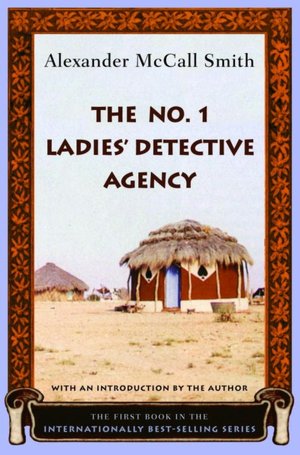
We don't forget, thought Mma Ramotswe. Our heads may be small, but they are as full of memories as the sky may sometimes be full of swarming bees, thousands and thousands of memories, of smells, of places, of little things that happened to us and which come back, unexpectedly, to remind us who we are. And who am I? I am Precious Ramotswe, citizen of Botswana, daughter of Obed Ramotswe who died because he had been a miner and could no longer breathe. His life was unrecorded; who is there to write down the lives of ordinary people?
I first heard the name Precious Ramotswe from my friend Barbara who was having a conversation with her daughter. The expression on their faces while they were talking about her was the expression that people have when they are talking about someone they love. I asked Barbara about the book, and thereby came to read The No. 1 Ladies' Detective Agency. I can remember that I found the book in our library, and sat down in my favorite chair in the children's section to wait for my daughter to finish selecting her books. By the time she was ready to go, I had a hard time closing the book.
Mma Ramotswe is a traditionally built Motswana (a person from Botswana). After the death of her beloved Father, Mma Ramotswe uses the proceeds from the sale of his cattle to open the the No. 1 Ladies' Detective Agency. Having amply prepared herself for her true vocation by studying that exemplary text, The Principles of Private Detection, by Mr. Clovis Andersen, she launches herself into her new life.
[Mma Ramotswe] was a good detective, and a good woman. A good woman in a good country, one might say. She loved her country, Botswana, which is a place of peace, and she loved Africa, for all its trials. I am not ashamed to be called an African patriot, said Mma Ramotswe. I love all the people whom God made, but I especially know how to love the people who live in this place. They are my people, my brothers and sisters. It is my duty to help them to solve the mysteries in their lives. That is what I am called to do.
The world of Mma Ramotswe is not always happy. The books deal with many serious subjects: the working conditions of the Kalahari diamond mines, the AIDs epidemic and the many orphans who suffer as a result of the epidemic, spousal abuse and infidelity, and people who have given themselves over to evil. Both Mma and her beloved country have sad and troubled histories. Nevertheless, the overall impression that one takes away from the series is one of joy. The books are funny with a gentle, understated humor, and the overall atmosphere is one of contentment and peace.
During the course of the series we become familiar with the people who surround Mma Ramotswe. First,there is her indomitable secretary, Mma Makutsi, a widow who has just graduated from the Botswana College of Secretarial and Office Skills with an average of 97%. And then, there is Mr. J. L. B. Matekoni, proprietor of Tlokweng Road Speedy Motors; he is her always trustworthy and dependable friend, an excellent man in every way and eventually, her husband. (Yes, this is a spoiler, but not much of one since it's pretty evident from the beginning.) We meet Mma Potokwane, the matron of the orphanage, who has her own irresistible way (cakes being a necessary incentive) of getting people–especially Mr. J. L. B. Matekoni–to do whatever she needs done for the children, and Mr. Polopetsi, who assists the ladies in their detection. There are also Mma Makutsi's nemesis, the evil Violet Sephotho who was an academic failure at the Botswana College of Secretarial and Office Skills, but who succeeds wildly in her profession because of her physical charms and lack of scruples, and Note Motoki, Mma Ramotswe's selfish and unprinicipled ex-husband.
Mma Romotswe's character is beautifully drawn. She is wise and fair and generous. She is a loyal friend and a just opponent. She's the sort of person with whom I would like to sit down and have a cup of red bush tea, had I not a deep suspicion of a substance called red bush tea. She reminds me of my two African women friends, and her voice seems to be an authentic voice, which is why I was a bit taken aback when I saw this.
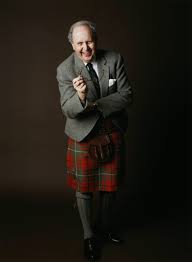
I must have know the name of the author of The No. 1 Ladies' Detective Agency, because I found the book in the library, but somehow it didn't really register with me, and it wasn't until I was well into the book that I realized that the creator of Mma Ramotswe's voice was a white (very white) man in a kilt, no less.
Despite the name and the kilt, McCall Smith comes by his knowledge of Botswana honestly. He was born in neighboring Zimbabawe, what was then Southern Rhodesia. Eventually, he received a PhD in law from the University of Edinburgh, and later returned to Africa where he helped to found the University of Botswana. He currently lives in Edinburgh.
He is the former chairman of the British Medical Journal Ethics Committee (until 2002), the former vice-chairman of the Human Genetics Commission of the United Kingdom, and a former member of the International Bioethics Committee of UNESCO.
(All this biographical information and more can be found in Wikipedia. I tried to find another source but since I am writing this literally at the last minute, I can't be too choosy.)
Very occasionally, Mma Ramotswe will say something which I think is out of character, most notably she once said that sometimes a woman must have an abortion, but when this happens, I just tell myself that McCall Smith is just putting words in her mouth.
McCall Smith is a very prolific writer. Since The No. 1 Ladies' Detective Agency was published in 1998 he has written 15 more books in this series and published at least 15 other novels, some short stories and at least 2 children's books.
Another series, The Sunday Philosophy Club series, features Isabel Dalhousie, the editor of the Review of Applied Ethics, and hostess of the eponymous club, although the club does not often appear in the books. I do not like these nearly as well as I do the Mma Ramotswe books, but I like them well enough. They are mysteries, but the mysteries are merely a background for the story of Isabel's life and material for her philosophical pondering about—well, everything.
There are also the 44 Scotland Street and the Corduroy Mansions series. I have read at least one of the former and perhaps I have also read one of the latter, but neither of these left much of an impression on me. I can't remember what they were about, nor can I remember much of anything about any of the characters.
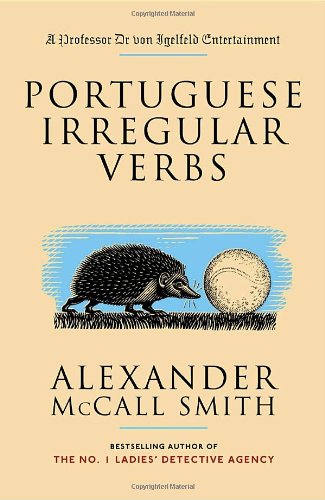
Last but not least, series-wise anyway, and totally different from any of McCall Smith's other series is the small, but entirely delightful series about Professor Dr Moritz-Maria von Igelfeld. Originally published as, Portuguese Irregular Verbs, The Finer Points of Sausage Dogs, and The Villa of Reduced Circumstances, it was later released in a single volume called The 2 ½ Pillars of Wisdom. This short trilogy (the entire series runs to about 400 pages) follows the personal and professional life of Professor Dr von Igelfeld, famous in his field for his 900 page exegesis of Portuguese grammar, and “pillar of the Institute of Romance Philology in the proud Bavarian city of Regensburg.” and I found it to be hilarious. I think that anyone who has had any involvement in the drama of academic life (even anyone who has been merely on the sidelines, as I was) will appreciate these books. I see that a new, and longer (224 pages) addition to this series was released in 2013, and I'm planning to listen to it on vacation.
As far as I can remember, while the morality of the characters in these novels is not always up to Christian standards, there are no titillating passages, graphic sex scenes, or disturbing sexual relationships in any of them, and all of them are fairly positive books. This cannot be said for the one collection of short stories that I have read, The Heavenly Date and Other Flirtations. It has been a long time since I picked this book up in the library, and I did not read all the stories, but my overall impression of the stories is that they were dark and perverse throughout. They show a side of McCall Smith that I was not particularly eager to see. They are probably well-written, but I wouldn't recommend them.
All-in-all though, I have found McCall Smith's books perfect reading for those days when I want to read for pure enjoyment and relaxation. I can't say that the series are not somewhat formulaic, but there is enough variety in the stories to overcome the formulas, and there are times when you look forward to a certain dependable sameness in a story, the same way you sometimes appreciate a favorite restaurant chain after you have been on a trip where you have been eating somewhat experimentally.
—Janet Cupo has been commenting on this blog for about as long as it's existed, and has her own excellent blog at The Three Prayers.
[Editor's note: special thanks to Janet for writing this on very short (24 hours) notice. We were about to miss a week. If you've signed up for an author and know pretty definitely that you aren't going to be able to do the piece, please let me know (email address on profile page).]
 Light On Dark Water
Leave a reply to Rob G Cancel reply