In the late 1940s Mary Tew, an Oxford doctoral student in anthropology, was looking around for a suitable place to do fieldwork. These days that could mean anything (Kate Fox’s Watching the English is an entertaining example of turning an anthropologist’s eye on one’s native surroundings), but in the 1940s, in a European context, it meant trying to understand the foreign thought-worlds of less developed communities in far-flung parts of colonial empires. She later wrote that her choice fell on the Lele people of what was then the Belgian Congo because she had been given to understand that they practiced not just polygyny (a relatively widespread form of polygamy) but also polyandry (much rarer), and she was intrigued by the idea of a woman having more than one husband.
By the time her doctorate was published as a book, in 1963, she had been married for about a decade and was working under the name Mary Douglas. (There is a Wikipedia entry, but it is not very informative.) The Lele of the Kasai is a readable observation-based analysis of a vanishing way of life in Central Africa, but it would be of little interest to those outside the academy. So far as polyandry was concerned, the Lele might have been something of a disappointment: male elders controlled access to brides, but there was also a ‘village wife’ who would take turns with the available men. This is not quite the harem of husbands that the word ‘polyandry’ might bring to mind, and missionaries regarded it as a form of prostitution. Mary Douglas, however, saw elements of honour and agency in the village wife’s status that gave her a key role in village life, not the sort of marginalised status one would associate with a prostitute in Western societies.
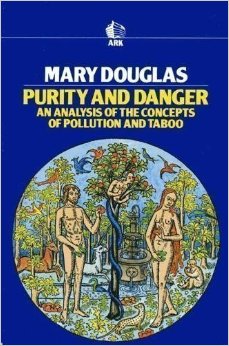
It might have been polyandry that first piqued Douglas’s interest in the Lele, but once living among them her intellectual engagement shifted to beliefs and practices relating to divination, sorcery, witchcraft, and notions of pollution and ritual purity. The fruit of her reflection on pollution and purity, encountered among the Lele but explored intellectually for over a decade once back in Britain, was the book for which she is probably most famous, Purity and Danger: An Analysis of the Concepts of Pollution and Taboo.
The book is the work of a brilliant mind, honed in the intellectual discipline of social anthropology, broadened by life among an utterly alien people, reflecting not just on theoretical questions but on the everyday concerns of a wife and mother. Douglas ranges widely through anthropological literature of all kinds, on castes in India, Nigerian smallpox priests, sexual taboos in New Guinea, to her own fieldwork among the Lele, but questions that she addresses include why it should be thought shameful to serve a guest tea in a chipped cup, and why we happily let children play in the sea, knowing that it houses many corpses, when we would not let them into a swimming pool with a single corpse in it. At what point is pollution perceived, and at what point is it perceived as a danger?
This is a question that has bearing on ecological questions as well, and Douglas explored these implications in Risk and Culture (1983), written with Aaron Wildavsky, although this made her unpopular with some ecologists who felt she had described them as a tribe whose beliefs about purity could be understood anthropologically (Roger Scruton, in contrast, says that the book 'captures tendencies within social and political thinking that help to show why there is a real, lasting and rooted difference between "left" and "right". And it provides a language with which both left and right can discuss their shared concerns without regarding their opponents as inhuman.')
To return to Purity and Danger, one of the most famous aspects is her discussion of Jewish dietary laws. She takes issue with the 19th-century idea, still apparently widely prevalent in the mid-20th century, that the dietary prohibitions of the Mosaic law were primitive regulations of health and hygiene, designed for the avoidance of disease. Instead, she seeks to understand them through notions of ritual purity. She points out that Jews are permitted to eat animals of the land, water and air that clearly fall into the category of a herd animal, or a fish, or a bird that does not eat carrion, but not those that lacked some of the key defining characteristics, or had ‘mixed’ features. Pork became the symbol of Jewish difference because it was the one animal prohibited that was widely eaten by neighbouring peoples, but the reason it was prohibited was not hygienic but conceptual: it shares some but not all of the key characteristics of herd animals as a set. This was a modelling of the body on the sacrificial altar: humans could eat only those animals that they would be permitted to give to God, and should avoid even physical contact with the rest.
If the proposed interpretation of the forbidden animals is correct, the dietary laws would have been something which at every turn inspired meditation on the oneness, surety and completeness of God. By the rules of avoidance, Holiness was given a physical expression in every encounter with the animal kingdom and at every meal.
Later she revised her view on the dietary rules, in two books I have not read, In the Wilderness (1993) and Leviticus as Literature (1999). When this series was mooted late last year, I put my name down for three authors (Christopher Derrick, Mary Douglas and Edith Stein) thinking it would encourage me to read those of their works that I had been meaning to get round to reading. So far, this has not actually happened. If anything, I have been reading what others have written about, rather than what I am supposed to be writing on. I gather indirectly that in her later thinking the concept of ‘covenant’ came to the fore: the ancient Israelites ate only those animals that did not eat other animals and that humans could in some sort raise. But this is something I may have misunderstood.
Douglas’s writing is fascinating for the broad themes she addresses, but also for the many anthropological details she fishes up from the literature as well as from her own experience both of fieldwork and of life in the United Kingdom (unlike most of her academic peers, she was herself consciously involved in making rituals happen, as a parish volunteer, and knew how much thought and work went into them each time, even when they were ‘traditional’). A lot of her books are relatively pricey (as academic books tend to be) and sometimes hard to get hold of, but the two major works, Purity and Danger and Natural Symbols, are both still in print in paperback editions.
This latter, Natural Symbols, published in 1970, examines the importance of shared symbols to social cohesion. It is a logical next step (in the Jewish case, having thought about why the prohibition on pork arose, she was now thinking about how it set them apart as a people; and also about how Friday abstention from meat set Catholics apart from non-Catholic neighbours.) As a social anthropologist she was convinced that ‘There is no person whose life does not need to unfold in a coherent symbolic system. … it is an illusion to suppose that there can be organisation without symbolic expression.’ She placed both symbols and societies on spectra of hierarchy and informality, seeking to correlate world-view and life-style through a plethora of contemporary and historical examples.
One of the insights of Douglas’s work is that people have a remarkable tendency to model the concept of the person on the concept of society, and to regard people who do not fit standard social categories as being dirty people (disease-bearing sexual delinquents who will cheat you or steal from you and who eat disgusting food) — who can then be labelled as lepers, witches, an underclass, ‘dirty foreigners’, or whatever else might fit the circumstances. This fits with her earlier work on sorcery and pollution, but questions of symbol and community also bring her to consider the sacraments. Writing of the modernizing liturgists and catechists of the day, she says:
The mystery of the Eucharist is too dazzlingly magical for their impoverished symbolic perception. Like the pygmies (I say it again, since they seem often to pride themselves on having reached some high peak of intellectual development) they cannot conceive of the deity as located in any one thing or place. But … vast unlettered flocks scattered over the globe do not share this disability. … What is too strong meat for the pastors is their natural food. ‘The hungry sheep look up and are not fed.’ There is no question now that the flocks are neglected by jolly, hunting parsons bent on pleasure. But there seems to be a case for arguing that serious, well-intending pastors misunderstand the need for a nourishing food, because it does not seem to suit their own digestive systems.
Speaking personally, to find an intra-ecclesial polemic such as this in the midst of a learned book that discusses every possible type of symbolic action and social system was exhilarating and breath-taking. (Perhaps this post should include a spoiler alert?)
Much of social anthropology as it developed up to the middle of the 20th century was, directly or indirectly, part of the colonialist project to understand what made the natives tick. There was a sense that our behaviour made sense, while that of other societies needed explaining. If there is a single main point throughout Douglas’s writing it might be that ‘primitive’ people (whether backwoods African tribesmen, or Bronze Age Israelites, or anybody between) are no more stupid than the rest of us: their behaviours make perfect sense, and are perfectly rational, when understood in the light of their societies and their preconceptions; and our own behaviours are just as much conditioned by the presuppositions we imbibe from our societies.
As Risk and Culture puts it: “standing inside our own culture, we can only look at our predicament through our culturally fabricated lenses”. Social anthropology gives us one way of getting a longer perspective on our own culture. This aspect of her writing has led some to label her a ‘postmodernist’, but don’t let that put you off. All it means is that she could see through modernism. She had none of the anti-humanism so typical of literary postmodernism, and she certainly didn’t take the view that people are prisoners of their cultures: a culture makes it possible to be human, providing the tools with which people respond to their environment; but the different ways in which people respond are conditioned by what tools they have available. Mary Douglas herself provides some of the sharpest tools one could wish for. While not a novelist, Mary Douglas is a writer who engages the sympathetic imagination at every turn, in helping to understand social behaviours and beliefs that are sometimes amazingly foreign.
—Paul has been reading the blog since 2008, when Janet drew his attention to a discussion about Brideshead Revisited. He currently trains translators in Belgium.
 Light On Dark Water
Leave a reply to Mac Cancel reply