It's been said that Guardini is a big influence on Pope Francis, and that was certainly apparent to me when I read Laudato Si soon after End of the Modern World. If the latter identifies any one greatest practical danger facing man in this new world, it's that his power has grown vastly greater than his wisdom. This is a point that Francis makes, too, and he does it in several points by quoting Guardini directly, so the question of influence is not speculative.
Just as interesting as my having followed Guardini's book with Francis's encyclical was thatI read End of the Modern World immediately after Christopher Lasch's Culture of Narcissism. And while I did admire Lasch's book (see this discussion), it was overshadowed by Guardini's. The two are similar in that they attempt to discern and describe the large-scale historical movement of our times. But Lasch, as I mentioned in that discussion, doesn't have a large enough philosophy.
And then the immediate successor of End of the Modern World in my reading was Thomas Mann's Doctor Faustus, and that was really the most interesting juxtaposition of all. The novel might have been designed as an exercise in working out Guardini's ideas in fiction.
But let me back up a little. The volume that's published as The End of the Modern World is actually two short books, or perhaps one short book and one rather long essay. The title work comes first and is followed by Power and Responsibility, which attempts to work out a concrete response to the situation described in the first book.
What Guardini means by "the modern world" is not what most people have meant in casual use for most of the past century, namely the world of automobiles, airplanes, radio, the telephone, the cinema; then later television, and, more recently, the various manifestations of computing technology married to communications. Or, politically and culturally speaking, the world of democracy as the presumptive good in politics, of naturalism as the presumptive norm in philosophy and religion, and, not least, of the presumption of a level of wealth that allows an unprecedented degree of personal freedom and comfort. Guardini is referring, rather, to the world that came into being with the Renaissance, the humanistic culture that rested on the foundations of Christianity but was detached from the faith and saw no need for it.
This culture he describes as being built upon three central ideas: nature, personality, and culture. I don't think I can explain briefly what he means; this paragraph will have to serve for a summary:
The intellectual consciousness of modern Europe as commonly delineated and accepted even in our day proclaimed those three ideals: a Nature subsisting in itself; an autonomous personality of the human subject; a culture self-created out of norms intrinsic to his own essence. The European mind believed further that the constant creation and perfection of this "culture" constituted the final goal of history. This was all a mistake.
It must be kept in mind that Guardini was writing just after the end of World War II. The solid, confident and essentially optimistic culture of which he speaks had vanished in two great wars, apocalyptic fires which took millions of lives and shattered every psychological certainty. There had been plenty of signs of cultural sickness before the wars, of course, so that it seemed as if a wasting disease had been growing invisibly and almost unnoticed for a long time, with the killing effects on the patient only seeming to appear abruptly. Whatever Europe is now, it is not what it was before those wars.
This is where the parallel with Doctor Faustus appears. Someone with more of a scholarly bent than I have might explore this in great detail. I note only the broad parallel: the novel is narrated by Serenus Zeitblom, a representative of the old culture, and moreover a Catholic who, although he sees the world from the broad bourgeois-humanist point of view, seems at bottom to believe. He tells the story of his friend Adrian Leverkühn, a composer who in an ambivalent way participates, by means of developing the twelve-tone aharmonic theory of music (borrowed from Arnold Schoenberg), in the destruction of the old order. Leverkühn may have sold his soul to the devil. Zeitblom's account begins with the late 19th century, and he is writing it during the last days of World War II. So alongside Leverkühn's artistic career we get glimpses of the madness into which Germany was descending, with Zeitblom writing of Leverkühn's end as Germany is disintegrating around him.
The parallel stops here, because Mann only tells us of the end, while Guardini is concerned with what comes next. For him–to over-simplify–the situation after that second war was something new, an atmosphere in which the sentimental and half-skeptical piety which was all that was left of Christian culture could not survive. A new orientation and a new response would be required. This is what he was getting at in words which fans of Walker Percy know even if they have never read another word of Guardini, because they are included in the epigraph of The Last Gentleman:
…the new age will declare that the secularized facets of Christianity are sentimentalities. This declaration will clear the air. The world to come will be filled with animosity and danger, but it will be a world open and clean.
As definite prophecy that hasn't so far proved to be exactly the case: sentimentality we have in abundance, but it's not Christian sentimentality. It's atheistic sentimentality which cannot conceive of any good greater than well-being in this world. That animosity and danger still lie beneath it, though, as we can see in the work of "ethicists" like Peter Singer, who, in the name of that well-being, approves the killing of infants.
So give the new world a bit more time. Anyone with ears to hear and eyes to see knows that a great hatred of Christianity and of the Christian civilization of the past is prevalent in the upper classes of our society, among intellectuals and those who are shaped by intellectuals, and now many of those who are shaped by those who are shaped–businessmen, schoolteachers, bureaucrats–so that the platitudes of the bourgeoisie are more and more the platitudes of the progressive intellectual.
As unbelievers deny Revelation more decisively, as they put their denial into more consistent practice, it will become the more evident what it really means to be a Christian. At the same time, the unbeliever will emerge from the fogs of secularism. He will cease to reap benefit from the values and forces developed by the very Revelation he denies. He must learn to exist honestly without Christ and without the God revealed through Him; he will have to learn to experience what this honesty means. Nietzsche has already warned us that the non-Christian of the modern world had no realization of what it truly meant to be without Christ. The last decades have suggested what life without Christ really is. The last decades were only the beginning.
But I don't want to leave you with the impression that this book exists in order to tell us that our doom is coming into view. It is rather an attempt to discern what is actually happening, and how Christians may face it.
[The new man] has overcome the modern dogma: all things of themselves are for the best. For him the optimism of the progress-worshipper no longer exists. He knows from experience that left to themselves, things just as readily retrogress. He knows that the world is in the hands of freedom, hence he feels responsibility for tomorrow's kind of freedom. And love, his love of the world is very special, deepened by the precariousness, vulnerability, helplessness of his beloved. To his respect for power and greatness, his comfortable relationships to technology and his will to utilize it, to the zest of looking danger in the eye, he adds another quality, chivalry, not to say tenderness, toward finite, oh-so-jeopardized existence.
Please don't think that I've given you an adequate picture of the book. I 'm only pointing it out and suggesting that you read it if you want to understand our cultural situation from the broadest perspective.
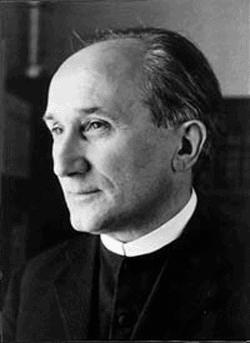
Here, for what it's worth, is Guardini's Wikipedia biography.
 Light On Dark Water
Leave a reply to Janet Cancel reply