
Christopher Plummer as Leo Tolstoy in The Last Station
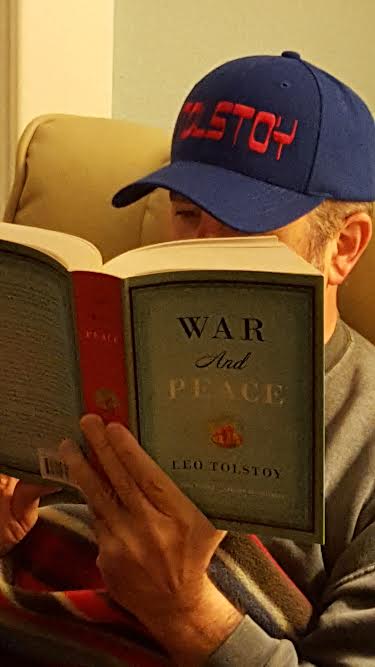
I am not a Tolstoy expert, but I sometimes play one in my personal life. But really… I have only read War and Peace once, Anna Karenina 2.5 times, and The Death of Ivan Ilych (once also); and that’s it. At the time I read War and Peace, around seven or so years ago, I felt like it changed my life. That is too broad a statement – perhaps (and more likely) it changed the way I look at the world, and literature, and writing in general. Teen-agers sometimes read big books and they’re proud. When I was in high school I read Atlas Shrugged by Ayn Rand, and I suppose I thought I was something. Yeah, you may have slogged your way through The Stand by Stephen King, but try a little Ayn Rand on for size! Or don’t, really, there’s no reason to. I think young people these days, or maybe days several years back now … might feel that way about Infinite Jest by David Foster Wallace. A big book about something, ideas maybe? You haul it around and impress people with its girth.
War and Peace is the real thing. Back immediately upon finishing it, when I strutted around the Spring Hill College campus (to Mac’s office among other places), I probably made grandiose statements like “all of life can be found in War and Peace”. As annoying as it is for someone to show up to your office and say this, it is true. Tolstoy takes the Napoleonic Wars as his centerpiece and displays Russian society, as much as he can tell you about them, while the French army marches towards Moscow. Upper-class Russians at this time are very French in their behavior, language, mannerisms … they want to try to be European. Moscow is so far from everything, it seems just barely part of Europe. The first sections of the novel are full of characters speaking to each other in French and in English. Oh, well, I suppose it is French and Russian, but in my volumes there are no Cyrillic characters. As the novel progresses you see less and less French, for obvious reasons.
This brings me to one of my favorite subjects – which translator of Russian literature is your favorite? There are of course the old standards: Constance Garnett (she met Tolstoy once), and Louise and Aylmer Maude (they knew Tolstoy!). Of the new ones, Richard Pevear and Larissa Volokhonsky are currently all the rage. The War and Peace I read is the Penguin edition translated by Anthony Briggs. Ever loyal, I had first begun Garnett’s version because I had found her Anna Karenina to be quite nice. Sadly, I had to give up after a few hundred pages and go elsewhere. In one of the many magazine internet articles I have read on the subject of Russian Literature in Translation I learned that Garnett translated War and Peace very late in her life when she had pretty much gone blind, having the Russian read to her and then reciting it back to her clerks/transcribers in English. It does not read as nicely as many of her other translations do. If you go with Pevear/Volokhonsky, be advised that they decided to leave in all the previously mentioned French, with the English translation on the same page below the text of the novel. I do own this edition (see picture) and plan to read it at some point in the future; but this does make slow going (unless you can read French). I found Briggs to be fine, easy reading; complaints about him tend towards Russian soldiers speaking in cockney – I did not notice. I have this (probably) ill-informed, and (certainly) non-scholarly opinion that Tolstoy is such a great writer that the translator does not matter. Whereas Dostoyevsky (for example) had a way of writing that is very different, and certain translators just don’t seem to be able to effectively express his prose in English.
Pierre, the main character, has a conversation with a Freemason about his lack of belief:
“He [editor: “God”] is not apprehended by reason, but by life,” said the Mason.
“I don’t understand,” said Pierre, fearfully sensing doubt arising in him. He feared the vagueness and weakness of his interlocutor’s arguments, he feared not believing him. “I don’t understand,” he said, “how is it that human reason cannot apprehend the knowledge you speak of?”
The Mason smiled his meek, fatherly smile.
“The highest wisdom and truth is like the most pure liquid, which we want to receive into ourselves,” he said. “Can I receive this pure liquid in an impure vessel and then judge its purity? Only by purifying myself inwardly can I keep the liquid I receive pure to some degree.”
“Yes, yes, that’s so!” Pierre said joyfully.
“The supreme wisdom is based not on reason alone, not on the secular sciences of physics, history, chemistry, and so on, into which rational knowledge is divided. The higher knowledge has one science – the science of the all, the science that explains the whole universe and the place man occupies in it. To contain this science, it is necessary to purify and renew one’s inner man, and thus before one can know, one must believe and perfect oneself. And to achieve that, a divine light, called conscience, has been put in our soul.”
“Yes, yes,” Pierre agreed.
This is just one little part I found that I love so. There is so much in War and Peace; so much that is quotable. Napoleon is a character! Pierre is in a duel! There is dancing, and singing, and travelling, and drunkenness. All of life. A scene that I am unable to find has a family ready to leave for a trip. Before doing so they all stop and sit in the front room together. Is this a Russian custom before travelling? One of many incidental moments in the novel that I loved.
Anna Karenina is different. Tolstoy said that Anna Karenina was a novel, while War and Peace was not. The latter is certainly a historical novel, and the former a novel more contemporary to the period in which Tolstoy wrote. Anna Karenina is about adultery, families, love, men and women. But of course there is so much more. Re-reading the novel recently I was struck by how sympathetic these adulterers are: Anna – lovely, loving, stuck in a loveless marriage; and Stiva (her brother) – a happy man, whose good nature is catching to all around him. His is the unhappy family described in the first sentence; but of course that first sentence is about more than him and Dolly and the governess. They are sympathetic in a way in which Emma Bovary is decidedly not. Gustave Flaubert is not wishing to express the same love for his characters as Tolstoy displays here.
Stiva and Dolly’s story is almost comic-relief for the plot of Anna Karenina, though melancholy for Dolly who must come to terms with the fact that her husband will always be a charming philanderer. More intense are the stories of the other couples: the love triangle of Anna, her husband Karenin, and her lover Vronsky (both men are named Alexie); and the story of Kitty and Levin. Kitty is initially fascinated with Vronsky, but later realizes Levin is the one for her.
Alongside all of this Harlequin Romance soap-opera drama resides the fabric of life in Moscow, and in St. Petersburg. There is the question of the serfs, and whether or not they should have more rights. There is life in the country as opposed to life in the city, and which is more worthwhile for your soul. There are upper-class people, and those who are not; intellectuals, and people who are moved by their emotions instead.
One of the wonderful pastoral passages in Anna Karenina occurs when Levin is back at his farm with the peasants. He has been rejected by Kitty and is scornful of her, of Moscow, of his friend Stiva, of anything that in any way reminds him of the woman he loves. In order to not think about all of this he joins the workers in the field:
He thought nothing and desired nothing other than not to lag behind the peasants and do the best work he could. He heard only the clanging of the scythes and in front of himself saw the erect figure of Titus pulling ahead, the semicircular mown swath, the grass and the blossoms near the blade of his scythe bending in slow waves, and ahead of himself the end, the road, where his rest would come.
Without understanding what it was or where it had come from, in the middle of working he suddenly experienced a pleasant sensation of cold across his hot, sweaty shoulders. He glanced at the sky while they were sharpening the scythes. A low, lumbering cloud ran up and rain came pouring down. Some of the peasants went for their caftans and put them on; others like Levin merely shrugged their shoulders in delight under the pleasant refreshment.
This passage is like something out of Thomas Hardy, except in a more warm and inviting setting.
As mentioned before, Constance Garnett’s Anna Karenina is perfectly fine. As is Rosemary Edmonds’ translation. I have the Pevear/Volokhonsky edition and have read passages in comparison, and theirs seems a little clunky. The other “half” I read was one of the two new (2014) ones, Marian Schwartz; hers reads very nicely as well. Rosamund Bartlett translated the other 2014 edition.
I had intended to read A Confession and Other Religious Writings in preparation for writing this blog post on Leo Tolstoy. I bought it, and it is a slim volume of essays which of course I have not yet read. Tolstoy is noted for his thoughts and writing on non-violence (he is said to have influenced Gandhi), the Gospels, love, morality, and more. I did find one small quote which I will close with:
‘The soul of man is the lamp of God,’ says a wise Jewish proverb. Man is a weak and miserable creature when God’s light is not burning in his soul. But when it burns (and it only burns in souls enlightened by religion), man becomes the most powerful creature in the world. And it cannot be otherwise, for what then works in him is not his own strength, but the strength of God.
This takes us nicely back to the freemason speaking with Pierre.
—Stu Moore inexplicably moved from New Mexico to Mobile, Alabama thirteen years ago. He remains there surrounded by books, which concerns his wife.
 Light On Dark Water
Leave a reply to Mac Cancel reply