Power is not a means; it is an end. One does not establish a dictatorship in order to safeguard a revolution; one makes the revolution in order to establish the dictatorship. The object of persecution is persecution. The object of torture is torture. The object of power is power.
—Orwell, “1984”
This quote was very startling when I first read 1984 only a few years ago. I’m not very qualified to write about George Orwell, not least because I have never read Animal Farm. I often feel as though I have read it, because it has come up in conversation and articles quite a bit over the years. I’ll have to add it to my growing list of Things To Read In The Next Twenty Years. At any rate, I saw 1984 on a friend’s shelf a few years ago and asked if I could borrow it. It was a great story. I like reading about dystopias, for some reason, maybe because they usually seem worse than the time in which we live, so it helps me to be grateful for what we do have. Also, there are aspects which highlight various problems we now have. It’s been a long time since I read Fahrenheit 451 and Brave New World, but even as a sixteen year old, back in the eighties, I remember that some aspects of those stories highlighted things already underway. There were the illiterate society infatuated with mass media in Fahrenheit 451 and the shallow and hedonistic lifestyle of BNW which have remained enduring impressions for me.
I’m sure we’ve had the discussion here which said that Brave New World is perhaps a better description of the trends we’ve seen than 1984. Certainly the current attitude towards sex is more like that of BNW than 1984, where sex is prohibited outside of marriage and this aspect of 1984 was extremely hard to imagine when I read it.
Another criticism is something I could not put my finger on at the time of reading, but my friend, Rob Stove, once sent me this quote from a letter Evelyn Waugh wrote to Orwell in 1949:
I think it possible that in 1984 we shall be living in conditions rather like those you show. But what makes your version spurious to me is the disappearance of the Church. I wrote of you once that you seemed unaware of its existence now when it is everywhere manifest. Disregard all the supernatural implications if you like, but you must admit its unique character as a social & historical institution. I believe it is inextinguishable, though of course it can be extinguished in a certain place for a certain time. Even that is rarer than you might think. The descendants of Xavier’s converts in Japan kept their faith going for three hundred years and were found saying ‘Ave Marias’ & ‘Pater Nosters’ when the country was opened in the last century. The Brotherhood which can confound the Party is one of love – not adultery in Berkshire, still less throwing vitriol in children’s faces. And men who love a crucified God need never think of torture as all-powerful.
I read this and thought “Yes! That’s it exactly.”
But in spite of these defects, as I see it, 1984 was still a great story and is a cautionary tale, I think. Surely the best things about it were the main themes and all the wonderful, clever neologisms, so many of which are sometimes used for the purposes of criticising negative aspects of our own time.
Here is a rather handy Newspeak dictionary. I’m not sure I would recommend it for those who have not yet read the book, but it’s great to refresh one’s memory. I have often thought of Facebook (which I still enjoy) as being my “Prolefeed.” Now that I think about it, FB can be quite a good venue for the Two Minute Hate. Other wonderful expressions I’ve enjoyed using or seeing in articles are newspeak, thoughtcrime, facecrime, doubleplus ungood, and memory hole. I should probably bring “bellyfeel” (for “full emotional understanding” and “blind, enthusiastic acceptance of a concept.”) into my vocabulary.
Themes include perpetual war, control of history by lies, extreme control of language and thought by the imposition of newspeak, total lack of privacy, extreme nationalism, and effective eradication of the individual. Like most – or all – dystopias, the family is under severe attack. In this novel, the family is under attack in that children are encouraged to report their parents for any “crimes” they commit and sex is only permitted for the procreation of children for the State.
The fact that torture, conducted in Room 101, is performed at the Ministry of Love (MiniLuv) is an excellent example of something Orwellian:
an adjective describing the situation, idea, or societal condition that George Orwell identified as being destructive to the welfare of a free and open society. It denotes an attitude and a brutal policy of draconian control by propaganda, surveillance, misinformation, denial of truth, and manipulation of the past.
(https://en.wikipedia.org/wiki/Orwellian)
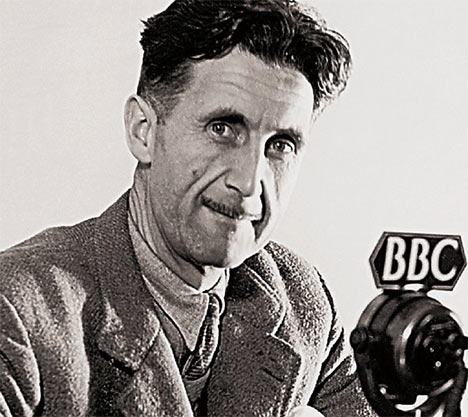
If You Read Nothing Else By Orwell, Please Read This
The Orwell work I really can’t live without is his wonderful essay, “Politics and the English Language.”
It begins:
Most people who bother with the matter at all would admit that the English language is in a bad way, but it is generally assumed that we cannot by conscious action do anything about it. Our civilization is decadent and our language — so the argument runs — must inevitably share in the general collapse. It follows that any struggle against the abuse of language is a sentimental archaism, like preferring candles to electric light or hansom cabs to aeroplanes. Underneath this lies the half-conscious belief that language is a natural growth and not an instrument which we shape for our own purposes. (my emphasis)
I think the opening paragraph just about says it all. He is confining himself to the use of English in non-fiction, of course. The homeschooling mother who runs our children’s debating club recently said that language is a precious gift and we must use it rather than letting it use us. That struck me forcibly and renewed my commitment to do all I can to keep my own writing to the highest level I can and to do all I can to improve it. I can choose to use the language well and shape it for my own purposes, which ideally, will be in line with God’s purposes.
This essay is one of the few things I really want all my children to read and absorb (apart from the small piece of anti-Catholicism in the section on “Meaningless Words.”)
His rules for clear writing are as follows:
-
Never use a metaphor, simile, or other figure of speech which you are used to seeing in print.
-
Never use a long word where a short one will do.
-
If it is possible to cut a word out, always cut it out.
-
Never use the passive where you can use the active.
-
Never use a foreign phrase, a scientific word, or a jargon word if you can think of an everyday English equivalent.
-
Break any of these rules sooner than say anything outright barbarous.
This bit on the not un- formation has almost cured me of the habit: “…and it should also be possible to laugh the not un- formation out of existence …One can cure oneself of the not un- formation by memorizing this sentence: A not unblack dog was chasing a not unsmall rabbit across a not ungreen field.”
More gems:
What is above all needed is to let the meaning choose the word, and not the other way around.
In prose, the worst thing one can do with words is surrender to them.
Political language — and with variations this is true of all political parties, from Conservatives to Anarchists — is designed to make lies sound truthful and murder respectable, and to give an appearance of solidity to pure wind (my emphasis). One cannot change this all in a moment, but one can at least change one’s own habits, and from time to time one can even, if one jeers loudly enough, send some worn-out and useless phrase — some jackboot, Achilles’ heel, hotbed, melting pot, acid test, veritable inferno, or other lump of verbal refuse — into the dustbin where it belongs.
This essay is the greatest reason for my admiration of Orwell’s work. I hope my little article does some justice to his talent and industry. As a little sober reminder of the fragility of our earthly life, George Orwell died in 1949 at the same age as me, 46. God be praised for the gifts He gives to us!
—Louise is an Australian homeschooling mother of six, currently living in Texas.
 Light On Dark Water
Leave a reply to Art Deco Cancel reply