I’m tossing this out for discussion

Over the past few days I've watched Antonioni's Red Desert. A very striking film, though I haven't quite decided how good I think it is. It depicts a troubled young woman (Monica Vitti) whose difficulties seem to be connected to her environment, an industrial area near Ravenna. The contrast between the lush, fragile, and vulnerable beauty of the woman and the brutal and toxic factories and polluted lands and waters with which she's surrounded is pretty powerful. I'm not sure what it all adds up to, but it's fascinating visually.
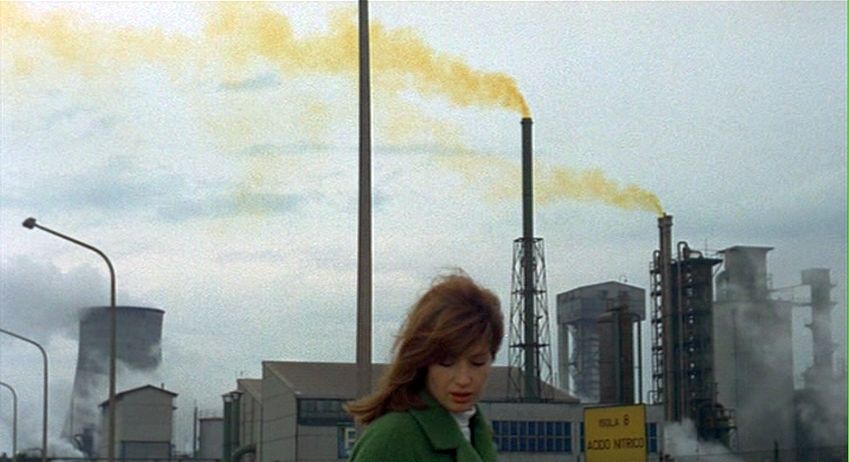
Giuliana3

The DVD includes an interview with Antonioni. The interviewer naturally is interested in what the director really intends to be saying about industrialization etc. Among other things in his reply, Antonioni says this:

But there are aspects of that world that I even find beautiful. For example, on the road from Ravenna to Porto Corsini on the coast, on one side, factories, smokestacks, and refineries fill the horizon. But the other side is completely covered by pine forest. I think the complex horizon filled with factories is much more beautiful, even esthetically, than the uniform green line of the forest. Because behind the factories, you sense the presence of human beings. They're alive. But behind the green of the pine forests there's nothing. Just animals, the wild. It's not as interesting to me.

What's your reaction to that?


29 responses to “I’m tossing this out for discussion”

  1. Maritain said Marseilles Harbour was more beautiful than the French countryside because it is manmade

  2. I agree entirely – as long as the factories aren’t poisoning you, you don’t have to see them every hour of every day, and it’s possible to get away from them completely into natural surroundings from time to time. There’s something beautiful, even sublime, about human ingenuity made manifest in steel and concrete, whether in bridges, power stations, silos, pylons, harbour installations, railway stations, or indeed factories. The problem is finding a balance. “Binsey Poplars” has a point too.
    In the past I used to drive past this chemical plant from time to time, and it was always something to look forward to.
    In terms of Princess Mononoke, which I think was mentioned the other day, there’s great nobility in human creativity, as long as it isn’t trying to kill or capture the heart of the forest.

  3. Interesting. Thank you. I’ll wait a while and see if there are any more reactions before giving mine.

  4. I have been thinking about this a lot–going back and forth. This comment is pretty much stream-of-consciousness.
    My first reaction was “That is nuts,” because I walk in the country a lot and it’s constantly changing and there are new beauties and fascinations always, even if some are very small. And in some ways, animals in the forest live a life that is more like human life than people who work in factories–work that can be almost insectile. Then again, each of those people, even the ones with most tedious and de-humanizing jobs, has a little world in his head.
    Harbors now, I didn’t even think of those. They are almost always really wonderful, and piers. I love those.
    The industrial buildings that I love are the ones that aren’t being used: old cotton gins and grain mills–so there are no people there.
    When I pass steels mills and such on the rivers and they are all lit up at night, there is a fascination there. Some are beautiful, but others smack of Mordor. I remember the first time I drove through Birmingham, AL when the steel mills were in full-force. We could see the smoke over the city from miles away. And the smell . . . . I don’t think I can ever disassociate the choking smell from even a picture of a steel mill.
    Which brings me to that picture, which is an excellent picture–the way it is framed and the use of that yellow in the smoke and the sign and the woman’s hair, but it just makes me want to get in my car drive away quickly.
    And anything that is built nowadays is so stark and utilitarian. There are early industrial buildings that, despite the horrid conditions for the workers, had a kind of grace in their structure.
    AMDG

  5. I think where I really disagree him is that he creates a dichotomy between God’s creation and man’s as if man’s best creation were not subsumed in God ‘s and he raises man’s above God’s. Forgive typos walking and on phone.
    AMDG

  6. Yes, it’s impossible to agree entirely with behind the factories, you sense the presence of human beings. They’re alive. But behind the green of the pine forests there’s nothing. Just animals, the wild. It’s not as interesting to me.
    I can sympathise with finding industrial buildings beautiful, but not with having such a dismissive attitude to nature.

  7. As though trees and animals somehow weren’t “alive”. That’s just ignorant.

  8. Yes, it’s true that what people thought was a ‘utilitarian, strictly practical building’ 100 years ago, when Maritain was thinking these things through, bears no relation to what people today think is a utilitarian, strictly practical structure.

  9. Ok, first: I agree with everything you all have said, notwithstanding that you haven’t said the same things. I don’t think this is a question where there is a single straightforward correct response, just different angles.
    Also, I don’t think what Antonioni says here should be taken entirely at literal face value. For one thing, he was speaking off the cuff, and even apart from that he doesn’t seem to be any sort of consistent or rigorous philosophical thinker. For another thing, having watched Red Desert immediately before hearing the interview, I find it impossible to reconcile what he says entirely with the film. The juxtaposition of the industrial wasteland and Giuliani’s (the woman in the picture) fragile psyche is just too insistent and powerful. So Antonioni was possibly being a little provocative in the interview. Not that he’s lying, but that what he really thinks and feels is probably more complex than that.
    Anyway, here’s what really struck me, the first thought I had when I heard that bit in the interview: this points to a guilty secret of those, including myself, who deplore modern industrialism and commercialism and look to nature instead. The guilty secret is that most of us are not really entirely cool with that pine forest, either. We may like to walk there, and in contrast to the dark satanic mills it may be comforting and healing. But really there’s only so much of it we can handle–we can’t live there and don’t really want to. Most people would be bored and want to go back at least to a house, if not to a town, after a few hours or a few days. Most of us would not be able to manage a few days without a fair amount of paraphernalia brought with us. We want and need civilization. So even though the industrial stuff in Red Desert looks hellish, almost all of us would choose to live nearby rather than in that pine forest without the paraphernalia made possible by the industrial stuff.
    I know, in the abstract it doesn’t have to be that kind of either-or. I’m just talking about impressions, emotions, and the tendency to oppose civilization to nature in favor of the latter.
    This is something that I’ve occasionally thought of when riding down the typical commercial strip that you find everywhere in America–fast food restaurants, service stations, etc. I’m thinking “What a god-awful place” and then I think “If I had just spent a week on my own in the woods without adequate food and shelter and saw that Macdonald’s sign through the trees I would think it was the New Jerusalem.”

  10. My thoughts were that I would probably like nature more if we were still in the Garden of Eden. Since we are not, I love the wilderness of Tasmania, for example, but I like to be close to civilisation too. I don’t like to go far away from human dwellings. I’m not sure how “civilised” factories really are. Driving though some places, such as La Porte in Houston, is just plain depressing. Driving through areas which are basically rural with forest is probably my favourite thing. Give me a vista!

  11. I deliberately didn’t read Maclin’s comment @4:45 until I had written what I thought of this morning when I read this post on my phone. I wanted to see if I had anything in common with his thoughts.

  12. “I would probably like nature more if we were still in the Garden of Eden”
    That’s the whole problem–because of the Fall, we can never (in this world) live in harmony with nature.
    Re-reading the Antonio quote, I realize I neglected the sentence that struck me the most: “Because behind the factories, you sense the presence of human beings.” We’re naturally and normally drawn to the human world, even when it’s ugly. There’s a reason why the desire to be a hermit in the woods is a pretty rare thing, and doing it really rare.

  13. “That’s the whole problem–because of the Fall, we can never (in this world) live in harmony with nature.”
    Yes, I was coming here to write something like that. When I was walking and thinking about this earlier, I was thinking that surely there won’t be anything like this–industrial complexes. They are just what we use to combat the consequences of the Fall, but like everything else we use, they’re a poor substitute for Paradise. Still, they don’t have to be as ugly as they are.
    AMDG

  14. godescalc

    Janet, I have to disagree a little bit with this: “I was thinking that surely there won’t be anything like this–industrial complexes.”
    If an unfallen world were necessarily pre-technological, then yes, no industrial complexes. However, seems a certainty to me that the instinct to do science and engineering is a natural Good Thing and pleasing to God (if rightly used), and is not merely there to fix problems caused by the Fall, and I think that a great many of the results of science and engineering are good in themselves, and would have been developed by an unfallen humanity in some form: recorded music, trains, space travel – these are not band-aids for bad consequences, these are positive Good Things that are compatible with perfection and innocence. Such unfallen goods imply unfallen industrial complexes to enable their production (unless original innocence would somehow enable us to refine dead dinosaurs into train fuel more easily. But I’m a little uneasy with the idea that original innocence would have such implications for the laws of physics.)
    That they don’t have to be so ugly, I agree, but it would be good to have an industrial engineer to weigh in here – I don’t think they look like that without reason. A toaster doesn’t look beautiful but we tolerate its aesthetic ugliness due to the fact it provides a positive Good Thing to us (toasted bread). Come to think of it, a painting or statue doesn’t always look beautiful in every stage of production; the intermediate ugliness is allowed for the sake of the final result. (Also, an engineer could probably see beauty in an industrial complex, or a toaster, that we couldn’t – having an appreciation of what something really does and how it works tends to help there.)

  15. Very interesting. It raises a question I sometimes think about: what will we do in heaven? Will it be one timeless moment of ecstacy, as suggested in the vision of choirs praising God unendingly? Or will there be in some way some kind of work to do? A similar question can be asked about an unfallen world. One can only speculate, but it seems that heaven is more often represented in Scripture by a city than a landscape.
    I don’t think Antonioni is being deceptive when he says he finds a kind of beauty in the industrial stuff he pictures in Red Desert, although I don’t see how it could have meant to include the pools of toxic waste that he also shows. I would describe the factories as having a brutal grandeur.
    The structures in this image have a better claim to beauty, but they’re part of a radio telescope, not a factory.

  16. It seems to me that anything that is well-designed will have a beauty of its own. But I think a lot of factories are needlessly ugly due to a need to make them cheaply. If you have enoough money, you can probably make most structures beautiful.

  17. I would be willing to argue that the typical American urban strip is objectively ugly.

  18. One of my younger brothers, when quite a small child, declared after a live performance of The Magic Flute: “When I get to heaven I’m going to go straight to the opera house to hear how the angels sing Mozart!”. It’s hard to disagree with that, but it does assume some degree of architecture and engineering in heaven.

  19. “I would be willing to argue that the typical American urban strip is objectively ugly.”
    What exactly is an urban strip?

  20. I think I just assume there will be buildings in heaven!

  21. Houston is probably at least 80% urban strip, Louise. 🙂

  22. Yes, it’s particularly bad when it block a view like that.
    AMDG

  23. Depending on where you are there’ a lot of nothing between strip!

  24. Marianne

    Maybe it’s due to the influence of reading D.H. Lawrence on coal miners at a very young age, but I don’t see how we can separate industrialization from the terrible work it requires of men. And doesn’t that work against any “beauty” that can be seen in the kind of structures that so grabbed Antonioni?

  25. That’s a good point. It isn’t especially applicable to Antonioni’s movie specifically, because as far as we see them there the factories appear to be decent workplaces and the workers not miserable or oppressed (although it opens with the fact that some of the workers are on strike). But in general it has certainly been a major problem. What Red Desert makes unavoidable to me is the scourge of pollution. The environment around the factories has been desolated.

  26. There is some sort of factory in Memphis and when it is burning whatever, and the wind is in the right direction, I can smell it at work, which is about 15 miles away. It smells like dead fish. It is dreadful.
    And then there’s China.
    AMDG

  27. godescalc, what you said makes a lot of sense, especially about the good things. I think, though, that that type of work would be done in a place that has beauty that corresponds to its truth.
    I have been wanting to write a more complete answer but by the time I get a chance to sit down to the computer and write, I’m too tired to think much, so this will have to do.
    AMDG

  28. ~~~I don’t see how we can separate industrialization from the terrible work it requires of men. And doesn’t that work against any “beauty” that can be seen in the kind of structures that so grabbed Antonioni~~~
    I thought this as well. I always see these structures as tainted, so to speak, by what’s behind them — the avarice, inhumanity, etc.

Leave a reply to Janet Cancel reply