Winter Light is one of my favorite films from my favorite director, Ingmar Bergman. Here’s what I said about it in a blog post back in 2007:
I was startled to learn that the Swedish title is The Communicants, which is probably better, although “winter light” certainly has its applicability and resonance. I saw this back in the ‘70s without really understanding it. I just finished watching our Netflix copy for the second time, and it’s magnificent. From the Christian point of view there is obviously a great deal to be said about this portrait of a Lutheran clergyman admitting to himself that he has lost his faith—far, far too much for me to try to go into here. So I’ll just say that almost every image and every line of dialog is pregnant with meaning. And that while Bergman was not a believer he understands what faith is about, what the implications of having or not having it are. The film seems to me very ambivalent on the subject, and certainly gives no comfort to atheists.
But then it doesn’t give much comfort to Christians, either, or to anybody else. It is decidedly not a comforting film. Before Craig submitted his beautiful account of Tree of Life, I had been thinking that I might say something along the lines of “greatest film about Christian faith.” But I’d better amend that, and claim instead that it’s the greatest film about faith and doubt. I can’t actually be sure of that, of course, as there are probably many films treating those questions that I’ve never seen. I’ll be surprised if I ever discover a better one, though.
What I said in that earlier post about there being more to say about Winter Light than I can go into here still applies. To say everything I’d like to say about it would take a longer essay than is really suitable for a blog post (and perhaps I’ll try writing it, and see if some magazine would be interested in it), so I’ll just hit a few major points.
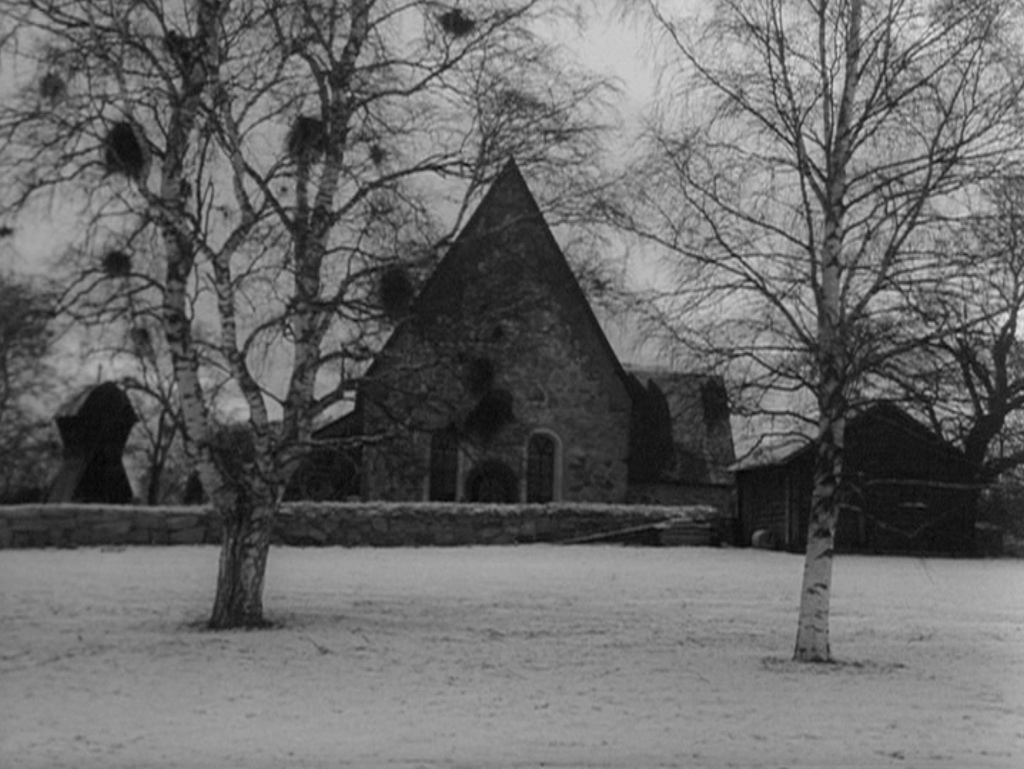
The church
The story, which apart from one major incident is pretty slight and inconclusive, takes place entirely on a Sunday afternoon in winter, between roughly noon and 3 p.m. It opens with a Lutheran communion service performed by the pastor, Tomas Ericsson (Gunnar Björnstrand). The scene begins with the consecration and ends with the dismissal, and it comprises something over twelve minutes of this 81-minute film. The congregation is very small, only eight or ten people. Among them are Tomas’s dowdy lover Märta (Ingrid Thulin), a fisherman named Jonas Persson (Max von Sydow), and Persson’s wife Karin (Gunnel Lindblom).

Tomas and crucifix. That crucifix plays a significant role, as does the altarpiece, of which I was unable to find a good photo.
After the service, Tomas is approached by the Perssons. Jonas is terribly anxious and depressed, obsessed by fear of nuclear war. Karin wants the pastor to help him. They agree that Jonas will return later for a longer talk.
The pastor is responsible for two small churches, and is due at the second one at 3 p.m. In the interval, he waits in the first church for Jonas to return, and reads a letter from Märta, a task which he seems to be reluctant to take up. The reading of this letter is a marvelous scene: it begins with Tomas reading, then switches into a full-screen shot of Märta’s face as she speaks the words of the letter to him. He doesn’t love her, and she knows it. She is an atheist, but she desperately wants her life to have a purpose, and she wants Tomas to allow her to make him her purpose, to be for her what God is for him. Or rather what God ought to be: it is apparent that she recognizes the hollowness of his professed belief.

Märta
This monologue seems to me to be the heart of the film. I find it very moving, and it has rich theological implications beyond what I’ve already suggested, and that I will leave you to discover on your own, if you haven’t already.
Jonas returns. Tomas attempts to give him words of comfort, or at least starts out that way, but does the opposite, confessing his own loss of faith. Jonas leaves, entirely uncomforted, indeed much worse off than when he arrived. After Jonas leaves, there is a mostly silent moment in which the English title of the film becomes deeply significant. Märta appears, seeming to have heard at least part of the conversation with Jonas. “Now I am free,” Tomas says. He weeps, and Märta comforts him.

Tomas and Jonas
For the benefit of those who haven't seen the film, I think I’ll end my synopsis here. What is so striking about Tomas’s loss of faith is that it does neither him nor anyone around him any good whatever, except in the sense that if you believe he’s right you might congratulate him on accepting the brutal truth. That, I think, was what struck me so forcefully when I saw the movie in 2007, and is one of the things I have in mind in saying that it gives no comfort to atheists. This is no triumphant emergence from superstition of the sort lesser artists have given us way too many of.
There are two souls in this story who have a kind of purity. Their roles are small but significant. There is the organist, whose name, if it’s mentioned, I can’t remember, and a man named Algot (Allan Edwall), who seems to be something like a sacristan, or perhaps sexton. The organist is a guiltless cynic who shows no interest in all this heavy religious stuff. He just shows up to do his job and then hurries off to enjoy himself. Algot, on the other hand, is a sincere and humble Christian, the only one in the group as far as we know. His back is misshapen as a result of an accident, and this seems to have given him, or enhanced, a deep sympathy for suffering. His one short speech is an important one, and its effect is partly due to the way it seems suffused with that sympathy.
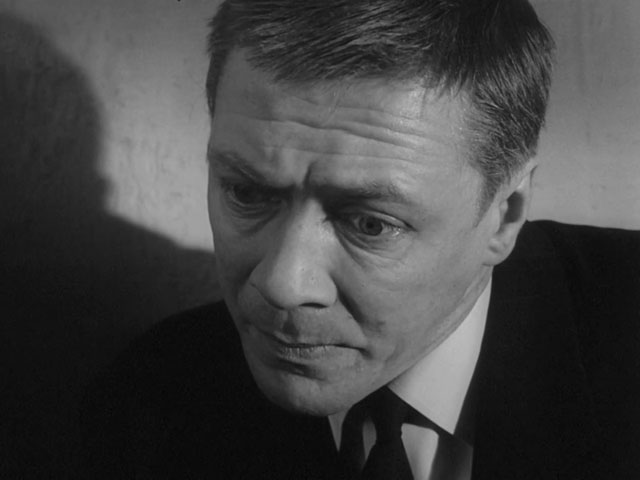
Algot
And there are two souls who are tormented by the collision of faith and doubt: Tomas and Märta (Jonas is more tormented, but not precisely in that way). I think of something C.S. Lewis says about the direction in which a soul is moving being more important than where it is at the moment. Tomas, the clergyman, is moving away from belief. Märta, the atheist, seems to me to be moving toward it, not necessarily intellectually but in her heart. There is no facile conversion, but there is a difference between the easy dismissal of faith with which she begins her letter to Tomas and the cry which eventually emerges from her heart. I can’t think of many other filmic characters of whom I would more like to know what the future beyond the film has in store for them. She might or might not become a Christian, but if she does she'll be a good one, perhaps a saint.
Accept no substitutes.
—Mac is the proprietor of this blog.
 Light On Dark Water
Leave a reply to Mac Cancel reply