Jean de Florette came out in France in 1986, and by 1987 in England everyone was talking about it. It was the must-see film of that year, and very rightly so, I think. It was the last year of my PhD research at London University, and I saw it in a London movie theatre with a friend. At the time I was locked into the struggle to complete my PhD, and impracticality versus worldliness was on my mind. I told my friend that the movie dramatized the defeat of the romantic, unworldly ‘Jean’ by the down to earth, farming Soubeyrans. My friend did not agree, arguing that the younger Soubeyran, Ugolin, also has a dream, of planting carnations on the land which Jean inherits. Certainly the movie is about the battle to possess this rich soil which Ugolin covets for his carnation project, but which the urbanite, tax-collector Jean has inherited from his mother.
Jean does not know he is in a battle with Ugolin Subeyran, or with Ugolin’s wicked uncle, César Subeyran. This ignorance on his part underlies much of the tragic irony of the movie, as we witness repeated scenes of lies, hypocrisy and double-entendre on Ugolin and César’s part, and of misunderstanding and false confidence on the part of the outsider, Jean. The Soubeyrans lie not only to Jean but withhold essential information from the villagers about him. So the hunchback Jean, his wife and their little girl are utterly isolated by this stream of bare faced lies and misinformation.
The basic lie told by the Soubeyrans in fact concerns a stream! Ugolin needs water for his planned carnation crops, and there is not sufficient on his own property. There is an old abandoned stream on Jean’s property. Ugolin and his uncle deliberately block the stream, and conceal its existence from Jean. Jean has arrived with his own romantic project, of escaping city life and breeding rabbits on his property. Without water, his hopes literally shrivel, his plants dying of thirst and his rabbits starving for lack of feed. Jean is destroyed by his increasingly heroic efforts to create a water source on his land.
The great irony of the film is that Jean has come to the French countryside in search of authenticity. Ugolin has never heard of that, and wonders if it is a plant which he will grow.
I remember, and I imagine most people, remember Jean de Florette for the wrenching performance as the hunchback by Gerard Depardieu. Its almost as tragic as the film itself to think of the fantastic promise of the young Depardieu, who displayed outstanding talents as an actor, and of his latter days when he has become famous for demeaning, drunken antics. Watching the film for a second time, after thirty years, though, I was struck by the wonderful, fox-like performance of Yves Montand as César Soubeyran, wicked through to the marrow, and of his weaker and more conflicted nephew, played by Daniel Auteil. All three of the main actors give brilliant performances in their roles.
The character played by Jean de Florette has been a staple of French comedy since Molière: he is the romantic idealist, whose ideas about how to live in the world come from textbooks, manuals and mathematical formulae. The comedy occurs when the rubber of the mathematical formulae hits the road of real life. So the city-dweller versus the earthy-peasants theme is a basic motif of French comic drama, and there is absolutely no doubt that the peasants have the upper hand, because their grasping nature leads them to grasp reality more firmly. Based on a novel by Maurice Pagnol, Jean de Florette is clearly no comedy because what happens to Jean is the stuff of tears, not of humour. But nor is the movie exactly a tragedy, because Jean lacks any tragic grandeur.

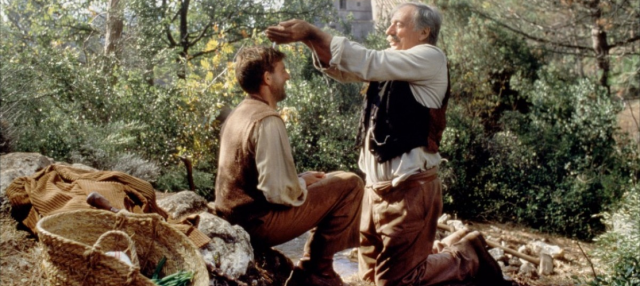
The movie has a direct religious theme from the start. The news that the land the Soubeyrans covet has slipped from their grasp comes to them in a letter from a priest’s housekeeper, who states that the man who has inherited the land, Jean Crespin is ‘a hunchback by the will of God’. In a great, unforgettable and climactic scene, when rain comes but falls on the other side of the mountain, not on his own crops, Jean cries out to ‘God’, demanding to know if he is ‘up there’ and if so how he could inflict such injustice on a hunchback. At the end of the movie, the exultant Soubeyrans perform an inverted ‘baptism’ of themselves in the gushing spring, blackening or blaspheming the sacrament. Jean de Florette is thus about the most typical of French theological questions, the absence of God. It may have been the last great burst of French Jansenism before the culture lapsed into secularism.
—Grumpy is a professor of theology in the Midwest.
 Light On Dark Water
Leave a reply to Marianne Cancel reply