Robert Osborne of Turner Classic Movies, introducing this film, says it’s his favorite film noir, and one of the best. I agree. In preparation for writing this note, I’ve just watched it for the third time, and liked it even better. I’d have to say now that it’s one of my favorite movies, period.
I think any reasonable critic would agree that it’s at very least among the best of its kind. To pick a personal favorite from a list including other excellent examples (Double Indemnity, The Postman Always Rings Twice, et.al.), is partly a matter of subjective preferences. The noir plot generally has near its center a bad romance, a man who is tough and perhaps somewhat shady, but usually fundamentally decent, and a beautiful but treacherous woman.
If you’re going to be emotionally involved in the story, you have to find that couple convincing and at least somewhat appealing. And for me that’s one of the things that distinguish Out of the Past from others: the couple are played by Robert Mitchum and Jane Greer, and both of them are to me both convincing and appealing. I’ve liked Mitchum for as long as I can remember watching movies. (If I saw Thunder Road soon after it was first released, which I think I must have, I was only ten or eleven.) As far as I can remember Out of the Past was the first time I’d seen Greer. What can I say except that she’s very beautiful, and in a way that happens to hit the mark for me? I’d certainly fall in love with her if I were sitting in a dim cantina in Acapulco and she walked in out of the sun.
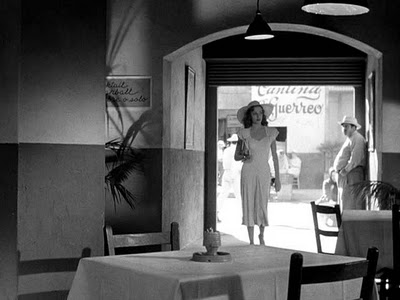
But that gets ahead of the story. The second thing that makes Out of the Past so powerful for me is the cinematography, which seems to me superior to most similar films of its time. This is especially striking in the opening. We’re given a number of beautiful scenes of the Sierra Nevadas, then a road sign that sets the stage: Los Angeles that way, Lake Tahoe and Reno the other way, and just one mile away, Bridgeport.
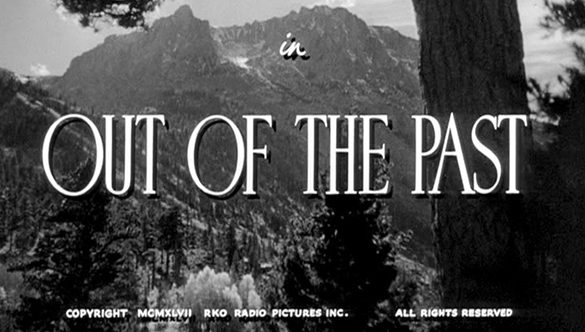

Corruption this way, corruption that way. Or you could stop and hide in Bridgeport.
We see a man in a dark hat and a dark coat driving a dark car into Bridgeport. It’s a nice-looking little town, and in fact a real town, in which these scenes were filmed. The man isn't Mitchum’s character, but someone out of his past, Joe Stefano. Stefano is looking for Mitchum’s character, who is introduced first as Jeff Bailey but is actually named Jeff Markham, and who runs a garage in Bridgeport. (If you wonder why it’s called “Mono Motor Service”, it’s because Bridgeport is in Mono County.)
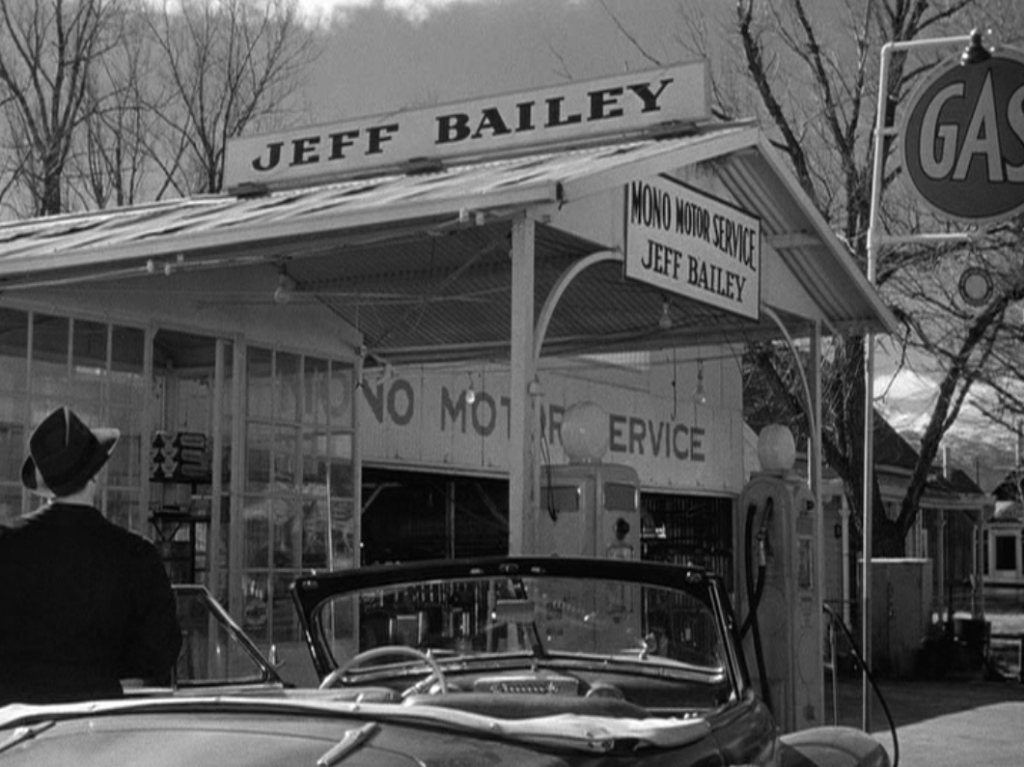
Stefano arrives at the garage.
These opening scenes are bright and crisp. It’s winter and the trees are bare, but the sun is bright, and lines are sharp. The town is quiet. Stefano arrives at Bailey’s garage, and learns from a deaf-mute boy who works there (referred to only as “the kid”, as far as I remember) that Bailey is not there. There is a bit here that I hadn’t noticed until I watched the opening again just now. We don’t yet know who these people are. But as Stefano is talking to the kid, a police car comes down the otherwise empty street. Stefano watches it come, which is natural. But then he turns to watch it go, with an interest which is not quite so natural. And the kid notices this, and doesn’t like it. We learn soon enough that his suspicion is justified.
Stefano walks across the street to Marny’s Cafe. Marny, friendly and chatty, tells us, and Stefano, a lot, and in passing utters a line that prefigures much of what is to come “Seems like everything people oughta know they don’t wanna hear.”

Big-city guy Stefano signals his disrupting presence in Bridgeport by cranking up loud jazz on the jukebox as soon as he sets foot in Marny's Cafe.
The kid has gone off into the mountains in search of Bailey, who is out fishing with a lovely local girl, Ann (Virginia Huston). If the town is pleasant, the fishing scene is idyllic, the winter sun glittering on the lake.
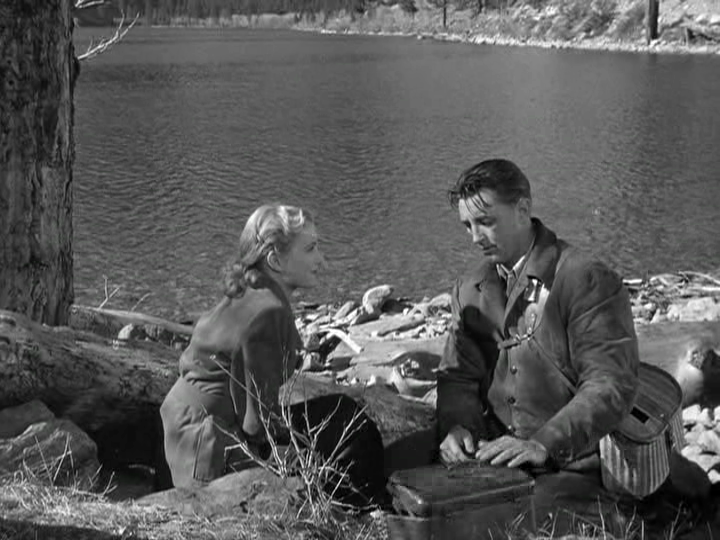
Talking about clouds, and the future, not realizing that this is noir.
There is a romantic conversation, and a brief kiss. Ann looks off into the distance. Over her shoulder Jeff sees the kid, who is signing to Jeff, and the idyll is disturbed.
Jeff: We’d better go.
Ann: Something the matter?
Jeff: Maybe not.
Not maybe, but maybe not: the perfect note for Jeff’s fatalistic but not hopeless attitude. And those two examples of the dialog illustrate another aspect of the film’s quality: the dialog is for the most part excellent, plain but with resonances, clever but not ostentatiously so, and happily lacking in the overdone wisecracks, labored slang, and macho posturing one often finds in crime dramas of this period. Well, okay, there is some macho posturing, but it's not exaggerated.
Stefano is a hoodlum who works for a gambler and “operator,” presumably of criminal enterprises, Whit Sterling (Kirk Douglas). Bailey/Markham had also worked for Sterling in the past, but there are clear indications that the parting was not a friendly one, and presumably has something to do with the fact that Markham has changed his name. Stefano seems friendly but there’s an undertone of menace in the conversation, not least as a result of the fact that Stefano has found Jeff at all. (How this came about is never quite explained.) Sterling wants to hire Jeff again. He agrees to meet with Stirling in Lake Tahoe the next morning. We assume there is an implied threat here, that Jeff was hiding from Sterling, and that now that he’s been found must deal with the situation.
The next scene takes place at night, and from this point the film gets literally and figuratively darker. Jeff asks Ann to accompany him on the all-night drive to Tahoe (only 78 miles according to the signpost in that opening scene, but maybe the mountain roads made for slow going). He wants to tell her the truth about his past.

Night drive to Tahoe.
In a lengthy flashback we learn of his previous life as a private detective hired by Sterling to locate Kathie Moffat (Greer), the girlfriend who had shot him and stolen $40,000.
I’ll stop the plot summary at this point. I’ve gone into this detail, and included these stills, in an effort to communicate how well-crafted the movie is. The story gets pretty complicated from here on, and I won’t be giving anything away if I tell you it's not a light-hearted one.
If you want to see a clip, go here. I didn't include it here because it goes further in the story than I wanted to, although it's not a major spoiler.
Kirk Douglas gives an excellent performance as Sterling—affable, smooth, and ruthless.
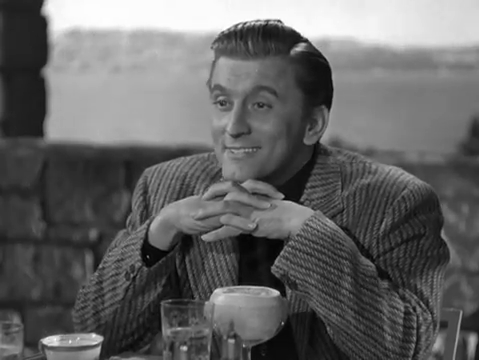
There's something crocodilian about that grin.
Sterling is involved with miscellaneous other shady types, including Rhonda Fleming as a femme at least as fatale as Kathie. The most potent thing about Kathie for me is that she taps something in men—or at least in this man—which makes us, against all evidence, suppose that a really beautiful woman is also good. (There is a great riff about this in one of John Le Carre's books, but I'm not sure which one.) Ann is perhaps a bit too sweet; I learn from poking around on the internet that Virginia Huston was somewhat typecast as the good girl in this sort of film, and you can see why.
The kid is a poignant figure. At the end of the movie we are back with him in Bridgeport. It's another bright day, but things have changed. There's an ambiguous bit at the end which fans of the film don't seem to be entirely agreed upon. Roger Ebert thinks it's just ambiguous, and I tend to agree.
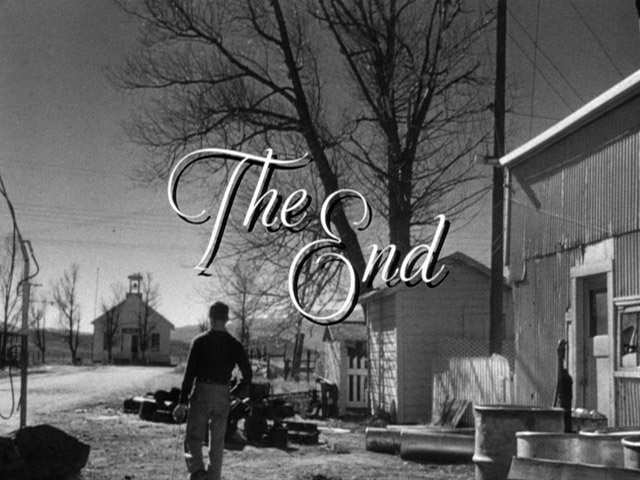
I like this movie so much that I may buy a copy. That's very high praise for me, as I own fewer than a couple of dozen movies, and a lot of those are Bergman. If there's a noir film that you think is better, please let me know. And of course if you like the genre and haven't seen Out of the Past, do so at your earliest convenience.
—Mac is the proprietor of this blog.
 Light On Dark Water
Leave a reply to Marianne Cancel reply