The Burmese Harp, a 1956 movie directed by Kon Ichikawa, is considered a classic antiwar film, but as some reviewers have noted it’s more than that because it dwells on what we do when great suffering happens, how we keep our humanity. I somehow missed it when it arrived in the U.S. in the 1960s, and only got around to seeing it a few months ago. Its gorgeously shot images in black and white will stay with you. As will the music, especially the song “There’s No Place Like Home,” sung repeatedly in the film. A few reviews I’ve read say there’s too sentimental a treatment of some aspects of the film, especially the music. I agree somewhat, but it’s pretty powerful nonetheless.
The story, based on a children’s book, is about a platoon of Japanese soldiers in Burma in the first days after Japan’s surrender. Their captain, a man who was a music teacher in civilian life, has taught the men choral singing as a way of keeping up their morale. One of the platoon members, named Mizushima, has taught himself to play a Burmese harp to accompany them, and he is the one chosen by the captain to seek out another company of Japanese soldiers who are holed up on a high mountain to tell them to surrender and not die meaninglessly. They refuse, and are then shelled by British forces, leaving them all dead except for Mizushima. Found and nursed back to health by a Buddhist monk, he then takes the monk’s robes to wear as a disguise as he makes his way back to his platoon in the POW camp. On the way, he comes across scores of dead bodies of Japanese soldiers. He stops and buries or burns many of them, but the task is too great to do all and he continues on his way, spiritually overwhelmed. When he arrives at the camp, he’s eager to meet up again with his platoon, but after watching a Catholic priest and some nurses sing a hymn at the grave of a Japanese soldier, turns away and all the horrors of the dead he has seen play over in his mind. It is at this point that he determines to stay in Burma, become a Buddhist priest, and make it his life’s work to bury all the dead.
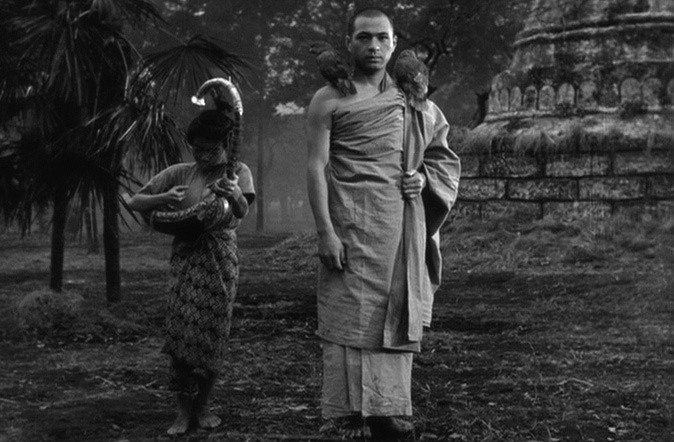
Most of the dialogue in the movie is that of other members of the platoon; Mizushima says very little and his interior monologue is carried mostly by images. A few stills might give an idea of the movie’s beauty and emotional pull. The first shows Mizushima after he’s burned and buried some of the dead he first comes across:

This one shows some Burmese men watching Mizushima burying the dead before they begin to help him — one of the scenes that captures a sense of great vastness:

This last is of Mizushima standing outside the British POW camp watching his fellow platoon members as they plead with him to come back to Japan with them:
You can watch a five-minute clip of that scene here; I think it’s one of the most moving in the film.
—Marianne lives in New Zealand
 Light On Dark Water
Leave a reply to Paul Cancel reply