Like many comedians of their era The Three Stooges got their start in vaudeville, and like their contemporaries The Marx Brothers and The Ritz Brothers they came from immigrant Jewish families. Moe and Shemp Howard (Moses and Samuel Horwitz) and Larry Fine (Louis Feinberg) were part of a popular act called Ted Healy and his Stooges, a vaudeville team that began doing film work in 1930. Fed up with Healy’s demanding ways Shemp broke off from the team to go solo, and was replaced by younger Horwitz brother Jerome, who showed up at his audition with long curly hair and a handlebar moustache. One commentator said that he looked like a chubby General Custer. He shaved his head, and eventually the moustache, and became “Curley.”
The Stooges appeared in several films with Healy through 1934, when their contract with MGM expired. Healy and the Stooges parted company, and the Stooges, now officially renamed “The Three Stooges,” signed with Columbia Pictures to do short films, and remained with Columbia for over 20 years.

Unlike most of the other comedians of their day The Stooges never made the leap from shorts into feature films until near the end of their careers. Moe, the leader and manager of the group, always felt that their brand of comedy would not work as well in a longer form. It is probably for this reason, and also for the fact that their comedic style was more lowbrow than some of the other acts of the era, that despite their popularity they never got the critical appreciation that others got. This is unfortunate, as at their best, they could be as funny as anyone.
In my opinion, the key to their humor is the natural comedic talent of Curley (later ‘Curly). Moe was funny as a pseudo-tough guy, and Larry, who basically went along and got in the way, sticking up for Curly from time to time, generally got the worst of things for his efforts. But Curly, the vacuous child-man, with his faces, mannerisms and odd noises, was the one who really held the thing together; I think he deserves to go down as one of the great film comics. His timing and ability to improvise were both top notch, as was his talent for physical comedy. He’s always doing something in character even when the camera’s focused elsewhere.
The Stooges often get an undeserved bad rap for the raucousness of their comedy, as if it were all face slapping, eye poking, and pie throwing. But such really isn’t the case. While they were never exactly subtle, there is a fair amount of wit, both verbal and physical in their best films.
I’ve watched the Three Stooges since I was little, and I can remember my Dad (who was a big fan) and I watching them together in the mornings before school – kindergarten and first grade even! I’ve seen some of their films literally dozens of times, and they still make me laugh. I probably have ten or so favorites, with another larger group as a second tier, but I’ve limited my picks here to six that I consider among the best. They run from 15 to 18 minutes each, about the length of a feature film, which seems appropriate, and I’m listing them in chronological order.
Men in Black (1934) – A spoof of a popular Clark Gable film of the era called Men in White, the boys play a trio of doctors who wreak havoc at a hospital. Only their third release, it was nominated for an Oscar for Best Short Film. This early film of theirs approaches the anarchic style of comedy that the Marx Brothers were famous for, and also includes a relatively high quotient of verbal jokes
Disorder in the Court (1936) – The Stooges play witnesses at a murder trial, the defendant being a dancer at the club where they are musicians. Featured is a very funny musical number, a classic scene, bits of which have appeared in various commercials over the years. Curly is especially good in this one, especially in his turn in the witness box.
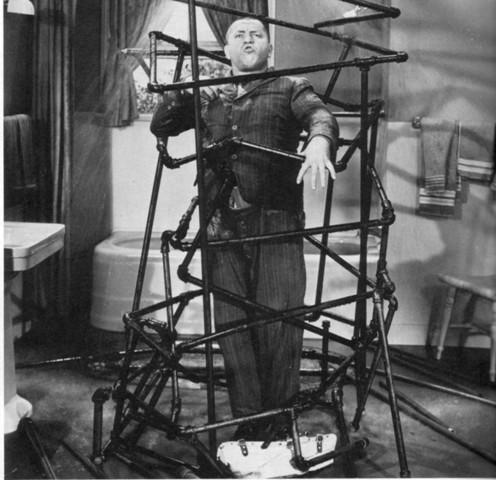
A Plumbing We Will Go (1940) – Fleeing the police, the boys escape in a plumbers’ truck, and are taken for the real thing by a society matron. They, of course, wreck the house. Some good sight gags here (Curly trapping himself in a cage of pipes is a famous one), but the show is almost stolen by what is the best non-Stooge performance in all of their films: the big-eyed black comedian Dudley Dickerson plays the cook, who experiences the Stooges’ plumbing expertise first hand when water begins appearing in his kitchen in unusual places, uttering the famous line, “This house has sho’ gone crazy!”
An Ache in Every Stake (1941) – The Stooges play ice men, who have to deliver a block of ice up a long flight of stairs (it melts on the way up). In the process, they ruin a businessman’s birthday cake, but inadvertently end up as the cooks at his dinner party. Highlights include Curly stuffing a turkey and “shaving the ice.”
Dizzy Pilots (1943) – The Stooges play the Wrong Brothers, airplane inventors who’ve been given a draft extension to complete their waterproof plane. If it fails, they have to join the army. Their attempts to get the plane done in time don’t work out quite right. And neither does boot camp. This one features one of my all-time favorite short Curly routines – his attempt to do the manual of arms in boot camp.
Micro-Phonies (1945) – Curly is mistaken for an opera singer at a radio station, and the Stooges, seeing a quick buck, agree to have him sing at a matron’s musical party (with the help of an opera record). Curly had had a stroke early that year, and the effects caused him to slow down both his speech and his physical gestures, and he retired soon after this short was made. He’s very good in this one though, and it remains one of their most memorable efforts.
I imagine that all of these are available online at various places, including You Tube. Enjoy!
—Rob Grano has a degree in religious studies which he's put to good use working on the insurance side of the healthcare industry for the past 20 years. He's published a number of book and music reviews, mostly in the small press, and sometimes has even gotten paid for it. He lives outside of Pittsburgh, Pa.
 Light On Dark Water
Leave a reply to Grumpy Cancel reply