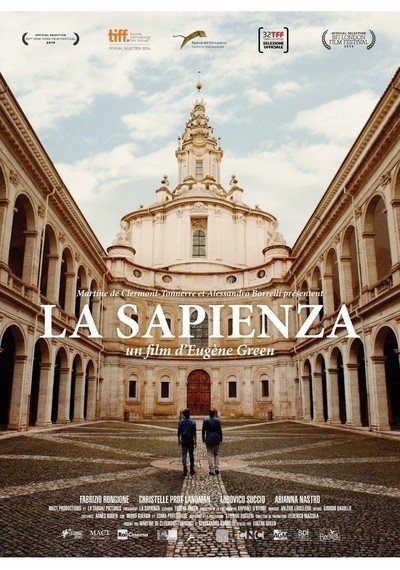
I believe that La Sapienza, a 2014 film written and directed by Eugène Green, has not been widely seen. I forget how it came about that I heard of it; probably there was some approving notice in the local press when it played at the Toronto International Film Festival in 2015. In any case, and box office returns notwithstanding, it is a film very much worth seeing.
We are introduced to a middle-aged couple, Alexandre and Aliénor, he an architect and she a psychoanalyst. They are both professionally successful, but beset by problems: their marriage has grown cold and dry, and he, in particular, has come to regret the path his professional life has followed, for though he has won many accolades he has neglected the guiding ideals that had inspired him to become an architect in the first place. He decides to travel to Italy to rekindle that early love of his subject, and she goes along.
It soon transpires that they cross paths with a young brother and sister, Goffredo and Lavinia. She is ill with a strange malady, and he, it so happens, is about to begin his university studies in architecture. Thus we get a natural shuffling: Aliénor elects to remain with Lavinia as she recovers in order that Goffredo can accompany Alexandre on his architectural tour. From this point, the film jumps back and forth between the two women and the two men, following their developing friendships, and, subterraneously, re-aligning and healing the original relationships.
The architectural tour, devoted especially to the works of Borromini, takes the two men to Turin and then, for the bulk of the film, to Rome. My friends, I know of no film more apt to delight the heart of a lover of the Eternal City! The camera lingers lovingly over details as it gently slides across a facade, or is content to gaze raptly at the intricate symmetries of a church ceiling. Rome, and its many beauties, is no mere setting, but becomes itself a subject of the film. It is truly glorious. Even were there nothing else going on in the film, the devoted attention it lavishes on these architectural gems would be enough to recommend it.

But there is more going on. As the two women get to know one another, Aliénor explores with Lavinia her hopes for the future and the nature of her illness. Meanwhile the two men, ostensibly the master and the student, through a series of encounters and conversations find their roles gradually reversed, the older learning from the younger how to recover his lost passion for his art. Those, at least, are two of the main arcs of the story, but to leave it there would be to oversimplify.
On the surface La Sapienza is about how the friendships and experiences of the characters change them for the better, for the film believes strongly in truth and beauty as spiritual curatives. But having pondered it at some length (and watched it twice), I believe that one of its leading convictions, sunk into numerous aspects of both story and presentation, is that spiritual realities manifest themselves in physical things, or, put the other way, that tangible things possess an inner reality. This is true of buildings as of bodies. It's a rather Catholic idea, consonant with a sacramental imagination, but the film itself does not stress any particular religious connection. (Indeed, all we know of the religious convictions of the lead characters is that one is a syncretist and another an atheist.) It is nonetheless an amazingly rich theme to explore, and one rarely encountered at the cinema.
At this point I should note the most obvious thing that will strike the average viewer of La Sapienza: it is weird. I choose the word advisedly, intending to catch the resonance with the old sense of 'uncanny', as well as the modern sense of 'unusual'. Green has adopted a daring formal technique: almost always the actors speak directly into the camera, as if addressing the viewer, even when actually addressing one another. The conversations have a studied quality, each line having a little more silence around it than we’re accustomed to. Furthermore the actors often adopt a highly artificial acting style, with stiff movements, vacant facial expressions, flat tone. Even the blocking is deliberate: characters who are unfriendly to one another, for instance, stand angled away from one another, while characters who love one another stand face to face. So strange is the cumulative effect of these unconventional rules that I confess I found the experience of watching it curiously unnerving.
Here is a short excerpt of a conversation between Alexandre and Goffredo, illustrating, in part, what I mean:
At first I was puzzled by the purpose of these odd formal strategies, but upon reflection I believe they are related to the idea I discussed above: that inner realities are conveyed by means of external signs. In this film what we see on the characters' faces, and in their postures, and what we hear in their voices, are their souls, without disguise or polite veil. The face looks hard because the heart is hard. The eyes are bright and open because the soul is alive and beautiful. They smile because they feel genuinely happy. They walk stiffly, or easily, because their souls are bound, or free. The drama we see is the interior drama. And this revelation of the inner world by the outer is transposed in the film also to the architectural masterpieces, palaces of space and light, in which we see only the surface but are drawn to the spirit.
I hope, but doubt, that these notes adequately convey what I found so alluring about the film. If I have made it sound dull or didactic, this is just because while writing I've been trying to work out in my own mind what I think it is doing.
All told, I found it to be a fascinating and surprisingly touching film. It is rare to find a movie that has such great confidence in beauty and goodness, and one that is so wholly oriented toward light. It may seem perversely odd at first, on account of its unfamiliar and apparently bizarre conventions, but as it proceeds it slowly excavates an interior space until the viewer, without quite knowing how, finds himself in a realm of mystery.
—Craig Burrell blogs now and then at All Manner of Thing and is curator of The Hebdomadal Chesterton. He lives near Toronto.
 Light On Dark Water
Leave a reply to Rob G Cancel reply