My best estimate is that it was 1983 when my friend Robert sent me a cassette of which one side (and maybe a bit of overflow to the other side) was Rupert Hines’s 1982 release Waving Not Drowning. I don’t remember what else was on the tape, and it’s gone now. I think it broke or had one of those malfunctions where the tape gets loose and tangled in the player, but that was after I had played it many times. I would have bought the album, but it was out of print, and in fact was already out of print when Robert bought it. In the letter accompanying the tape he said he had found the album in a cutout bin. If you don’t remember those, they were the bins in which LPs that were no longer in print, and therefore mostly unwanted, were sold for low prices. So it must have gone out of print very quickly after its initial release.
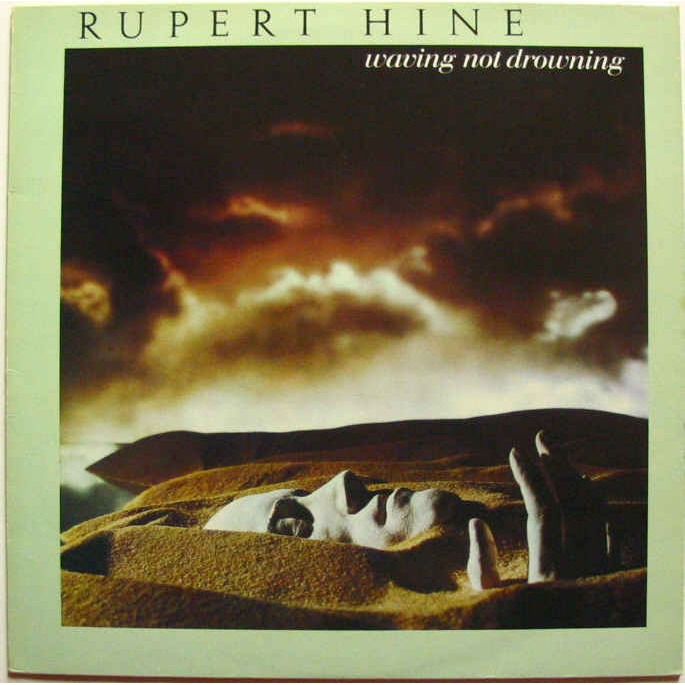
That was a great injustice, because it is a very very good piece of work. Ten years or so ago I included it in a list of my 25 favorite pop albums, and I probably still would, though such preferences tend to be volatile. It is not, however, for everybody. In fact it’s so much not for everybody that I question whether I should even be writing about it here, because I don’t actually think many people reading this would like it, and I can’t even recommend it without a certain amount of disclaiming.
Which I guess means I shouldn’t complain about its commercial failure. It’s now available on CD and MP3, and I find on looking around for information about it that it seems to have acquired a sort of cult following over the years. The AllMusic review describes it, very strangely, as “an enjoyable piece of British synth-pop”. Well, it does include a lot of synthesized sounds, but that’s like calling The Doors’ “The End” “an enjoyable piece of California pop.” Anyone buying this album and expecting something like Depeche Mode would get quite a surprise, either pleasant or unpleasant depending on the person. (Though I don’t suppose anyone buys an album unheard these days.)
It is a very dark and strange album, though the title suggests that we shouldn’t take its darkness as the last word: it’s a variation on the Stevie Smith poem “Not Waving But Drowning,” which describes a man whose struggles in the water are mistaken for a greeting, and who dies in the same desperation in which he had lived:
He was too far out all his life
And not waving but drowning.
But the desperate speaker in this album is, in the end, apparently not drowning after all. I say “speaker” deliberately, because although this is a Rupert Hine album the lyrics are by Jeannete Obstoj, and they are a crucial element, without which the album wouldn’t have nearly the same force, and you really can’t say whether what you’re hearing is more his voice or hers. I hope she got songwriting credits. I have not been able to find out much about her. There’s a Wikipedia entry, but there’s not much there beyond the fact that she lived from June 5, 1949 until March 26, 2015. There’s more at her web site, but still not a great deal, except for something that I’ve wanted for years: the text of the lyrics. The link is to a PDF, and not everything in it is a Rupert Hine lyric, but I think all of Waving is there.
The album opens suddenly with a loud electronic whip-crack sort of noise followed immediately by a rapid chant, growing louder: “I feel the blood I feel the blood I feel the blood…” This soon becomes
I feel the blood of a reptile run
Through
The veins of a child
The song is called “Eleven Faces,” and the speaker is trying to pick out of a police line-up a man who has assaulted, perhaps killed, a woman, but is unable to decide which face if any is the guilty one.
Perhaps his face was wiped away that night
to leave some other that I'll never recognise…
Ten faces melt away, until there's only one
and someone murmurs now
you must decide, you must decide
The music is intense and driving and, unsettlingly, catchy. “Enjoyable piece of synth-pop”, indeed. I was about to say that it’s the darkest track on the album, but that honor should probably go to “The Sniper,” which is mainly a list of ways you might meet sudden and unexpected death:
The crash – the gas
the heart attack
The rare disease you cannot fight
The poisoned bite
the faulty light
The wet hand on the stereo…
I find it impossible to discuss this music without using words like uneasy, disturbing, disquieting, sinister, nervous, paranoid, menacing. Hine in fact took this music on tour with a band billed as Rupert Hine and The Menace.
So why would you even want to listen to it? Because it is absolutely brilliant. Musically it is strikingly imaginative and unpredictable. It achieves its effects with skill, not shock: no harsh or sudden noises (well, not many) or cheap eerie dissonances, but carefully crafted melodies and arrangements. It really could just as well be classified as progressive rock as synth-pop, though it doesn’t include the long instrumental jams typical of prog.
Here’s the most conventional song on the album, “The Set Up.” I picked it partly because it’s the only actual video I can find for anything on the album: a pointless criterion, I guess, since this is about the music. Moreover, the video is nothing special. Well, anyway…it's an unhappy childhood, blame-your-parents song, and maybe not a good thing for anybody under 30 or so to listen to (maybe 40?).
That’s a fairly quiet, even pretty, song. But listening to Waving Not Drowning again after an interval of ten years or so, I’m a little surprised at how many of the songs are up-tempo and driving. That seems contrary to expectation for an album devoted to sensations that are typically quiet and private, but it certainly works. Hine has had a more steady career as a producer than as an artist in his own right, and it is apparent from this recording that he's very skilled in the studio. Notice that odd breathy burr, sort of dropping off a bit in pitch (I think–it's hard to describe) at the end of the last word of many phrases: “Every opportunity to make me like them.” It seems to be an electronic effect and it gives the end of the phrase an emphasis which is at once angry and spooky.
Lest you think the album too dark and perhaps nihilistic, I’ll point out a couple of other things besides the rather desperate affirmation of the title. From “Innocents in Paradise”:
Then should your concrete footsteps stop
to watch this town go down in flames
you'll feel your feet touch grass again
could be you'll find you're going sane
It was only a couple of weeks ago, when I found the lyrics as mentioned above, that I discovered that I had been mis-hearing these lyrics from the beginning. I thought that last line was “could be you’ll find you’ll go insane.” Having the correct words makes a pretty massive difference.
And from the same song:
No ifs or buts, you'll be broken before you learn to love
Maybe that’s not really very positive, but at least it supposes that you will learn.
There was one thing wrong with Robert’s tape. It included two songs from Hine’s previous album, Immunity: “Surface Tension” and “I Hang On to My Vertigo.” But I didn’t notice that they were from a different album, and in my mind they are an almost essential part of Waving Not Drowning. They fit perfectly as the last two tracks in the set, so I was a little disappointed to find that they were from a different album. That same reviewer at AllMusic thinks Immunity is the better album by far. I disagree completely. I like Immunity, and there are some great tracks on it (especially the two just mentioned). But I don’t think it has the consistent brilliance and unity of Waving.
Nevertheless, here is the official video for “Surface Tension.” It’s really more like most of Waving than “Set Up.” If you like it, get both albums. You won’t be sorry. But get Waving Not Drowning first. And by the way, most re-releases seem to include an annoying extra track: "Kwok's Quease," a silly novelty thing about getting sick after eating at a Chinese restaurant. You might want to be ready to skip it. It completely destroys the atmosphere of the album. I only allowed it to play once. I listen to the album as an mp3 playlist which does not include that track.
P.S. The “Piña Colada” guy is Rupert HOLMES.
–Mac is the proprietor of this blog.
 Light On Dark Water
Leave a reply to Stu Cancel reply