Some time ago, a year or maybe two, before I cut our cable TV service back to the minimum, a 1965 movie called The Loved One caught my eye in the Turner Classic Movies schedule. Was it Evelyn Waugh's Loved One? I wasn't aware that a movie had ever been made from it. I checked, and it was, so I recorded it, but I didn't expect it to be very good. Months went by and it remained unwatched. I was seriously considering deleting it but decided to give it a chance. So my wife and I watched it. When it was over, we said "Well, that was strange." It was funny, but…I wasn't quite sure what I thought of it, and whether I wanted to recommend it to anyone else. I thought I might watch it again, so instead of deleting it I left it there. Another six months or so went by, and a couple of weeks ago I watched it again.
This time I said again, "Well, that was strange." But it's also very funny, in a monstrous kind of way. And yes, it is good, quite good on the whole, and so I do recommend it to anyone who likes Waugh.
I didn't remember the book well enough to know whether the movie was at all faithful to it, so before this second viewing I read the book again (the last time having been decades ago). It's quite short, hardly more than a novelette. And the film is quite faithful to it, as far as the book goes. But the film goes further. While faithful to the basic plot, even down to using a fair amount of Waugh's dialog, it adds a whole new plot element, and, amazingly, does so quite successfully.The book is a satire of the American funeral business, especially as it is most lavishly and weirdly seen in Hollywood. The story involves a young Englishman, Dennis Barlow, a poet, who gets involved in a love triangle with two employees of Whispering Glades. He and Mr. Joyboy, who is the chief mortician, are both in love with Aimee Thanatogenous (rhymes with "heterogeneous", at least if you pronounce it in the usual American way). She is one of the cosmeticians who spruce up the dead (the Loved Ones) for viewing by their mourners (the Waiting Ones). I think her name means something like "death-born."
To this basic structure the movie adds a major extension of the plot involving the impresario of Whispering Glades, the Reverend Wilbur Glenworthy (Dr. Kenworthy in the book), and his less successful brother Henry (invented for the film, I think), who runs the Reverend's side business, a pet cemetery called The Happier Hunting Grounds. The movie also expands the roles of several minor characters, and introduces some new ones, such as some top brass of the U.S. military. Whispering Glades itself gets more attention, with Waugh's relative lack of description leaving the way open for the director to go in for a great deal of visual indulgence. And it all ties together: Glenworthy's machinations are not an extraneous subplot but are directly connected to the triangle.
It's an English film, and I probably wouldn't have had such low expectations of it if I'd seen the names of the people involved: the director is Tony Richardson; the writers are Terry Southern and Christopher Isherwood; and the list of actors includes a number of well-known names–John Gielgud, Robert Morse, Robert Morley, James Coburn, Liberace(!), Jonathan Winters, Rod Steiger, Milton Berle, Roddy McDowall, Tab Hunter. Steiger's performance as Mr. Joyboy is especially striking: I think of him as playing tough guys, but he is utterly and creepily convincing as the effete and neurotic mortician. Liberace has a brief but very funny appearance as a coffin salesman. Jonathan Winters plays both Glenworthys, brilliantly. Robert Morse is Barlow, who may or may not be a decent poet but certainly has a gift for low cunning; Morse is capable of looking both lupine and simian. Miss Thanatogenos is played by an actress of whom I had never heard, Anjanette Comer, and she is not only beautiful but has the "rich hint of lunacy" which Waugh specifies for her.
My only serious reservation is with the treatment of Joyboy's home life, and his mother. She's barely present in the book, and seems at worst to do a lot of complaining. The filmmakers chose to make her something of a monster, an enormously fat woman with repulsive habits, and to give the relationship between her and her son a pathological twist. Those scenes are off-putting to say the least, and almost enough to make me dis-recommend the film. So be warned about that, but if you like Waugh and have a taste for black humor in general, have a go at The Loved One. My copy of the book has a quote from Orville Prescott's New York Times review, presumably on its initial publication: "A thoroughly horrible and fiendishly entertaining book." The movie is more so. It was truthfully advertised as having "something to offend everyone."
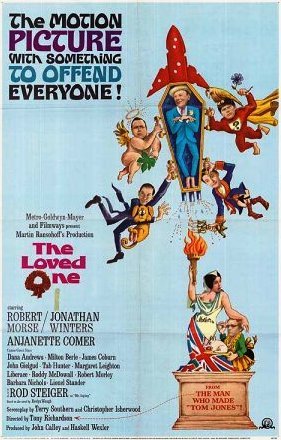
(By Source, Fair Use, https://en.wikipedia.org/w/index.php?curid=20353293)
Here's the not-all-that-informative trailer:
Oh, and something else worth mentioning about the book: it was Waugh's next novel after Brideshead Revisited. The two could hardly be more different. It would be fair to say that The Loved One is the anti-Brideshead. I found myself wondering if he wrote it mainly to voice his disdain for the United States.
*
In the context of the Benedict Option discussion last week, we were discussing when it's justifiable to dismiss a book without reading it. I don't mean not reading it because one is simply not interested in the subject, but because one feels safe in concluding that it does a bad job of whatever it has set out to do, or that its stated thesis is obviously false or absurd. Someone pointed out that The Benedict Option is high on the New York Times best-seller list, which caused me to look at the list. It surprised me that several conservative and/or right-wing books are in the top 10, including one by Michael Savage at #1.
Currently at #12 is a book called Homo Deus by Yuval Noah Harari. It meets my criteria for dismissability. It seems to be another manifesto of the "transhumanist" school of thought, which believes that humanity as we know us is about to be transformed by the power of technology into "gods."
Having raised humanity above the beastly level of survival struggles, we will now aim to upgrade humans into gods, and turn Homo sapiens into Homo deus.
This is going to happen through technology of various kinds, of course. When I hear this kind of thing, and consider that one of the tools at the disposal of the would-be transformers of humanity is genetic manipulation, I wonder if we might be approaching not utopia (impossible) or the end times (maybe, but don't plan on it), but some sort of Tower of Babel moment, when God intervenes to cast down the mighty from their thrones, to knock the props out from under the perennial human effort to become as gods and thereby prevent us from becoming demons.
…let us go down, and there confound their language. (Genesis 11:7, KJV)
*
Speaking of The Benedict Option, the BookTV interview with Dreher is available online here. I've only watched half an hour of it, and may or may not watch more. It's almost two hours long, though I expect a big part of that is some kind of Q&A. I don't mean to be dismissive, but I guess I am: there doesn't seem to be much here that I haven't heard before. Dreher is a decent speaker so maybe this is a good way to get the gist of the book if you don't want to read it.
*
One of the very mild Lenten disciplines I've been attempting is to pray the morning and evening prayers in Magnificat. I've been moderately successful–that is, I've done it maybe two-thirds of the mornings and evenings. Well, half, at least…I keep forgetting…I should set a reminder on my phone.
Anyway, the evening prayers always end with a Marian antiphon. These vary from month to month, and are usually–this will sound negative, though I don't mean it that way–fairly ordinary. But I love this month's:
The Savior of the world shall arise like the sun, and shall descend into the womb of the Virgin, like rain upon the meadow.
I can't think of a better verbal picture to go along with the Solemnity of the Annunciation, which of course was yesterday.
*
This picture is out of focus but it's the closest I came to capturing one of my favorite things about spring: the shades of green in new cypress needles.

That's actually a little cypress tree. It was growing next to the fence around our yard, a "volunteer" where it wasn't wanted. I forced myself to pull it up, though I always hate to do that, because eventually either it or the fence would have to go. Then I didn't want to throw it away, so I took it over to the edge of the woods and planted it. It may be too damaged to survive. I'll keep it watered and see if it can survive the summer.
 Light On Dark Water
Leave a reply to Art Deco Cancel reply