As you know if you read (or contributed to) the 52 Authors series a couple of years ago, I am a great fan of the mystery writer Ross Macdonald. "Ross Macdonald" was the pen name of Kenneth Millar. Most biographical notes included in the Macdonald books say something like this, from my 1973 Bantam printing of The Wycherly Woman: "[his wife] is now well known as the novelist Margaret Millar." I've been seeing that since I began reading Macdonald in the early '70s, but had never heard her name mentioned anywhere else, and supposed that she had been a sort of pop novelist whose work was no longer read. (I did, however, in the course of writing that 52 Authors piece about Macdonald, come across some signs that a revival of interest in her might be under way.)
I was mildly curious about her work but had never sought it out. Then a couple of months ago I saw a copy of Wives and Lovers at a library sale and grabbed it. I read it last week and can report that this instance at least of Millar's work is still very much worthwhile.
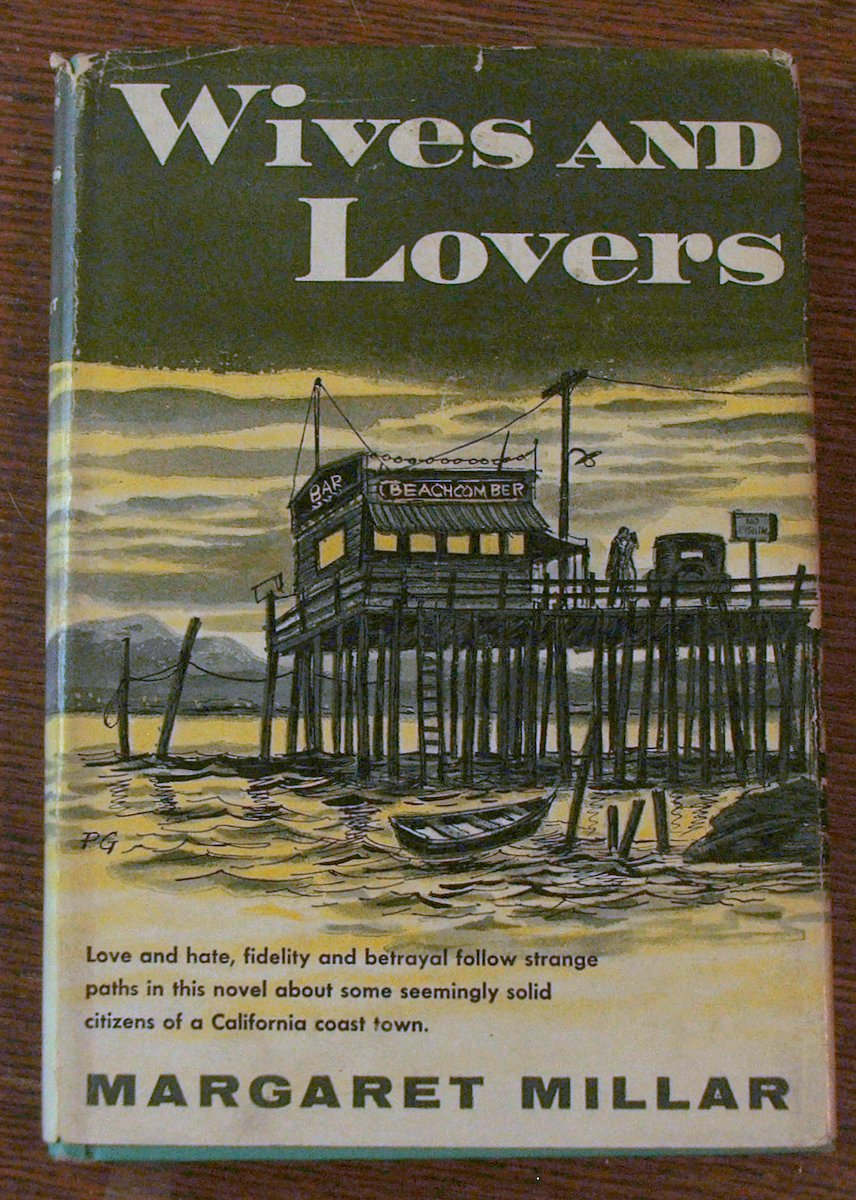
I started reading the book with low expectations but found myself getting excited: This is sort of interesting…This is not bad…This is pretty good…This is really good. By halfway through I was comparing her to Flannery O'Connor: "Flannnery O'Connor without the faith," I said to my wife. I've learned over the years to distrust my initial reaction, especially initial enthusiasm. So maybe the O'Connor comparison is a little too much, and maybe after a bit, or on a second reading, I'll back off a little from that. But this is not fluff, which I guess is what I was expecting. If nothing else, it is a very well-written novel.
It's what would once have been called a "woman's novel," and though it may not be polite to use it, I think the description is justified. I say that because the book is principally about four women–Elaine, Hazel, Ruth, and Ruby–and their relationships to each other and to the men in their lives. Elaine is married to a dentist, Gordon. Hazel is Gordon's assistant and the ex-wife of George, a restaurant owner (see the jacket cover). Ruth is Hazel's cousin; she has been a schoolteacher but, having suffered some sort of breakdown, is now unemployed and living with Hazel; she also baby-sits Elaine and Gordon's children. Ruby is a rootless young woman who is in love with Gordon, and he with her; George also develops a crush on her.
The story takes place in a small town on the California coast, which is where the Millars lived. Although the men are pretty crucial to the story, it is the women whose character is most thoroughly depicted and exposed. That latter word is the main reason for the O'Connor comparison: Millar is surgically skilled at portraying the ways people attempt to disguise from themselves their pursuit of selfish and malicious ends. She is particularly hard on Elaine, a cold and self-righteous woman who despises her husband and keeps him in line with the skillful exercise of a sort of psychological cattle prod. That may sound like a bit of a cliché, and maybe it is. The book was written in the early '50s and I think there was a sort of pop-psychology fashion at the time for blaming a lot of social problems on emasculating women. Maybe there's even some Freudianism lurking in the background of Wives and Lovers.
Well, okay, thinking about it a bit more, I'll concede that Elaine's malice and hypocrisy are a bit overdone. Still, overall it's a very well executed novel and very much worth reading. Here are a few bits that I marked:
Right was something you were going to do anyway, and if it didn't justify itself afterwards it became wrong.
—
George was an incurable optimist. Like an alcoholic who needs only one drink to set him off, George needed only one happy thought….[the "happy thought" that follows is completely without factual foundation]
—
Elaine folded her troubles away in one corner of her mind, neatly and carefully, so that it wouldn't be hard to find them again and unfold them as good as new.
—
"My land, the things that happen. The things that happen that aren't really anybody's fault."
—
"Something must have happened."
"Something always does."
*
The Republicans have produced a health care plan, and of course the Democrats have immediately denounced it as "the worst, most heartless, most cruel thing on earth, causing untold suffering and death." That's Neo-neocon being sarcastic, but it's really not much of an exaggeration of the Democrat/media reaction. I find the whole thing very depressing. I had had at least a faint hope that the Republicans might try to come up with a truly different approach rather than attempting to patch a crazy mess. In 2009, before Obamacare was even passed, I wrote this assessment of the situation. I know nothing in detail about health care policy, but I think it was accurate then and still is. That's possible because what we've been doing for so long is obviously mistaken in its broad outlines. You don't need to know the details of how an automobile works to recognize that a design that includes wings and propellers is not going to work very well. On this point in particular I was basically correct, except that it proved to be an even bigger problem than I thought:
Among many other problems with the idea is that it would increase the polarization of the country by locking our disagreements about abortion, euthanasia, etc. into a health care system that no one can escape, either as a patient or as a taxpayer.
It didn't necessarily have to be that way. The Obama administration deliberately chose to force that conflict, and it's reasonable to assume that progressives implementing a national system will not let up in that effort. For today's progressives, "divisive" means "you're in my way."
One of Obamacare’s major architects, Ezekiel J. Emanuel, has just co-authored (with bioethicist Ronit Y. Stahl) a major attack on medical conscience in the New England Journal of Medicine. His position is that physicians must abandon their own moral sensibilities once they don the doctor’s coat.
(That's Wesley J. Smith writing in National Review, and I'm including the link for the sake of accuracy, but I don't recommend following it, as their web site seems to get worse all the time for hogging up system resources and generally behaving badly.)
Also, I would say now that we should be aiming for a system where small, routine expenses are not involved in the insurance system, and that medical insurance should be more like other forms of insurance (with some kind of government assistance for those who can't afford it). The employer as purchaser of insurance needs to be out of the picture altogether. I think it would be hard to overstate the damage this linkage has done and is doing. But if any politicians are trying to move us in that direction I haven't heard about it. At this point I think it quite likely that we will eventually have a government-run health care system, it will be extremely expensive and insanely complex, and, as noted, it will help to perpetuate the culture war.
*
Speaking of Neo-neocon: she has an amusing account of her experience tasting a reputedly very high-quality Scotch whiskey. Her quotation from a review of the whiskey amused me. I never really believe connoisseurs of whiskey, wine, and beer who detect flavors like "boggy peat, strawberry jam, and chocolate fudge." "Boggy peat," yes. I have no actual experience of tasting actual peat or peat bog water, but I find it very believable that it tastes a bit like Scotch (which is not to say that I dislike Scotch–it's not my favorite thing but I like it). But strawberry jam? Come on.
I tend to be skeptical of connoisseurs in general, and strongly suspect them of making things up. I consider that the correct sensitivity to various nuances in whiskey, wine, beer, audio, and most anything else is roughly mine. Anything less is cloddish, anything more is probably just a pose. But I once knew someone who believed that those who claim to be able to taste the difference between butter and margarine were lying, so maybe I'm just a clod.
*
With the Comey firing and even more with his raving and lying after it, Trump convinces me that I was right last year in saying "Donald Trump is not right in the head." I had hoped he would get better but he doesn't seem to be.
*
The gardenias are blooming. It's too bad you can't smell this one.

 Light On Dark Water

Leave a reply to Stu Cancel reply