I suppose Fr. Antonio Spadaro, S.J. and his co-writer, Marcelo Figueroa, thought "ecumenism of hate" was a clever turn of phrase. They were wrong. It is unjust and seems to be malicious, though perhaps less malicious than ignorant. The article as a whole (I assume you've heard about it, it's in La Civilta Cattolica, considered to be something of a mouthpiece for the pope) is so incoherent that it doesn't warrant much further comment. It's not entirely wrong, but that could be said about almost anything from the people it attacks.
*
I know someone who is associated with the anti-Trump movement called "Indivisible." He has said forthrightly that he "has always despised" the religious right, apparently not noticing the irony.
*
"Lord, I thank thee that I am not as this Pharisee" rather misses the point.
*
I remember when my children were young thinking that observing them gave me a very different view of Jesus's counsel that we must "become as little children." Before that I had tended to think of the prescribed surrender as a sort of passivity, accepting without much thought what one was told about grownup matters. But one evening at dinner I remarked to my wife that of the three people at the table, the two-year-old was clearly the most intellectually active. Young children may be ignorant of a great deal, but it is certainly not because they aren't trying to learn. They are relentless inquirers, testers, and speculators. There's nothing passive about the "childlike faith" which we attribute to them. The faith they exhibit consists not in their lack or suppression of intellectual energy, but in their trust that we are telling them the truth.
This has been on my mind a lot in recent weeks, as two of my grandchildren, boys ages 5 and 7, are spending several days a week with me while school is out for the summer. Except when they're asleep, they never stop looking, wondering, questioning, investigating, experimenting, and in general trying to figure out literally everything in the world, as far as they can see it. They noticed this stack of back issues of The New Criterion.
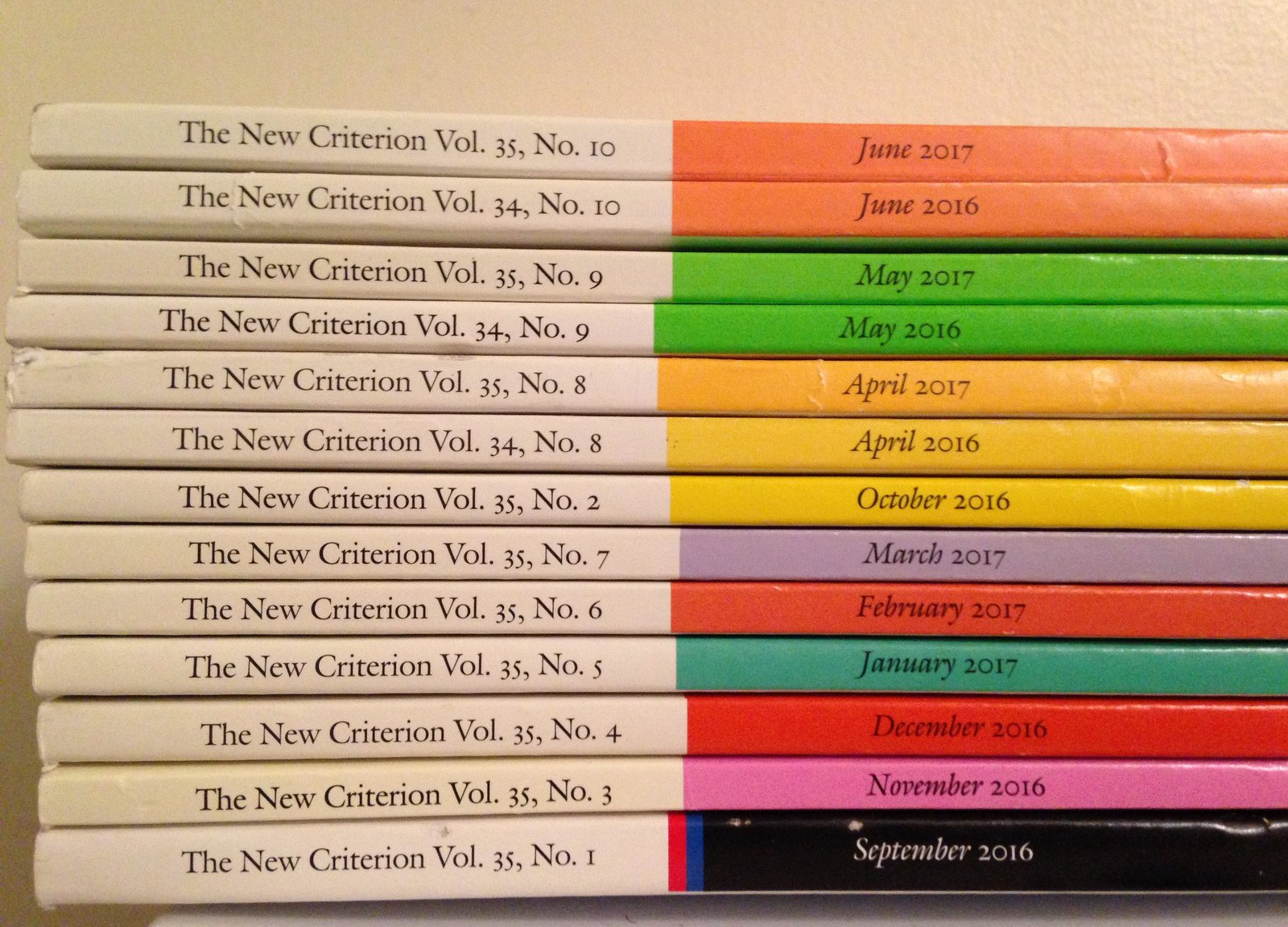
It was jumbled, and they–mainly the seven-year-old for this–put it in order by year and month. They noticed that an issue was missing, and we looked around the house until we found it on my desk. Then they put it in its proper position. They hypothesized that each month had the same color every year (I had never bothered to notice), and to the extent that they could verify that, they did, and rearranged them to put like colors together. They wondered why the September issue was black (the 15-year-anniversary of 9/11/2001, I think). It was mid-June when they started this, but the June issue had not yet arrived, and they wanted to know why. They asked every day if it had arrived, until it did, and then they put it with the others. Once July had begun they wanted to know why the July issue hadn't arrived. When I told them that the magazine is not published in July and August, they were a little offended, and wanted to know why. And almost every day they ask me if I've finished reading the June issue yet (not quite), and why not (well, something to do with dealing with two small boys all day).
Why? Why? Why? I read somewhere years ago that the average four-year-old asks some great number–in the hundreds I think–of questions every day, and I believe it. And no doubt a large percentage of them begin with "Why?"
"All men by nature desire to know," said Aristotle. Well, ain't that the truth? And much of what they want to know involves purpose: what is it for? why do you do that? why do I have to stop playing games on the iPad? Why?
Watching my grandsons gives me confidence that the commitment of the modern world to suppressing the question of ultimate purpose will not stand indefinitely. One way or another, that empty space will be filled. I hope it will be filled by truth.
*
I've been reading The Book of Common Prayer: A Biography by Alan Jacobs, and I recommend it to anyone who has any interest at all in the Book of Common Prayer itself or the history of Anglicanism in general. It is just what the title suggests, the story of how the BCP came into existence, and how it has developed over the centuries since its birth in 1549. Well, before that, actually, because Jacobs goes into some of its antecedents, and naturally has to deal with the whole matter of the establishment of Protestantism in England.
I think I've been half-consciously half-suppressing my awareness of that history. I know it, of course–what Catholic has not seen A Man for All Seasons at least once? But having grown up in an Anglican-ish tradition (Methodism), and spent some time in the American Episcopal Church, and now being a member of the Anglican Ordinariate (which is not what we're supposed to call it), and having a great love of many elements of the Book of Common Prayer, I didn't especially like to contemplate how thoroughly rooted in heresy and schism it really is. I found myself wondering "Why do I want to be associated with this thing? Is it really salvageable?"
Of course most of it is salvageable; a prayer written by a heretic needn't be heretical; I can (and do) pray right along with most of what would be included in any Protestant prayer. And in fact it has been salvaged–thank you, Benedict XVI–and purged of its heretical elements. And as to why I want to be associated with it, to use it: the prose. Ecclesiastical criminal Cranmer may have been, but he was also a great writer of devotional prose.
Keep watch, dear Lord, with those who work, or watch, or weep this night, and give your angels charge over those who sleep. Tend the sick, Lord Christ; give rest to the weary, bless the dying, soothe the suffering, pity the afflicted, shield the joyous; and all for your love's sake. Amen.
That is a sample of what I loved, what as a Catholic I missed, and what keeps me going in the effort, always on the edge of failure, to keep our local Ordinariate group alive.
Chesterton has a great commentary on the Prayer Book in The Well and the Shallows, one of the books I read long ago when I was considering conversion.
*
Distant rain, 6/29. We're having a rather wet, cool summer so far.

 Light On Dark Water
Leave a reply to Mac Cancel reply