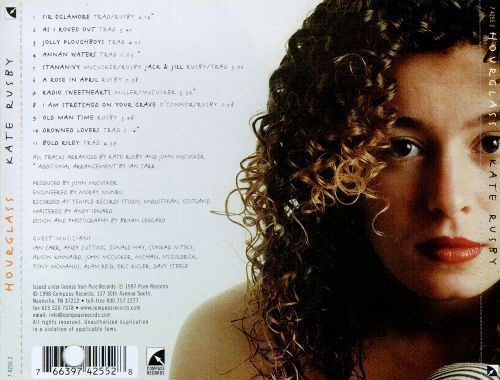
In 1997, the year my first child was born, Kate Rusby, the Barnsley Nightingale, brought out her debut album, Hourglass. At the time I was working on my doctorate, and sharing a flat with an old school friend, also a doctoral student, who spent money on music. I had not yet then myself got out of the habit of spending money only on books. The combination of a colicky child who was quiet only when held, and my friend’s purchase of the newly minted CD of Hourglass, meant that I spent many, many hours rhythmically ambling around the flat with a baby in my arms, to the sound of Kate Rusby’s voice (Eliza Carthy sometimes providing variety).
The album’s centre of gravity is traditional. About half the songs are anonymous folksongs, and those that aren’t are stylistically similar. The performance is acoustic. None of Steeleye Span’s or Fairport Convention’s electric folk here. The opening track, “Sir Eglamore”, is a light version of a combat between dragon and knight (in the spirit of the St George of winter entertainments), with the knight of the title unable to pierce the dragon’s hide with his sword, and finally jabbing for its open mouth, only for the dragon to run off home with the sword stuck between its jaws. It is related to the American “Old Bangum”, in which a hunter fights a wild hog.
As I Roved Out” (Roud 3479) is perhaps more familiar from Planxty's version of the 1970s . “The Jolly Ploughboys” was entirely unfamiliar to me:
When six o' clock comes, me boys, at breakfast we'll meet,
And cold beef and pork we'll heartily eat.
With a piece in our pockets, to the fields we do go
For we're all jolly fellows that follows the plough.
And so on through the day. Two of the songs, both about drownings, were sung by Nic Jones in the 1970s: “Annan Water” (a Child Ballad) and “The Drowned Lovers”, my absolute favourite from the album, and the one the baby most often slept to. It is not only a tragic story of thwarted young love, but also a dramatic piece in different voices, as much direct speech as narrative reporting.
A little under half of the songs are original or new compositions — “A Rose in April”, “Radio Sweethearts”, “Old Man Time”, and a couple more. These are very much in the same style but somehow, to my taste, do not match up to the traditional material. A piece that falls somewhere between the two is another of my favourites, “I Am Stretched on Your Grave” (recorded by Sinead O’Connor a few years before, but in nothing like so effectively creepy a rendition), a modern translation of an old, and anonymous, Irish poem.
—Paul has been reading the blog since 2008, when Janet drew his attention to a discussion about Brideshead Revisited. He currently trains translators in Brussels.
 Light On Dark Water
Leave a reply to Craig Cancel reply