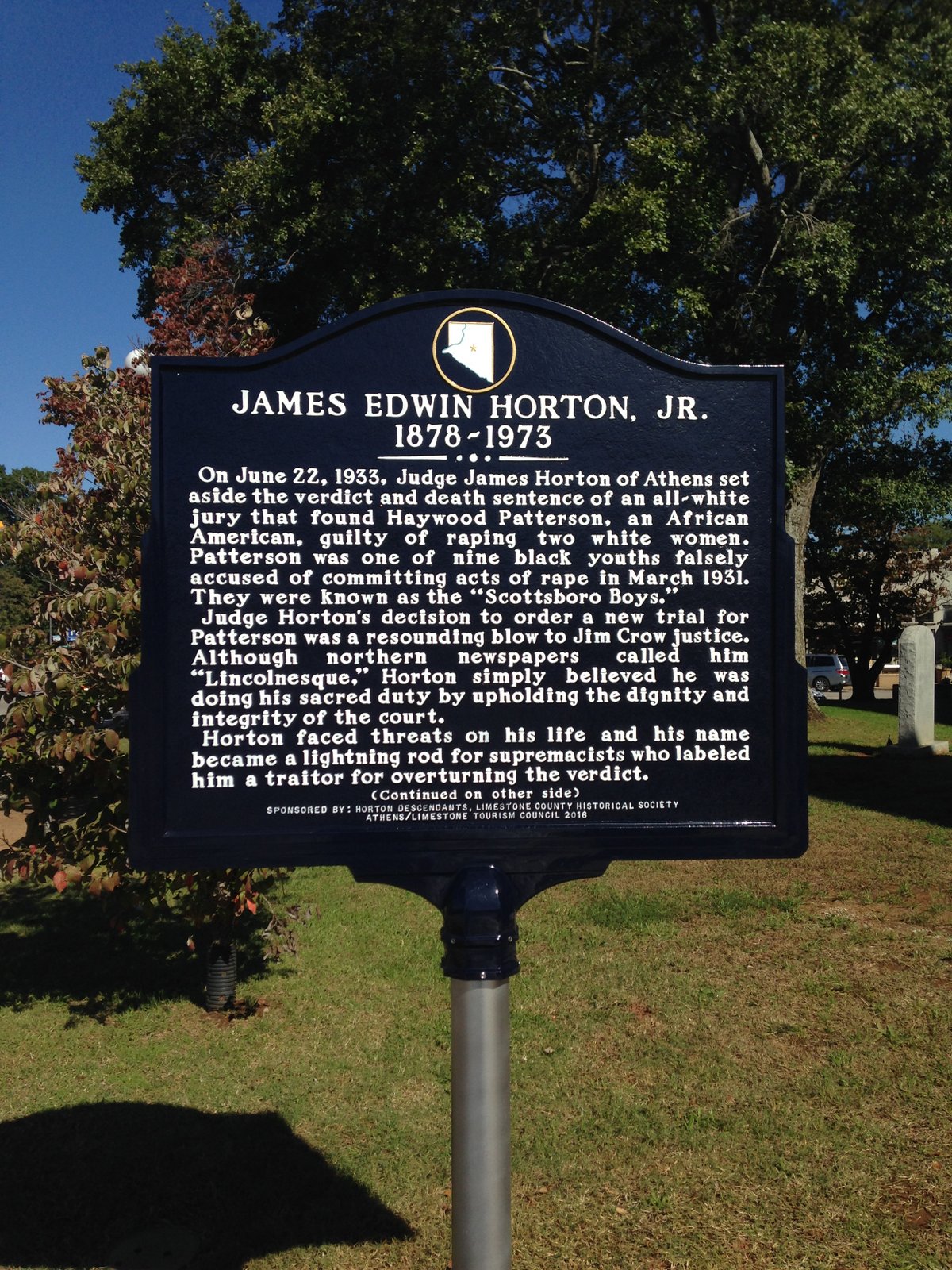
Last week I spent a couple of days in Athens, Alabama, for the dedication of a statue of my grandfather, Judge James E. Horton. He was the judge in one episode of the long-running and shameful Scottsboro Boys case: a notable episode, because he set aside a jury verdict which he believed to be a miscarriage of justice. I think most people have heard at least the broad outlines of the case: in 1931, nine black youths were accused and convicted of raping two white women. If you don't know about it, here is the Wikpedia account. As the article says, it was and is "widely considered a miscarriage of justice," and my grandfather has long been honored for his resistance to it.
You can read about the statue and the ceremony here. In the photo gallery there are several shots just before and after the unveiling. The people gathered around are all my family; I'm the guy in the dark coat and sunglasses just to the left of the statue. It was a very beautiful day, though a little hot for late October even in north Alabama. That's my sister giving the speech; she did a great job. There were several speeches, all good, none overly long.
For me this is an old family story, and as I suppose sometimes happens its very familiarity has preserved for me a surprising level of ignorance. I discover this whenever someone asks me certain fairly obvious questions about it: for instance, exactly how is it that a judge can overrule a jury verdict? Under what circumstances can this happen? Well, I'm not exactly sure. I have owned for many years a book which I think is considered the definitive account of the case, Scottsboro: A Tragedy of the American South, by Dan Carter. But I have never read it, and I really should.
One of the main movers of the statue project was retired Judge James Woodroof of Athens. He's six or seven years younger than I am, which makes the "retired" part of that a little shocking to me. His parents and mine were friends, so I knew him slightly growing up, and ran into him a few times around the University of Alabama in the '70s. Those are my images of him, and I still haven't quite adjusted to the fact that he is not only grown up and then some, but in a position of prominence and grave responsibility, far more responsibility than I've ever had. He has a great regard for the statement my grandfather made, and that touches me.
Some people seem to regard what my grandfather did as first and foremost a blow struck against racial oppression, and it certainly was that. But I'm fairly certain that he didn't see it primarily in that way. For him it was the discharge of a sacred duty: to apply the rule of law in a sternly impartial way, without concession to popular sentiment, much less to mob sentiment, without consideration of race, status, or anything else apart from the law and the facts of the case. I do not have any at all of the talents that make for a good lawyer or a good judge, but that ideal moves me deeply. And I'm gratified that it still resounds in the legal profession. I sometimes think it has little place there nowadays, and maybe it isn't as widely revered as it should be, but it isn't dead. A sitting judge from neighboring Morgan County came up to me after the ceremony to tell me how much my grandfather's example means to him.
It's an odd sensation to be the descendant of such an admired figure. Most of us, the descendants, were at the ceremony. Of his eight or so grandchildren and roughly twice that many great-grandchildren (none of the very young great-great-grandchildren were there), only one, the daughter of one of my brothers, has made the law her career. There is thus no direct way in which the rest of us can think of ourselves as carrying on his legacy. Nevertheless it's difficult not to feel that we–well, I suppose I should speak only for myself–that I have some sort of share in his virtue. I don't. I know that. And yet I'm proud to be his grandson, to be a part of the same elemental community, the family, which produced him. And since I do not and can not and would not deny that my family were also part of the system of oppression which began with slavery, his deed is a reminder that there was always nobility in that culture alongside the evil: the good crop and the weeds existing together, mysteriously, as they always do.
I didn't grow up in Athens, exactly. My parents did, but we lived out in the country, and I went to school there. We visited in Athens frequently, but only for the three years of high school was it really a major part of my life. For thirty years or so after high school I rarely went there and mostly lost touch with the people I'd gone to school with. In 2000, not long before my father's death in 2001, my parents moved into town, and so since then visits home have been visits to Athens. I feel closer to it than I think I ever did as a teenager, and very much enjoy seeing old acquaintances. I find that the older I get the more I value these precisely because they are old, because they go so far back into youth and in some cases childhood. It is a community of memory.
*
This appeared in the September issue of Magnificat. It's by Fr. Donald Haggerty, whom I know nothing about beyond what's given in the magazine, that he's a priest of the Archdiocese of New York, currently serving at St. Patrick's Cathedral. I like it so much that I'm going to the trouble of typing the whole thing into this post.
For some people, the intensity of their belief in God is matched by an inclination to ask questions of God. The correlation is not a sign of disrespect or of doubt. They would not ask questions in this manner except for a conviction that God can be addressed in an utterly personal manner. In fact, their questions, which often begin with a "why is it" or "how can it be," tend to summon a deeper act of faith from their souls. Inasmuch as their questions are not answered so readily, as usually they are not, these questions plunge their souls much more blindly into the mystery of God. The unanswered question demands a surrender to God and a greater offering. The surrender can only be made with a conviction that God has heard the request for some light and accepted the offering of one's soul for others. If no clarity is forthcoming, the soul can still remain at peace, certain that God has been listening and will extend grace to others.
Logical labors of thought that seem to provide clear answers and explanations are usually false solutions in the realm of sacred mystery. Only in waiting and in darkness do quiet spiritual insights come upon us, and when they do so, they are like the light slowly emerging at dawn. And often they have to do with our need to offer ourselves more fully in love for others.
I realized recently that in a sense it no longer matters to me whether a prayer is answered, the sense being that the lack of the hoped-for result, or even of some sense of response, does not disturb "the conviction that God has heard…and accepted…."
*
This afternoon I went to pick up our dog and cat at the office of the vet where they have to be boarded when we go out of town. While waiting my turn, I saw the cover of a cat-lover's magazine which announced an article called 5 New Litter Trends!
 Light On Dark Water
Leave a reply to Janet Cancel reply